Fendi doesn't do quiet
Fendi doesn't do quiet. The house came up in postwar Rome making fur coats for women who wanted to be seen, and that gene hasn't left. What it has done—what Karl Lagerfeld spent five decades helping it do—is learn how to be loud in ways that don't announce themselves from across a room. The double-F logo, designed in 1965, is still everywhere, but it's also optional now. You can carry a Fendi bag that whispers or one that shouts, and both will be cut from the same cloth: a belief that luxury should feel like luxury, not like an apology for wanting it. The bags worth knowing share a few qualities. They're structured without being stiff. They use leather that feels substantial in the hand—you notice the weight before you notice the logo. They tend to have one memorable detail: a twist-lock, a stripe, a way the strap connects. And they all assume you have somewhere to be. Fendi doesn't make bags for running errands in athleisure. It makes bags for people who still get dressed.
Peekaboo
The Peekaboo is what happens when a house known for fur decides to make a doctor's bag. It launched in 2009, and the frame is the whole point: two compartments that open away from each other, each with its own magnetic closure, so you see the lining before you see what's inside. The name isn't cute—it's descriptive. The bag is designed to be opened toward you, not away, which means the person across the table doesn't get a view of your phone or your keys or the receipt you've been meaning to deal with. It's a privacy move dressed up as a design flourish. The silhouette is formal—top handle, structured base, no slouch—but it's not precious. You can fit a laptop if you go for the Regular size, or just a wallet and a paperback in the Mini. The leather options run from smooth calfskin to textured crocodile, and Fendi rotates through seasonal colourways, but the black-on-black version is the one that makes sense long-term. It's a bag that works for a meeting, a dinner, a gallery opening where you'll be standing for two hours. It doesn't work for a grocery run, and it doesn't pretend to.
Baguette
The Baguette is thirty years old and still the bag people mean when they say "that Fendi bag." It debuted in 1997, back when Silvia Venturini Fendi was designing accessories and the idea of a small shoulder bag—short strap, meant to tuck under your arm like a loaf of bread—was still new enough to name after the gesture. The shape is compact, almost squared off, with a flap closure and a turn-lock that's changed over the years but never disappeared. What's made it last isn't the size or the logo. It's that Fendi treats it like a canvas. There have been Baguettes in sequins, in terry cloth, in leather embossed to look like denim. There have been collaborations with Tiffany, with Marc Jacobs, with Sarah Jessica Parker, who carried one on Sex and the City and made it a plot point. The version worth buying is simpler than all that: nappa leather, tonal stitching, the FF clasp in brushed metal. It holds a phone, a cardholder, lipstick, not much else. It's an evening bag that also works for lunch. You wear it high on the shoulder or crossbody if you swap the strap, and it doesn't get in the way. That's the whole pitch. A bag that's there when you need it and invisible when you don't.
First
The First bag is older than the Baguette by two years, and it's never gotten the same attention, which is part of why it works. It's a small flap bag with a chain strap and a turn-lock shaped like the Fendi logo, but it's quieter than the Baguette—less about the hardware, more about the leather. The proportions are compact: it's a bag for a phone, a key, a card case, maybe a small paperback if you're optimistic. The chain strap is long enough to wear crossbody, and the leather is soft enough that the bag doesn't hold its shape when it's empty, which some people read as a flaw and some people read as character. Fendi has reissued it in different leathers and colours over the years, but the one that makes sense is black calfskin with gold hardware. It's a bag that works for dinner, for a wedding, for any situation where you don't want to carry much but you still want to carry something. It's not trying to be anything other than what it is, and that's rarer than it should be.
Fendigrafia
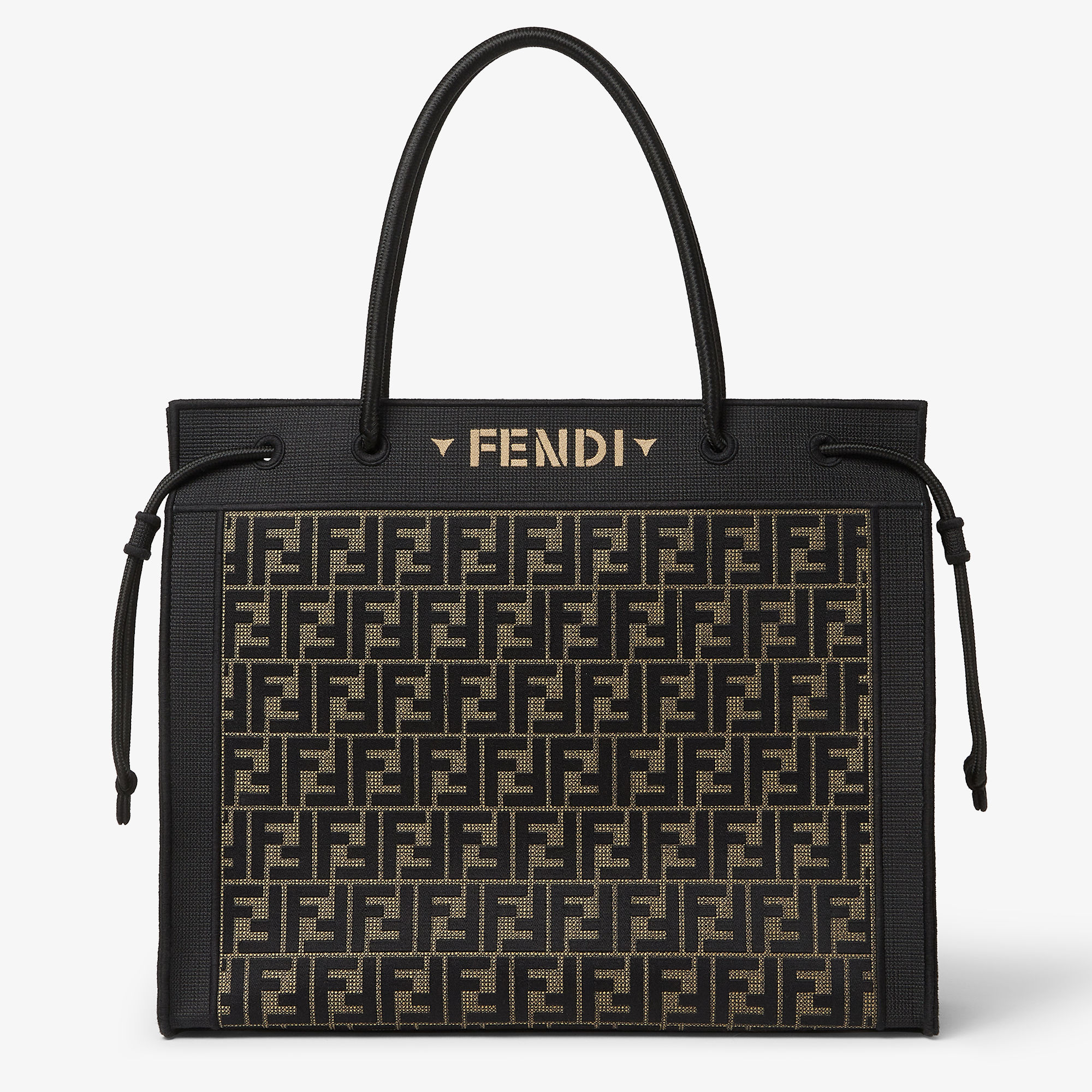
The Fendigrafia isn't a single bag—it's a print, a pattern of interlocking Fs that Fendi applies to whatever silhouette it's working on that season. You'll see it on totes, on camera bags, on shoppers. The version that's held is the shopper: a flat tote with two handles, no closure, coated canvas on the outside and leather trim at the edges. It's the bag you take on a plane, or to a meeting where you'll be carrying a folder and a laptop and a bottle of water. It's not subtle—the logo is the point—but it's not loud in the way a monogram bag from another house might be. The print reads as texture before it reads as branding, and the coated canvas means it holds up better than leather would under the same conditions. Fendi rotates through colourways—brown and tobacco, black and grey, occasional seasonal blues or greens—but the classic is the tobacco version, which looks like it's been around longer than it has. It's a workhorse bag. It doesn't ask for much, and it gives you room.
By The Way
The By The Way is Fendi's answer to the question of what a structured handbag looks like when you strip out the flourishes. It's a small satchel with a top handle and a detachable shoulder strap, a zip closure, and a body that holds its shape whether it's full or empty. The leather is smooth, the stitching is tonal, and the hardware is minimal—just the zip pull and the clasp where the strap attaches. It's not trying to be interesting. It's trying to be useful. The size is deceptive: it looks small, but it fits more than you'd expect. A wallet, a phone, sunglasses, a small notebook. The bag works equally well in your hand or on your shoulder, and the shape is clean enough that it doesn't compete with what you're wearing. Fendi makes it in black, in grey, in seasonal colours that come and go, but the black version is the one that'll still make sense in five years. It's a bag for someone who wants a handbag, not a statement, and who's willing to pay for the construction that makes that possible.
On care and keeping
Fendi bags are built to last, but they're not indestructible. Smooth leather will scratch—accept that early and you'll be less precious about it. Store them upright, stuffed with tissue, away from direct light. The coated canvas pieces are more forgiving, but the leather trim still needs attention: wipe it down after a long day, condition it twice a year, don't leave it in a hot car. If you're buying a bag with a chain strap, check the leather where the chain sits every few months—that's where wear shows up first. Fendi offers repair services, and they're worth using. A bag that costs what these cost should be fixable, and most of them are. The hardware can be replaced, the lining can be restitched, the leather can be reconditioned. The question isn't whether a Fendi bag will last. It's whether you'll take care of it long enough to find out.