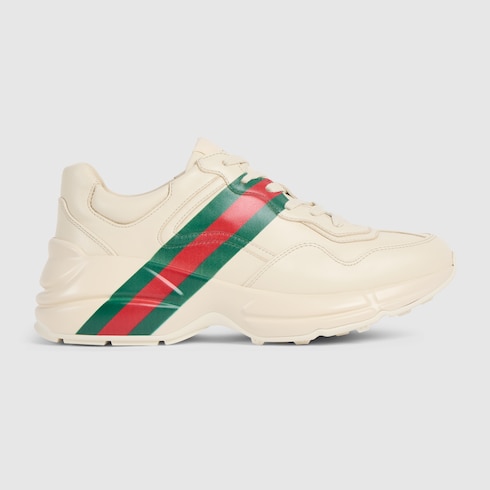
Gucci doesn't require a manifesto buy
Gucci doesn't require a manifesto buy. The house has spent the last decade cycling through registers — Allessandro Michele's Renaissance salon, Sabato De Sarno's pared-back Milanese codes — but the through-line is simpler than the press notes suggest. Gucci has always made things that telegraph well from three metres and hold detail at thirty centimetres. That's the test for a first piece: it should work in both registers.
What makes a good entry point isn't logo volume. It's whether the house's material fluency shows up in the object itself. Gucci's leather goods operation runs deep — the Scandicci atelier has been finishing edges and setting hardware since 1953 — and that shows in hand-feel before it shows in stitching. A good first Gucci piece lets you understand why the Florentine houses spent a century on vegetable-tanned calf and brass fittings. It also needs to outlast the creative director who signed it.
Three budgets, three pieces. All of them carry the house's historical range — equestrian detailing, archival hardware, that particular shoulder construction — without requiring you to explain them at dinner.
Under $800: The Marmont Matelassé Card Case
Gucci's GG Marmont line has been in production since 2016, which in accessory terms makes it almost structural. The card case — not the continental wallet, not the zip-around — sits at $550 and gives you the house's chevron matelassé in full. The quilting here isn't decorative. It's a softness strategy: the calf gets padded, the surface gains dimension, and the whole piece compresses slightly in a jacket pocket without creasing flat.
The double-G hardware is an Antonio Riva design from the early Seventies, reissued under Michele and kept through De Sarno's tenure. It's aged brass-toned metal, not plated, so it darkens with handling rather than flaking. The card case format forces a decision about what you carry, which is useful. Six slots, one bill compartment. You edit your wallet down or you don't buy it.
Marmont pieces move through the secondary market cleanly, which tells you they're holding shape. The chevron quilting hides minor scuffs better than smooth leather, and the card case scale means you're not managing a flap closure that will loosen after two years of daily use. This is the piece that lets you test whether Gucci's hand-feel works for you before you commit to a bag.
$1,200–$1,800: The Horsebit 1955 Shoulder Bag
The Horsebit bag went back into production in 2020 as a direct archival pull — same silhouette as the 1955 original, same hardware, same curved-front construction. It sits at $1,790 for the small size in leather, and it's the most structurally honest bag Gucci makes right now. The horsebit isn't branding. It's a functional closure that came out of the house's saddlery line, and it still works as one: you lift the bit, the flap releases, no magnets involved.
What you're paying for here is the curved-front shaping. Most shoulder bags are flat-backed because it's faster to cut and assemble. The Horsebit's front panel is heat-moulded, which means it holds a gentle convex curve even when empty. That curve sits against your hip correctly — it doesn't jut or flatten — and it's why the bag photographs well from the side. The interior is suede-lined, three compartments, no logo jacquard fighting for attention.
The small size works as a daily bag if you're not carrying a laptop. It fits a small wallet, phone, keys, a paperback if you fold it. The shoulder strap is adjustable leather, wide enough that it doesn't dig, and it's the one place Gucci's current production feels noticeably better than it did a decade ago. Strap hardware used to loosen; the updated swivel clips don't.
This bag has been in continuous production across two creative directors, which suggests the house considers it part of the permanent range. That matters for resale and for repairs. Gucci's atelier will service Horsebit bags directly, and replacement hardware is still spec'd to the original fittings.
$2,500–$3,500: The Jackie 1961 in Leather
The Jackie — named retroactively after Jacqueline Kennedy carried a version through the Sixties — is Gucci's answer to structured top-handles. It returned in 2020 as the Jackie 1961, and the medium size in calf runs $3,200. This is the piece where Gucci's Florentine leather training becomes legible. The bag is made from a single piece of leather, curved and stitched at the sides, with no front seam. That's a cutting luxury: you're paying for the part of the hide that's large and smooth enough to yield a continuous panel.
The piston closure — a metal loop that slides through a leather keeper — is mechanically simple and wears in rather than out. After six months of use, the keeper softens and the loop finds its position. The bag's crescent shape means it doesn't stand upright on a table, which some people dislike. It also means the weight distributes along your forearm when you carry it by the top handle, rather than pulling at your wrist.
The Jackie comes with a detachable shoulder strap, and this is where you see Gucci hedging between codes. The strap is canvas-backed leather with the house web stripe, which makes the bag read more casual when you wear it crossbody. That's intentional — De Sarno has been pushing the Jackie as a day-to-night piece — but it also means you're getting two bags in one frame. Top-handle for meetings, strap for everything else.
The interior is structured with a metal frame, so the bag holds its shape when you set it down. Three compartments, zip pocket, suede lining in a neutral tan. The leather Gucci uses here is vacchetta that's been tumbled and finished matte, which means it will darken and gain pull-up over time. That's not damage. That's the material doing what it's designed to do.
A Note on Care
Gucci's vegetable-tanned leathers want conditioning twice a year if you're using the piece regularly. A neutral cream, worked in with a soft cloth, will keep the surface from drying. The house's own leather care line is fine but not necessary — any conditioner formulated for aniline-dyed calf will work.
Hardware tarnish is normal and, on brass fittings, arguably preferable. If you want to slow it, store the piece in its dust bag between uses. Gucci's atelier offers refurbishment services for structural repairs — strap replacements, hardware resets, edge repainting — and the turnaround is generally four to six weeks. Keep your receipt. The house tracks production codes, and pieces bought through authorised retailers get priority in the repair queue.