Gucci makes more bags than anyone needs to think about, which is both the point and the problem
Gucci makes more bags than anyone needs to think about, which is both the point and the problem. The house has spent the past decade churning out monogram canvas, logo hardware, and collaborations that arrive with the shelf life of a fashion week hashtag. But beneath that noise sit a handful of designs that predate the hype cycle and will likely outlast it. These are bags built around a shape that works—structured enough to hold form, soft enough to age without looking beaten—and a history that doesn't require a press release to justify. Good Gucci, in other words, is rarely about what's new. It's about what was solved correctly the first time: a shoulder bag that sits flat against the body, a top-handle that doesn't tip forward when you set it down, a flap closure that you can operate with one hand in the dark. The maison's best pieces share a particular restraint, a sense that someone thought about how the thing would function after the first month of ownership. What follows are five bags that meet that standard, each of which has been in production long enough to prove the point.
Horsebit 1955
The shoulder bag that taught every other house how a chain strap should distribute weight, introduced in—as the name makes clear—1955.
This is Gucci's answer to the 2.55, and it arrived in the same year, which either speaks to a shared moment in postwar Italian and French design or suggests that Guccio's sons were paying close attention to what Coco was doing in Paris. The horsebit closure, borrowed from the house's equestrian hardware, gives the bag its name and its only ornament. Everything else is geometry: a structured rectangular body, a fold-over flap, and a chain-and-leather strap that was among the first to let women carry a bag on the shoulder rather than in the hand. The current version, reissued under Alessandro Michele and kept in production since, comes in both smooth and textured leather. The textured version ages more gracefully—scuffs read as patina rather than damage—and the medium size, roughly 10 inches across, works as both a day bag and an evening piece if you're comfortable carrying a phone, wallet, and keys without the additional cargo of modern life. The flap closure is secure without being fussy, and the chain has enough leather woven through it that it won't dig into your shoulder after an hour. This is the bag Gucci should lead with when someone asks what the house actually makes.
Jackie 1961
The hobo that Jacqueline Kennedy carried in the Sixties, later named for her, now back in structured and slouch versions.
Gucci didn't name this bag after Kennedy until decades after she was photographed with it, which suggests a certain confidence that the design would hold up without the association. It did. The shape is a soft half-moon that rests under the arm, closed with a single piston lock that you can flick open with your thumb. The original was unstructured, meant to slouch and fold when set down. The current iteration offers both that version and a more rigid take with an internal frame, which is the one to buy if you carry a laptop or prefer a bag that doesn't collapse into itself. The piston lock remains the smartest piece of hardware Gucci has ever used—simple, functional, and prone to developing a satisfying worn finish after a few years of use. The shoulder strap is adjustable, which matters more than it should, and the bag comes in a small, medium, and large. The medium is the most versatile, large enough for daily use but not so oversized that it reads as luggage. This is the Gucci bag that requires the least explanation and the least maintenance, which is another way of saying it's the one that works.
Dionysus
The tiger-head closure on a structured shoulder bag, introduced under Michele in 2015 and still in production because the hardware does the work.
This is the youngest bag on the list, and the only one that couldn't have existed before Michele's tenure, which makes it either a gamble or proof that the house can still produce something with staying power. The Dionysus is built around a chunky tiger-head clasp—Greek god of wine and excess, hence the name—that sits at the centre of the flap and operates as both closure and visual anchor. The bag itself is a structured rectangle, available in monogram canvas, smooth leather, or the GG Supreme canvas that has become Michele's signature. The leather version is the one that will age into something you'll want to keep. The chain strap is adjustable and removable, and the bag comes in a small, medium, and large. The small works as an evening bag, the medium as a daily carry, and the large as a weekend piece. The tiger heads are polarising, which is the point—this is the only bag here that announces itself before you notice the rest of the design. But the structure underneath is sound, and the flap closure is more secure than it looks. If you can live with the hardware, this is the bag that will look the most distinctly Gucci in twenty years, when the rest of Michele's output has been archived.
Bamboo 1947
The top-handle bag with a curved bamboo handle, developed during wartime material shortages and kept in production ever since.
Gucci started using bamboo because leather was rationed and the house needed an alternative material for handles. That accident of necessity became the maison's most recognisable design detail, and the Bamboo bag remains in production because the handle, however decorative it now reads, still works as a handle. The current version is a structured top-handle bag with a tapered body and a flap closure secured by a turn-lock. The bamboo handle is treated and curved, and it develops a deeper colour with age and handling. The bag comes in small, medium, and large, and the medium is the most practical—large enough for daily use, small enough to carry comfortably by the handle. The leather is typically smooth calfskin, which shows wear faster than textured leather but also develops a patina that looks intentional rather than neglected. This is the bag that requires the most commitment, both because the bamboo handle makes it immediately identifiable as Gucci and because the shape is formal enough that it won't work with everything. But if you want a top-handle bag that isn't a Birkin or a Kelly, this is the one with the longest history and the most coherent design.
Marmont
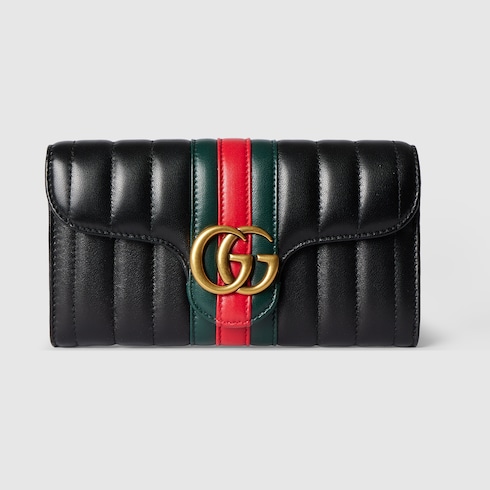
The quilted leather shoulder bag with the double-G logo, introduced in 2016 and now ubiquitous enough to prove it works.
The Marmont is everywhere, which is both a recommendation and a warning. Gucci introduced it under Michele as a quilted leather shoulder bag with a prominent double-G logo—a revival of a Seventies house motif—and it became the bag that funded the rest of Michele's tenure. The quilting is a nod to Chanel, the logo is pure Gucci, and the result is a bag that works because the proportions are correct and the hardware is restrained. The chain strap is woven with leather, the flap closure is magnetic, and the bag comes in a small, medium, and large. The small works as a crossbody, the medium as a shoulder bag, and the large as a tote alternative. The leather is soft, which means it will show wear, but the quilting hides minor scuffs better than smooth leather would. This is the bag that will date the fastest—anything this popular has a built-in expiration date—but it's also the one that proves Gucci can still design something that people actually want to carry. If you buy one, buy it in black, and accept that it will look like every third bag on the street for the next five years.
A note on care
Gucci leather is no more or less durable than any other luxury house's leather, which means it will last if you treat it correctly and fall apart if you don't. Store your bag stuffed with tissue paper to hold its shape. Keep it out of direct sunlight, which fades colour faster than wear does. Clean it with a dry cloth, not a wet one, and take it to a professional for deeper cleaning or hardware repair. The hardware on older Gucci bags—particularly the horsebit and piston-lock closures—can be serviced at Gucci boutiques, though the process takes weeks and costs more than it should. The bamboo handles on the Bamboo 1947 can be reconditioned, but only by Gucci, and only if the damage isn't structural. The chain straps on the Horsebit, Dionysus, and Marmont are the weakest point—leather woven through chain will eventually crack and need replacing. Budget for that, or buy a bag with an all-leather strap. A well-maintained Gucci bag will last fifteen years of regular use. A neglected one will look tired in three.