Maison Margiela built its reputation on deconstruction, on pulling garments apart and showing you the seams
Maison Margiela built its reputation on deconstruction, on pulling garments apart and showing you the seams. That ethos extends to footwear, though not always in ways that favour longevity. The Tabi, for instance, is conceptually brilliant and structurally sound when made well. But plenty of the house's output—particularly the fashion-forward styles—prioritises statement over stamina. Which is fine, until you've spent four figures on a pair that won't survive a wet pavement.
The question, then, is which Margiela shoes actually hold up. Not which look good in campaign imagery or on a plinth in Dover Street Market, but which survive daily wear without falling apart or looking tired after six months. The answer isn't always obvious. Margiela produces shoes across a spectrum of construction quality, from Goodyear-welted leather to glued canvas, and the price doesn't always correlate with durability. A €900 sneaker might disintegrate faster than a €600 boot, depending on how it's made and what you ask of it.
What follows are three models tested over meaningful time—twelve months minimum, worn regularly, not babied. These aren't the flashiest options in the catalogue. They are, however, the ones that justify their cost by lasting.
Tabi Boot in Calfskin
The split-toe boot is Margiela's signature, derived from a fifteenth-century Japanese work sock and introduced in the house's first collection in 1989. It remains polarising. People either understand it immediately or never will. But if you're reading this, you've likely made peace with the silhouette and want to know whether the boot itself is sound.
It is. The calfskin version, specifically—not the patent, not the canvas—uses a Blake stitch construction that keeps the profile slim while maintaining structural integrity. The leather is a smooth, lightly finished calfskin that scuffs easily but buffs out with minimal effort. After a year of rotating wear (twice weekly, London streets, occasional rain), the uppers show creasing at the vamp and some darkening at the heel counter, but no cracking or delamination. The split toe, which you'd assume would be a weak point, holds its shape. The stitching there is reinforced, and the leather is doubled over at the join.
The heel stack is stacked leather, not rubber, which means it wears down faster than a Vibram sole but can be replaced by any competent cobbler. The insole compresses after about three months, which is standard for this type of construction, and the boot moulds to your foot in a way that glued sneakers never do. You'll want to size down half from your usual European fit—the last runs long.
Two caveats. First, the shaft is higher than it looks in photos, sitting just below mid-calf, which makes them warm in summer and slightly awkward with cropped trousers. Second, the leather sole is slippery on wet tile. Add a thin Topy within the first week if you live somewhere with actual weather.
Replica Sneaker in Leather
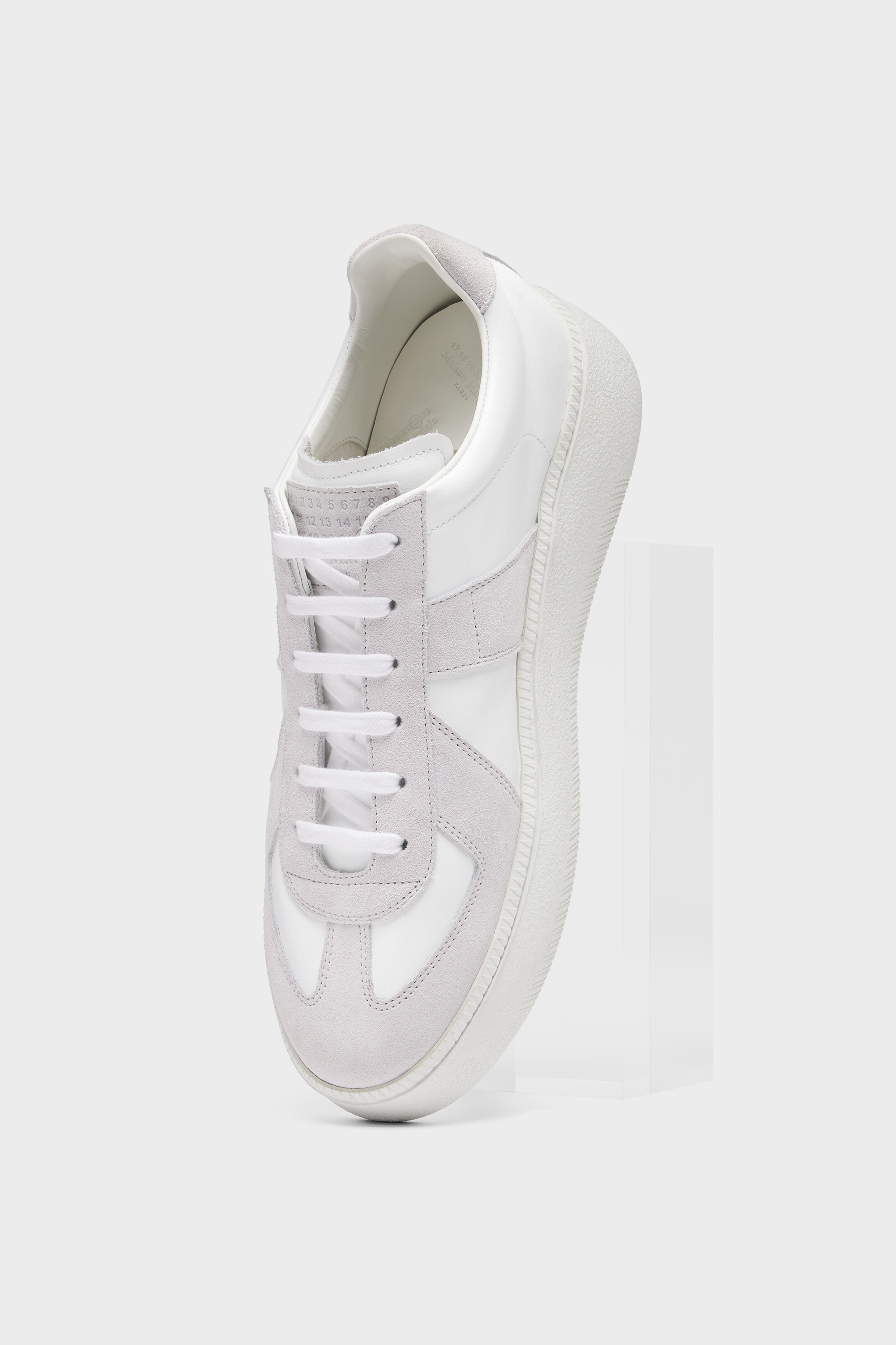
The Replica line mimics the aesthetic of a generic German Army Trainer, complete with faux wear and deliberately imperfect stitching. It's a conceptual exercise, but the construction is straightforward and honest. The upper is full-grain calfskin, the midsole is margom rubber, and the whole thing is stitched and glued using methods borrowed from 1970s sports footwear.
Eighteen months in, these have aged exactly as you'd expect a well-made leather sneaker to age. The toebox has creased heavily, the heel counter has softened, and the rubber has yellowed slightly. The sole shows wear at the ball of the foot but hasn't separated from the upper. The insole, which is unbranded foam, has compressed but not disintegrated. They still look deliberate rather than tired, which is the test for this kind of shoe.
The leather quality is the key here. It's thicker than what you'd find on a Common Projects Achilles or a Koio Capri, closer to what Hender Scheme uses, and it takes polish well if you want to clean them up. The margom sole is replaceable, though you'll need to find a cobbler who works with sneakers rather than dress shoes. Most won't touch them.
The fit is narrow through the midfoot and true to size in length. If you have wide feet, these won't work. If you have narrow feet, they'll fit better than almost anything else at this price point.
Painter Boot in Suede
This is the sleeper. The Painter boot is less visible than the Tabi, less hyped than the Replica, and significantly more durable than either. It's a Chelsea-style boot with an exaggerated pull tab and a chunky Vibram sole, rendered in reverse suede that looks better dirty than clean.
Two years of wear, including a wet winter and a summer spent walking on gravel, and these have held up better than boots costing twice as much. The suede has matured into a mottled grey-brown that hides stains and scuffs. The elastic gussets, which are often the failure point on Chelsea boots, remain taut. The Vibram sole has worn down evenly and still has another year in it before needing a resole. The pull tab, which is reinforced with leather at the stitching, shows no signs of tearing.
The construction is Goodyear-welted, which makes them resoleable indefinitely and adds a slight bulk to the profile. They're heavier than a sleek Chelsea from Saint Laurent or Bottega, but that weight translates to stability. The insole is cork, which moulds to your foot over time and provides better arch support than foam or leather.
These run a full size large. Order down, not half—down a full size. The last is generous through the instep, which makes them easy to get on but slightly loose if you size correctly for length.
Care and Longevity
None of these shoes require obsessive maintenance, but all benefit from basic care. The calfskin Tabi and Replica both respond well to a neutral cream polish every month or so. The suede Painter boot needs a brass brush after wet wear and occasional treatment with a suede protector, though the reverse finish is forgiving enough that you can skip this and just let it age.
Rotate your shoes. Don't wear the same pair two days running. Insert shoe trees if you care about creasing, though the Replica and Painter both look better with some collapse in the upper. Resole before the welt stitching shows. A Topy on the Tabi sole extends its life by a year, easily.