Maison Margiela has never been about logos
Maison Margiela has never been about logos. The four white stitches on the back of a garment do more work than most houses manage with an entire ad campaign. They mark a lineage that runs from Martin Margiela's original Paris atelier through to John Galliano's current tenure — a lineage built on deconstruction, anonymity, and a refusal to make things easy. The house doesn't court newcomers. It doesn't explain itself. But if you're willing to meet it halfway, the first piece you bring home can recalibrate how you think about dressing.
The question isn't whether Margiela is worth the investment. It's which entry point makes sense for you. A Tabi boot at $1,200 is a different proposition than a Replica sneaker at $500, and both are different again from a tailored blazer at $2,800. All three carry the house codes — the tension between craft and conceptualism, the way a seam can be both structural and decorative, the insistence that fashion should make you think before it makes you comfortable. But they ask different things of a wardrobe, and of a wearer.
What follows are three budgets, three silhouettes, three ways in. None of them are safe. That's the point.
Under $600: Replica GAT Sneaker
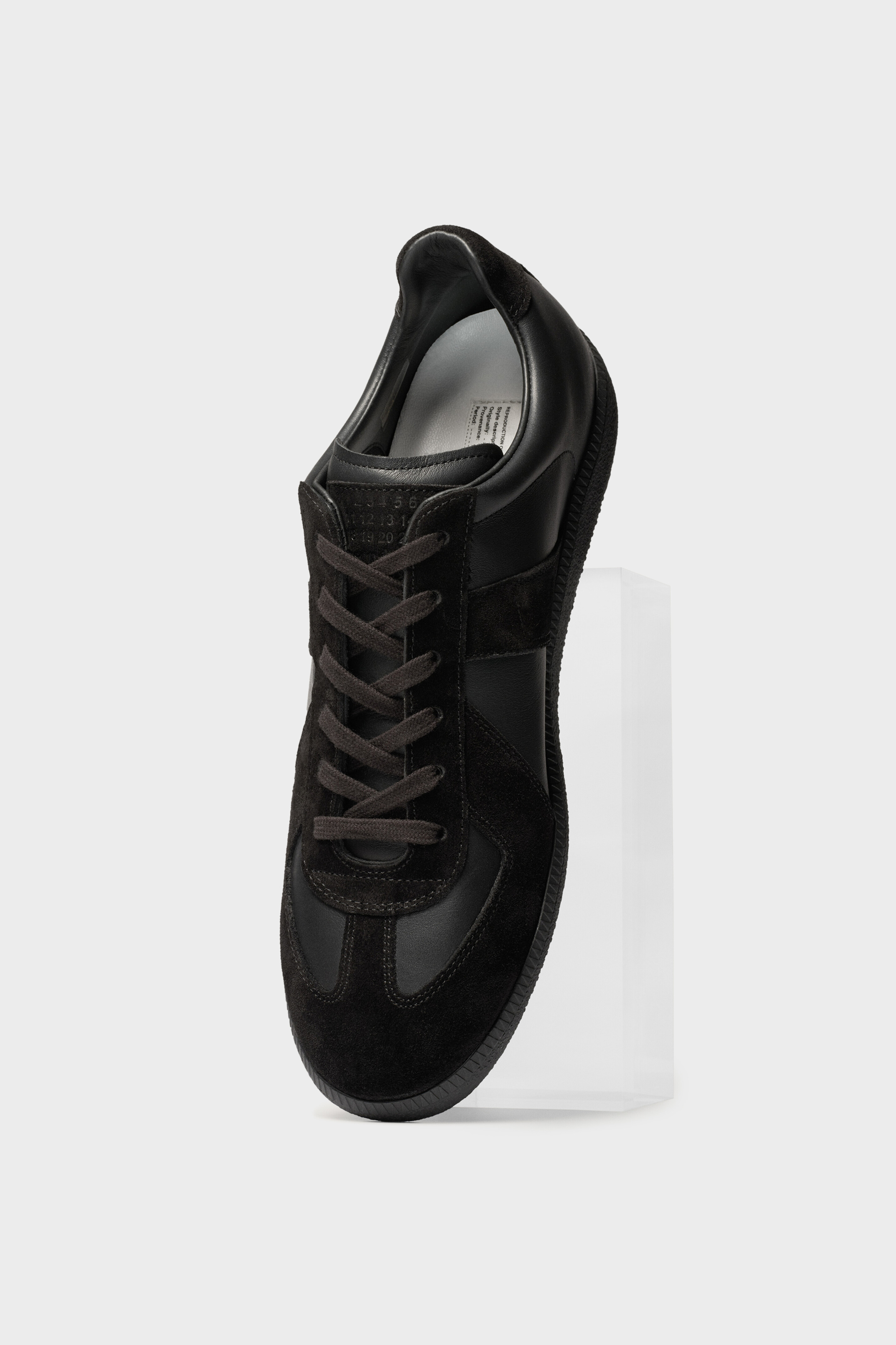
The German Army Trainer replica is Margiela's most accessible piece, and its most misunderstood. People treat it as a luxury sneaker. It isn't. It's an argument about originality rendered in full-grain calfskin and a gum sole. The house took a 1970s military trainer — standard-issue, made by three different German manufacturers to the same spec — and reproduced it with marginal improvements. Better leather. A more considered last. A label inside that reads '1970s Original, Maison Margiela 2000s Replica' in plain type.
The result looks like something you'd find in a surplus store, if surplus stores carried shoes this carefully made. The leather is thick enough to crease visibly after a week of wear. The sole has give but no spring — it doesn't want to propel you forward, it wants to keep you grounded. The shape is wide through the toe box, which reads as clunky until you wear it with a wider trouser and realise the proportions were never meant to work with a slim jean.
This is the piece that teaches you Margiela's first lesson: luxury isn't about newness. It's about regard for the thing itself. The GAT costs around $500. You'll wear it until the sole separates from the upper, and then you'll have it resoled, because the leather only improves with age.
Wear it with: a straight-leg chino, a white oxford, no socks. Let the shoe do the talking.
$1,000–$1,500: Tabi Boot
The split-toe boot is Margiela's most recognisable silhouette, and the one that separates tourists from residents. It's based on a fifteenth-century Japanese work boot — a tabi, designed to be worn with traditional split-toe socks — and Martin Margiela put it on a Paris runway in 1989. The fashion press called it unwearable. He kept making it. Forty years later, it's still in the collection, and it still makes people uncomfortable.
The discomfort is the point. The Tabi forces you to reconsider what a foot should look like in a shoe, what elegance means, whether beauty requires comfort. The split toe reads as aggressive from a distance and sculptural up close. It changes your gait slightly — you're more aware of how your weight shifts, how your ankle flexes. The boot is usually offered in smooth black leather or patent, with a stacked heel that adds two inches of height and a zipper up the back. It costs between $1,200 and $1,400 depending on the finish.
This is not a first-date shoe. It's not a job-interview shoe. It's a shoe that announces you've made a decision about how you want to move through the world, and you're not interested in consensus. Wear it enough and it stops reading as confrontational. It just reads as yours.
The best version for a first purchase is the classic ankle boot in black calfskin. It works under a wide trouser, with a knee-length skirt, over a slim legging if you're willing to commit. The shape is unforgiving but not inflexible. You'll know within two wears whether you can live with it.
Wear it with: a column of black — trousers, a fine-gauge knit, a wool coat that skims the knee. Let the silhouette stay clean.
$2,500–$3,500: Deconstructed Blazer
Margiela's tailoring is where the house philosophy becomes most legible. The deconstructed blazer — often shown with exposed seams, unfinished hems, or linings worn on the outside — is a garment that refuses to hide its construction. You see how a sleeve is set, how a shoulder is padded, how a lapel is interfaced. The blazer becomes a blueprint of itself.
The house has offered variations on this since the beginning, but the current iteration under Galliano leans into volume. Wider shoulders, a longer line through the body, sleeves that break at the wrist rather than sitting clean. The fabric is usually a wool-blend suiting or a heavyweight cotton canvas. The palette is neutral — black, grey, navy, occasionally a chalk stripe. Prices start around $2,800 and climb depending on fabric and finish.
This is the piece that asks the most of you. It doesn't flatter in the conventional sense. It doesn't nip at the waist or broaden the shoulder in a way that reads as powerful. It sits on the body like a question: what if tailoring didn't have to resolve into a single clean line? What if the process mattered as much as the result?
You wear it open, over a white tee and a slim black trouser. Or you wear it buttoned, with nothing underneath, and a pair of Tabis. Or you wear it as a dress, belted at the waist with a leather cord. The blazer doesn't tell you how to style it. That's your job.
Wear it with: intention. This isn't a piece you throw on. It's a piece you build a day around.
On Longevity
Margiela pieces don't age gracefully in the way a Hermès bag ages gracefully. They age like work boots age, like a plaster cast ages — with visible wear that becomes part of the narrative. The leather on a Tabi will crease and scuff. The sole on a GAT will compress and patina. The lining on a deconstructed blazer will fray at the seams, because it was never finished to begin with.
This is intentional. The house has always been interested in the life of a garment after it leaves the atelier, the way use and time rewrite the original design. Store your pieces in cotton dust bags, not plastic. Condition leather annually with a neutral cream. Have a tailor you trust for repairs — Margiela's construction is specific, and not every alteration shop will understand the logic.
The four white stitches on the back of the garment aren't just a signature. They're a reminder that what you're wearing was made by hand, and it will wear like something made by hand. That's not a flaw. That's the point.