Portrait: the creative director at Acne Studios
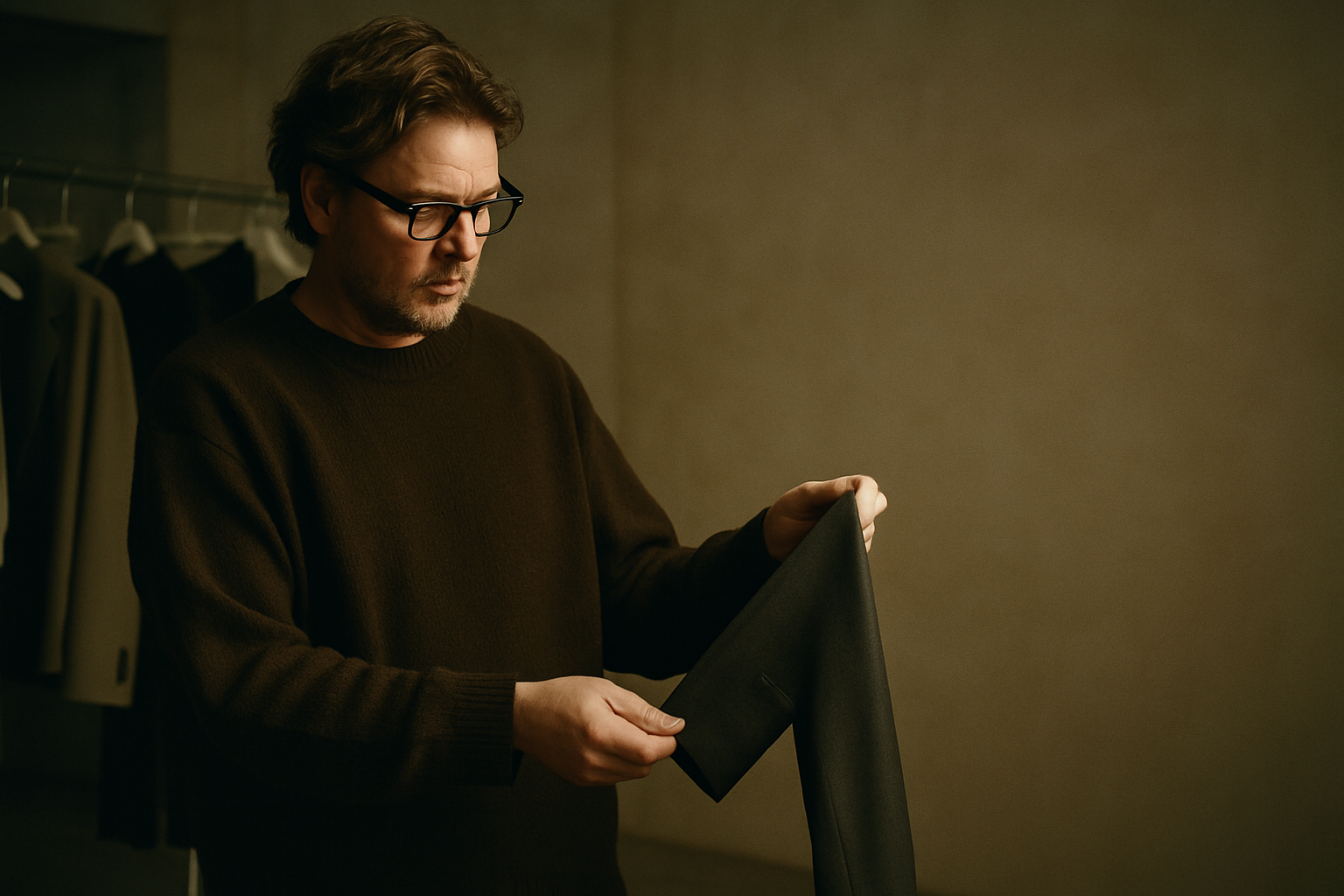
Jonny Johansson stands in the Acne Studios atelier on Torsgatan, holding a jacket sleeve between his thumb and forefinger. The sleeve is too long. He doesn't say this — he folds the cuff back twice, pins it, and waits for the pattern cutter to nod. This is how most of his fittings go. Few words, many adjustments, a room that smells faintly of wool and coffee.
He has been creative director of Acne Studios since he co-founded it in 1996. That tenure — twenty-seven years — makes him an outlier in an industry that replaces designers every four seasons. The longevity is not sentimental. Johansson still owns part of the company. He answers to a board, but the vision remains his.
The long route in
Johansson did not train as a designer. He studied graphic design and advertising at Beckmans College of Design in Stockholm, graduating in the early nineties with no particular interest in tailoring or drape. His first project after school was a creative collective called Acne — Ambition to Create Novel Expressions — which made films, furniture, and eventually a run of raw denim jeans with bright red stitching. The jeans sold. The collective pivoted.
There was no atelier in those early years, no couture training, no apprenticeship under an established name. Johansson learned by making mistakes in small batches. He has said in interviews that he still doesn't sketch — he works directly on the stand or drapes fabric on a model. This is not a romantic affectation. It is a practical response to the fact that he never learned to draw garments the way Central Saint Martins graduates do.
What he did have was an eye for proportion and a distrust of anything too polished. The early Acne collections were raw-edged, deliberately unfinished, more art-school than Savile Row. The jeans had exposed seams. The knitwear was oversized in a way that felt accidental. The palette was muted — grey, navy, rust, black. It was not minimal in the Jil Sander sense. It was minimal in the sense that Johansson did not yet know how to do anything else.
The signature, built slowly
Acne Studios became known for a specific tension: tailored shapes that looked like they had been slept in, knitwear that was too long or too short, trousers that pooled at the ankle. The clothes were expensive but not precious. You could wear them on the Tunnelbana without feeling like you were performing.
The breakthrough came in the mid-2000s, when the brand began showing in Paris. Johansson's approach — Scandinavian restraint with a slight punk undertow — resonated with buyers who were tired of logo-heavy luxury. Acne was not trying to be Dior. It was not trying to be Margiela either, though the comparisons were inevitable. It was trying to make clothes that looked good on people who were not models.
The scarves helped. The oversized wool scarves, specifically, which became a kind of uniform for a certain type of European creative in the 2010s. Johansson has never seemed particularly proud of this. In a 2018 interview with System, he said the scarves were useful but that he wished people paid more attention to the tailoring. The tailoring, by then, had improved considerably. The jackets were still soft-shouldered, but the construction was cleaner. The trousers had a better fall. The studio had grown.
What stays, what shifts
Johansson's collections do not pivot sharply. There are no reinventions, no apology tours, no abrupt changes in direction. Each season builds on the last. A relaxed blazer from 2015 reappears in 2023 with a slightly longer skirt and a different button stance. A knit from 2008 comes back in a heavier gauge. This is not laziness. It is a deliberate refusal to treat fashion as a series of unrelated episodes.
The palette has barely changed. Grey, camel, black, rust, the occasional sharp blue. The silhouette has loosened over time — the trousers are wider now, the coats longer — but the underlying structure is the same. Johansson is not interested in trends. He is interested in a specific kind of ease, the kind that comes from wearing the same jacket three days in a row until it moulds to your shoulder.
The brand has expanded, inevitably. There are now Acne Studios stores in twenty-three cities. The denim line, which started everything, is still a significant part of the business. The accessories — particularly the Musubi bag, with its knotted handle — have become commercial anchors. Johansson oversees all of it, though he has said he finds the accessories work less satisfying than the clothing. He is a garment person. He thinks in terms of cloth and body, not leather goods and margin.
The studio, now
The Torsgatan atelier is not large. There are eight pattern cutters, a handful of seamstresses, and a wall of fabric samples organised by weight and weave. Johansson works here most days, though he travels frequently for fittings in Paris and production meetings in Italy. The studio does not feel precious. There are coffee cups on the cutting tables. The mood boards are pinned directly to the wall, not framed.
He is fifty-one now. He has no obvious successor. The brand is majority-owned by a private equity firm, which bought a controlling stake in 2019, but Johansson remains creative director and retains a significant minority holding. He has not announced plans to step down. He has not announced plans to stay forever either. The question hangs.
What seems likely is that he will continue doing what he has always done: make clothes that feel like they were not overthought, refine the same silhouettes year after year, avoid the kind of spectacle that fashion journalism rewards. Acne Studios is not a house built on grand gestures. It is a house built on the accumulation of small, deliberate choices — a sleeve that is half an inch longer than it should be, a shoulder that does not announce itself, a coat that works in Stockholm and Paris and London because it does not try to be anything other than what it is.
Johansson folds the sleeve back one more time, checks the line, and moves on to the next fitting. The jacket will be ready by Thursday. The collection will show in March. The work continues.