Portrait: the creative director at Jacquemus
Simon Porte Jacquemus stands in a white-walled studio in the 10th arrondissement, pinning a straw hat the size of a bicycle wheel to a model's head. The brim extends so far it grazes her shoulders. He steps back, considers, removes two pins, adjusts the angle by perhaps three degrees. "Voilà," he says, though the word carries no finality. He will return to this hat four more times before the look is photographed.
This is the method: obsessive iteration on a single, often absurd, idea until it becomes somehow inevitable. The oversized hat. The micro-bag so small it holds a single credit card. The asymmetric cut that leaves one shoulder bare while the other remains covered. Jacquemus has built a house on gestures that should not work — and then made them work through sheer force of repetition and conviction.
The Apprenticeship That Wasn't
Simon Porte Jacquemus did not attend the Institut Français de la Mode. He did not apprentice under a storied creative director. He moved to Paris from the village of Mallemort, in Provence, at eighteen, enrolled at ESMOD for a single term, and left. His mother had just died. The tuition felt like money better spent elsewhere. What followed was not an education in the traditional sense but a kind of autodidactic immersion: he worked at Comme des Garçons, watched, absorbed, and began making clothes in his apartment.
The first collection, shown in 2009 under the name Jacquemus — his mother's maiden name — consisted of eighteen looks. He was nineteen. The pieces were shown not on a runway but in a showroom. The press response was polite and sparse. One editor, writing in Les Échos, noted "a certain naïveté, though not without charm." This is the sort of review a young designer frames or burns, depending on temperament. Jacquemus kept working.
What he lacked in formal training he substituted with a kind of relentless self-mythologising. Early lookbooks featured him in Provençal fields, shirtless, holding lemons. The clothes — linen shirting, wide-legged trousers, straw hats — referenced the South with an intensity that bordered on parody. And yet. The vision was consistent. The same motifs appeared season after season, refined incrementally, until the referentiality became a language.
The Breakthrough, Staged
The pivot arrived in 2017, though the seeds were planted earlier. Jacquemus began staging shows in locations that had nothing to do with the conventional Paris calendar. A lavender field in Valensole. A salt flat in Provence. A wheat field at sunset, the models walking a narrow path cut through the crop, the whole thing lasting eleven minutes. The fashion press, by then exhausted by the sameness of tent shows and borrowed palaces, paid attention.
But location alone does not make a collection. What shifted in those years was Jacquemus's willingness to distill his references into something more graphic, more immediate. The silhouette narrowed. Hemlines rose. Colour became declarative — Klein blue, sunflower yellow, chalk white. And then came the bag.
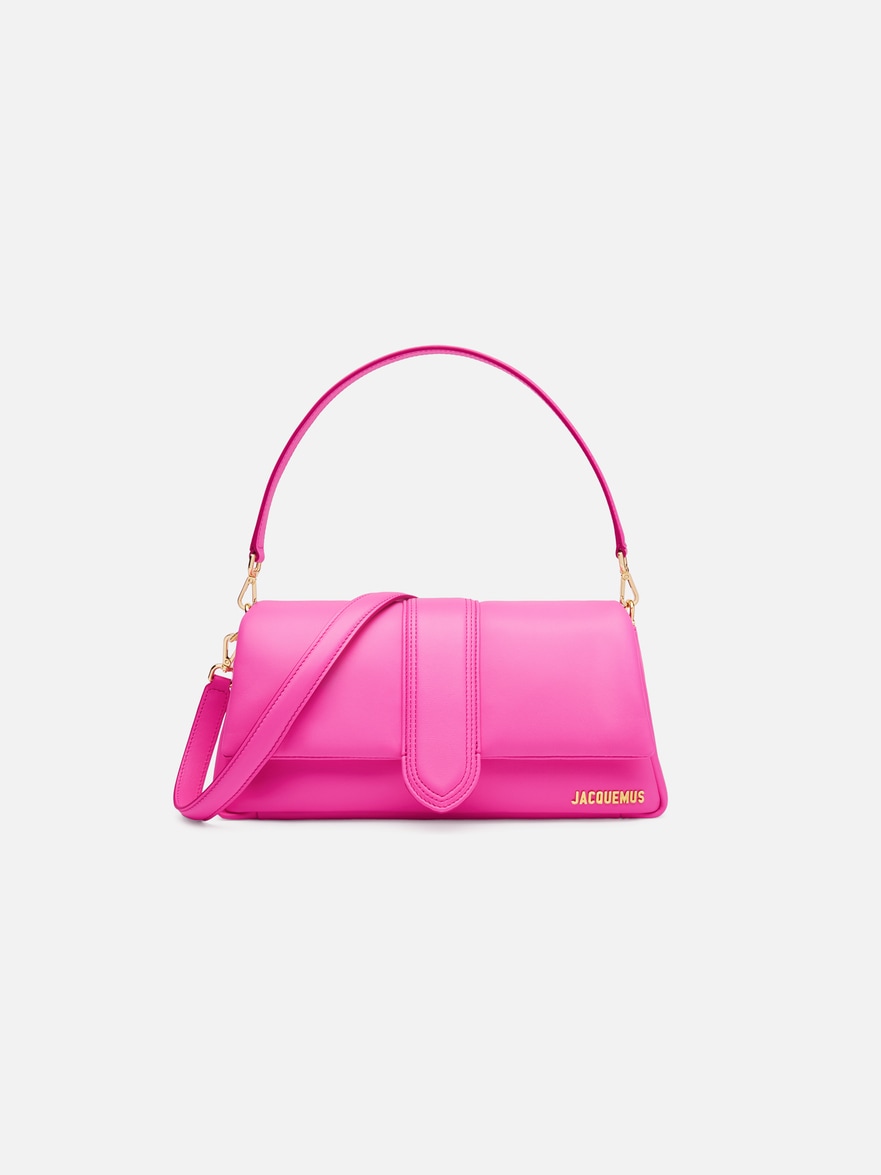
Le Chiquito, introduced in 2018, measured roughly ten centimetres across. It could not hold a phone. It could barely hold car keys. It was, by any functional measure, ridiculous. It also became the most-photographed accessory of the year, slung across the shoulder of every influencer with a grid to maintain. Jacquemus had discovered something the old houses sometimes forget: a signature need not be serious to be consequential.
The Signature, Refined
If one examines the Jacquemus vocabulary now, a decade and a half in, certain elements recur with the regularity of a basse continue. Asymmetry, yes — but asymmetry as a structural principle, not an afterthought. One sleeve long, the other absent. One pant leg cropped, the other pooling at the ankle. The effect is not chaotic but strangely balanced, as though the garment has been edited down to its essential gesture.
Then there is the question of scale. Jacquemus toggles between the oversized and the miniature with a kind of gleeful instability. A hat brim extends a metre. A bag shrinks to the size of a matchbox. A shirt collar rises to the cheekbones. These are not wearable propositions in the traditional sense, but they photograph with startling clarity. In an image economy, clarity is currency.
The palette, too, has calcified into something recognisable. Whites that read as sunlight on stucco. Blues pulled from the Mediterranean at midday. The occasional stripe, always in high contrast. Prints are rare. Embellishment rarer still. The clothes rely on cut and colour, and when they succeed, they succeed because the cut is precise and the colour is unapologetic.
The Expansion, Managed
Jacquemus is no longer a one-man operation in a 10th arrondissement walk-up. The house now shows in Paris, produces multiple collections a year, operates standalone boutiques, and collaborates with brands as varied as Nike and Sephora. Bastien Daguzan, the house's CEO, has steered the business through a period of aggressive but controlled growth. The Nike collaboration, announced in 2024, signalled a willingness to step outside the rarefied world of runway exclusivity and into something more accessible, more scalable.
This is the tightrope Jacquemus now walks: maintaining the aura of the hand-pinned straw hat while producing sneakers at a price point that moves units. Some critics argue the house has diluted its vision in pursuit of market share. Others counter that Jacquemus has simply recognised what the industry already knows — that survival requires reach, and reach requires compromise.
What remains consistent is the designer's presence. Simon Porte Jacquemus is not a recluse. He appears in his own campaigns, posts prolifically on Instagram, and gives interviews in which he speaks candidly about ambition, anxiety, and the pressure of maintaining momentum. This is not the old model of the designer as remote auteur. It is something more contemporary, more exposed, and arguably more fragile.
What Comes Next
The question now is whether Jacquemus can sustain its trajectory without becoming a caricature of itself. The straw hat can only get so large. The bag can only get so small. At some point, the gesture exhausts itself, and the house must find new ground.
There are signs of restlessness. Recent collections have introduced tailoring — sharply cut blazers, trousers with a higher waist and a wider leg. The palette has darkened slightly, incorporating charcoal and navy alongside the signature whites and blues. Whether this represents a genuine evolution or a temporary detour remains to be seen.
In the studio, Jacquemus returns to the oversized hat. He removes it from the model's head, sets it on a table, and stares at it for a long moment. Then he picks up a pair of shears and begins cutting into the brim. The gesture is decisive, irreversible. Whatever the hat was, it will now be something else. This, one suspects, is the method that will carry the house forward: the willingness to destroy the thing you have just made in order to discover what it might become.