## The Fitting
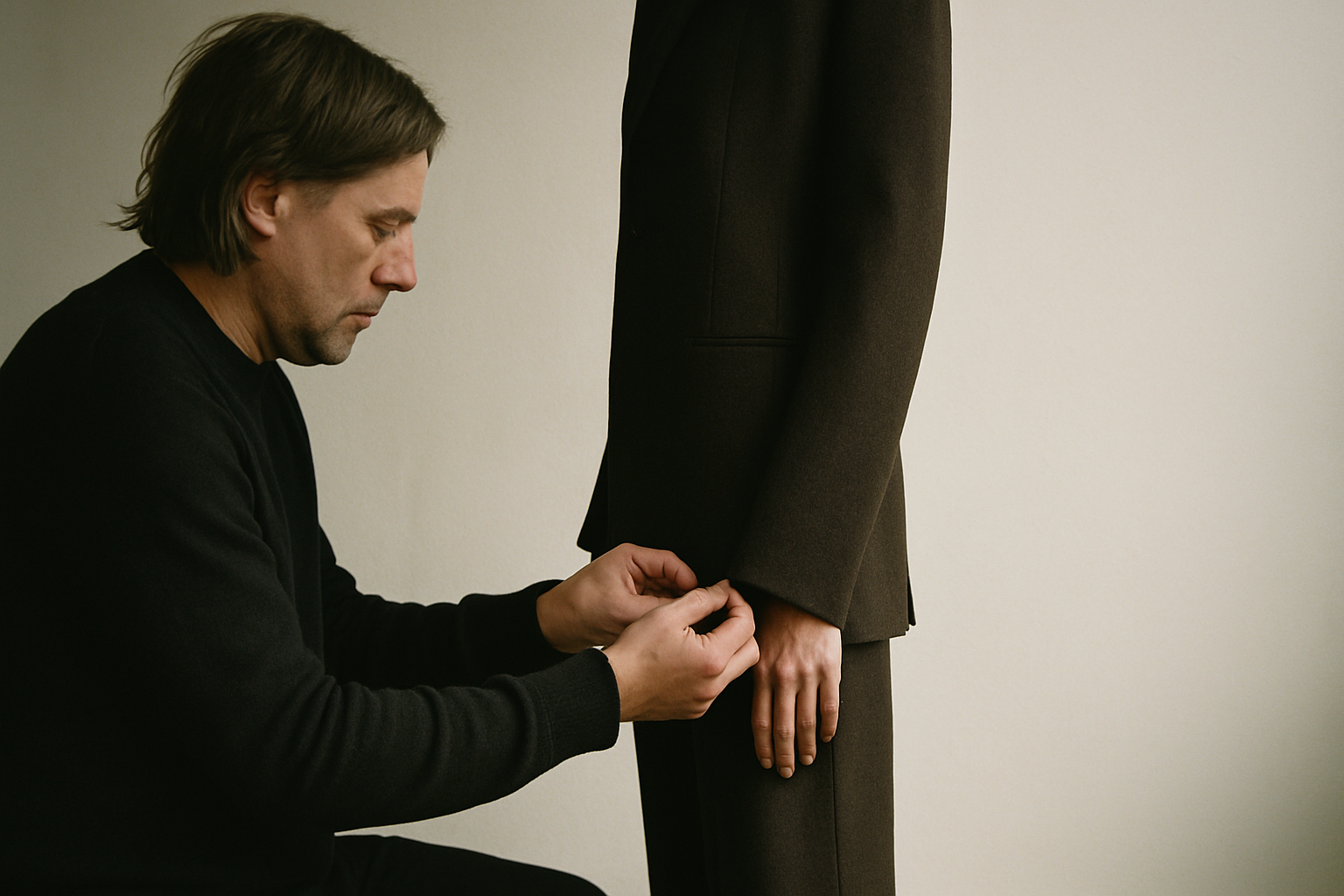
The Fitting
Jonny Johansson stands in a white-walled room on Norrmalmstorg, pinning a sleeve on a model who is not moving. The fabric — a wool-silk blend, dense but not stiff — falls two centimetres past where he wants it. He adjusts. The model, a Swedish woman in her early twenties with the kind of face that reads differently depending on the light, shifts her weight. Johansson steps back, squints, and says something in Swedish that makes her laugh. This is how Acne Studios has worked since 1996: a small room, a conversation, a sleeve that needs to fall differently.
But the house has never been about one muse. It has been about three, each arriving at a different inflection point, each reframing what the Stockholm label could mean beyond its origins in denim and art-school provocation. They are not models in the traditional sense. They are collaborators, interpreters, and in one case, a kind of ghost.
Sofia Coppola, or the American Who Wasn't American
When Sofia Coppola began wearing Acne Studios in the early 2000s, the house was still a niche proposition outside Scandinavia. She was drawn to the jeans first — the Hep, a straight-leg cut with a mid-rise that felt neither retro nor aggressively contemporary. In a 2006 interview with The Guardian, she described the fit as "easy, but not sloppy." That distinction mattered. Coppola's wardrobe, both on and off set, has always operated in that narrow band between studied and unstudied, and Acne Studios, at that moment, occupied the same territory.
Johansson took note. By 2008, the house was dressing her for premieres, but more importantly, for her life between them. A grey crewneck sweater. A navy blazer with shoulders that didn't announce themselves. A leather jacket that looked like it had been worn for three years even if it had been worn for three weeks. Coppola was not modelling Acne Studios; she was living in it, and that distinction — again — mattered.
The effect on the house was oblique but consequential. Acne Studios became legible to a certain kind of American woman who had no interest in Scandinavian minimalism as a lifestyle brand but wanted clothes that worked without requiring a thesis. Coppola's influence was not about a single piece or a single season. It was about establishing a vernacular: quiet, specific, and resolutely anti-statement.
Hari Nef, or the Muse Who Talked Back
By 2015, Acne Studios had expanded beyond denim and knitwear into a broader ready-to-wear proposition, and the house needed a new kind of visibility. Enter Hari Nef, then a twenty-three-year-old actress and model who had just been cast in Transparent and was beginning to appear in campaigns for Gucci and L'Oréal. Johansson cast her for the Autumn/Winter 2015 campaign, shot by Daniel Jackson in New York. The images were straightforward: Nef in a camel coat, Nef in a black turtleneck, Nef looking directly at the camera with an expression that suggested she was in on the joke, whatever the joke was.
What made Nef's relationship with Acne Studios different from earlier muse arrangements was her willingness — eagerness, even — to articulate what the clothes meant to her. In a 2016 interview with i-D, she described the house as "interested in how clothes feel on a body that isn't hypothetical." She was speaking, of course, about her own body, but also about a broader shift in how fashion was beginning to think about casting and representation. Acne Studios, to its credit, did not make a spectacle of this. Nef appeared in campaigns, yes, but she also wore the clothes off-duty, posted them on Instagram, and spoke about them in interviews without the usual brand-approved talking points.
The house's response was to give her more room. By 2017, Nef was not just a face in the campaign but a recurring presence in the brand's visual language. She attended shows, appeared in lookbooks, and became a kind of unofficial ambassador. The relationship was transactional, obviously, but it was also collegial in a way that felt rare. Nef was not performing a version of herself for Acne Studios; she was performing herself, and the house was smart enough to let her.
Beca Lipscombe, or the One You Haven't Heard Of
The third muse is less visible, which is precisely the point. Beca Lipscombe is a stylist based in London, and if you don't recognise the name, you've almost certainly seen her work. She has dressed Rosalía, FKA twigs, and a rotating cast of musicians and actors who want to look like themselves, only sharper. Her relationship with Acne Studios began in the mid-2010s, not through a campaign or a collaboration but through repeated use. She pulled pieces for clients. She wore the clothes herself. She became, in the trade's parlance, a house friend.
What Lipscombe brought to Acne Studios was a kind of street-level credibility that cannot be manufactured. When she put a client in an oversive Acne Studios trench or a pair of the house's now-signature leather trousers, it registered differently than when a magazine stylist did the same. Lipscombe's clients were not fashion people; they were musicians, actors, artists who needed to look a certain way for a certain audience, and Acne Studios, in her hands, became a solution rather than a statement.
Johansson has never publicly named Lipscombe as a muse, and she has never appeared in a campaign. But her influence is evident in the way the house has evolved over the past decade: more oversized outerwear, more leather, more pieces that work on stage as well as they do in a fitting room. Lipscombe's contribution is not about visibility. It is about utility, and in that sense, she may be the most important of the three.
What Comes Next
Acne Studios is now owned by Lanvin Group, and Johansson remains creative director, though the house's scale has changed considerably since the days of that white-walled room on Norrmalmstorg. The question, as it always is with houses that grow, is whether the muse model still functions. Can a brand that sells in forty countries and operates a robust e-commerce platform still build its identity around individual women who wear the clothes in a particular way?
The answer, on balance, seems to be yes, but with a caveat. The muses are no longer singular. They are plural, diffuse, and increasingly difficult to track. Acne Studios still casts interesting faces — Adut Akech, Selena Forrest, others — but the relationship is more fluid now, less about a single woman defining a moment and more about a rotating cast of women who each bring something different. Whether that dilutes the model or evolves it is a question for another article. For now, it's enough to note that the three women who defined the house — one American, one New Yorker, one Londoner — did so by refusing to perform a version of Acne Studios that didn't already exist inside them. That, more than any sleeve length or saddle stitch, is what made them muses.