## The Fitting
The Fitting
Daniel Lee stands in a white-walled studio in Horseferry Road, one hand on the shoulder of a toile-clad mannequin, the other holding a length of gabardine that hasn't yet decided what it wants to be. He adjusts the fall of the cloth across the bust, pins it, steps back. The room is quiet except for the sound of scissors and the occasional murmur to a pattern cutter whose name doesn't make it into press releases but whose hands have been at Burberry longer than Lee has been designing.
This is the part that doesn't photograph well. The part before the runway, before the campaign, before the handbag appears on every relevant shoulder between Sloane Square and Shibuya. Lee came to Burberry in 2022 with a reputation for making Bottega Veneta's intrecciato weave into something people queued for. What he's doing now is quieter, more structural, and significantly harder to explain in a caption.
The Training
Lee studied at Central Saint Martins, which is either the most important detail in his biography or the least, depending on how you feel about the college's grip on the industry. He graduated in 2006. More useful is what came after: a decade at Maison Margiela, then Céline under Phoebe Philo, then Bottega. That's the real training. Not the degree, but the years spent learning how a sleeve should hang, how to cut volume without losing line, how to make a bag that photographs flat and feels sculptural in the hand.
At Bottega, he became known for a particular kind of restrained maximalism. Big shapes, clean seams, no visible hardware. The Pouch became shorthand for a certain kind of taste, the kind that doesn't announce itself but gets recognised anyway. He was there for three years. When he left in 2021, the industry spent several months speculating about where he'd land. The answer, when it came, made sense in retrospect. Burberry needed someone who understood both craft and commerce, who could reference the archive without being buried by it.
The Pivot
Burberry is not an easy house to steer. It has 167 years of history, most of it tied to a single garment. The trench coat is both an asset and a constraint. It's the thing everyone knows, the thing that funds everything else, and the thing that makes it difficult to do anything that isn't, in some way, about outerwear and weather-proofing and a particular vision of Britishness that may or may not still exist.
Lee's first collection for Burberry, shown in February 2023, opened with a trench. Of course it did. But the trench had been cut wider through the body, the belt replaced with a leather corset that wrapped the waist and tied at the side. The next look was a parka with the proportions of a ball gown. Then a series of tailored coats in navy and camel, each one built over a foundation garment that shaped the torso before the outerwear even went on. The collection was called Britishness. The clothes were about structure.
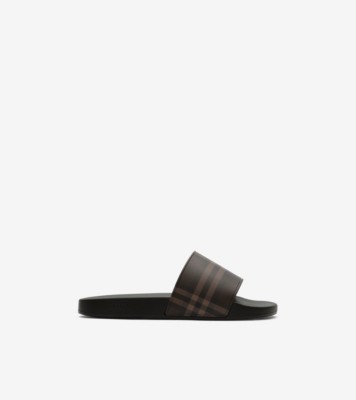
What became clear over the following seasons was that Lee wasn't interested in making Burberry louder. He was interested in making it more specific. The check, which had been everywhere and therefore nowhere, got pulled back. When it appeared, it was woven into the lining of a coat or used as a base for embroidery, not printed on nylon and stretched across a bucket hat. The logo, which had spent the better part of a decade trying to appeal to a younger customer, became smaller. The bags became bigger.
The Signature
If there's a through-line in Lee's work at Burberry, it's the corset. Not as lingerie, but as architecture. He uses boning and lacing to create shape where there wasn't shape before, to turn a trench into something that moves differently, sits differently, photographs differently. The effect is both historical and modern. Corsetry is as English as the trench itself—think Victorian tailoring, think Westwood—but Lee's version is stripped of ornament. The boning is visible. The laces are functional. The result is a coat that looks soft and feels engineered.
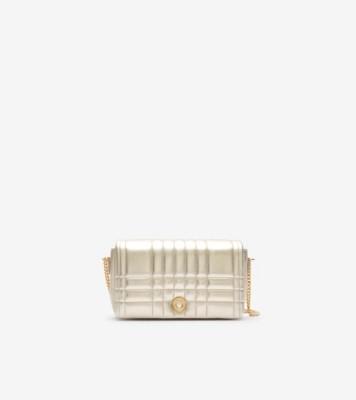
The bags, too, have a signature. Lee's first major introduction was the Knight bag, a soft hobo with a single buckle closure and a shoulder strap that could be worn long or doubled. It was followed by the Shield, a structured tote with curved edges and a magnetic clasp hidden under a flap. Both bags share a quality that's harder to quantify: they look simple until you pick them up, and then you realise how much construction is involved. The leather is thick. The stitching is tight. The hardware, when it appears, is solid brass.
This is the Lee method. Make the thing well, make it clearly, and trust that the customer will notice. It's not a revolutionary approach. It's just rare.
The Tension
There is, inevitably, a tension between what Lee wants to make and what Burberry needs to sell. The house is publicly traded. It has investors, quarterly earnings calls, a stock price that moves when a collection is well-received and drops when it isn't. Lee's clothes are expensive—not in the aspirational sense, but in the "this is what it costs to make a coat with eight pattern pieces and a boned bodice" sense. That's fine for the runway. It's less fine for the stores, which need product at multiple price points, which need things that move quickly, which need the check to appear somewhere because the check still sells.
Lee has navigated this by creating a clear hierarchy. The runway is the statement. The pre-collection is the translation. The accessories are the access point. It's a model that works as long as the statement is strong enough to justify the translation, and so far, it has been. The autumn 2024 collection, shown in February, was tighter, more focused, built around a series of tailored coats with exaggerated shoulders and nipped waists. The accompanying campaign featured models in empty fields, wearing the coats over bare legs and boots. No props, no narrative, just the clothes and the landscape. It felt like a consolidation. Lee knows what he's doing now.
What's Next
The question, as always, is how long this lasts. Lee has been at Burberry for two years. The industry moves quickly. Designers get poached, contracts don't renew, creative directors get replaced by creative directors who get replaced by committees. But for now, the work is steady. The collections are coherent. The bags are selling. The trench coat, that impossible garment, has been reimagined without being discarded.
Lee is not interested in revolution. He's interested in refinement. In taking a house with a deep archive and a narrow public image and finding space within that to build something specific, something considered, something that doesn't shout. Whether that's enough in an industry that rewards noise is another question. But in the fitting room on Horseferry Road, with the gabardine and the pins and the pattern cutter who's been there for twenty years, it's the only question that matters.