## The Fitting Room in Arles
The Fitting Room in Arles
Simon Porte Jacquemus stands in a rented studio in Arles, pinning a linen shirt onto a dress form that is, by his own admission, too small. It is 2009. He is nineteen. The shirt is cut from fabric his mother once wore, and he has no formal training in pattern-making. What he has is a name — his mother's maiden name — and a conviction that fashion can be made outside the Parisian system that has, so far, declined to let him in.
Fifteen years later, Jacquemus is a house with three hundred employees, a flagship on the rue de Castiglione, and a valuation north of two hundred million euros. The linen shirt, one suspects, is in a museum somewhere. But the question lingers: what remains of that first impulse, and what has been traded away in the pursuit of scale?
The Autodidact
Porte Jacquemus arrived in Paris at eighteen, enrolled briefly at ESMOD, and left after three months. The curriculum, he told System in 2015, felt irrelevant — too much theory, not enough cloth. His education came instead from the Palais Galliera archives, where he spent afternoons studying Courrèges and Cardin, and from a job folding sweaters at Comme des Garçons. He learned construction by unmaking garments he bought at the flea market, seam by seam, then reassembling them with his own amendments.
His first collection, shown in 2010, was called L'Ouverture. Twelve looks. No budget. The models were friends. The venue was a borrowed apartment in the Marais. What registered, even then, was a kind of clarity: high waists, cropped jackets, a palette of cream and rust and faded blue. The silhouette was informed by the women he grew up around in the Var — his mother, his grandmother — and by the way they dressed for the market, not the runway.
The press took note, but buyers did not. For the next three seasons, Jacquemus showed collections that barely sold. He worked part-time at a concept store to cover rent. The breakthrough came in 2013, with a collection called Les Parasols de Marseille. The show was staged outdoors, in the Tuileries, and the clothes — striped shirts, wide-brimmed hats, drawstring trousers — felt less like fashion than like a memory of summer. It was, in hindsight, the first articulation of what would become the house signature: not garments, but a mood.
The Signature
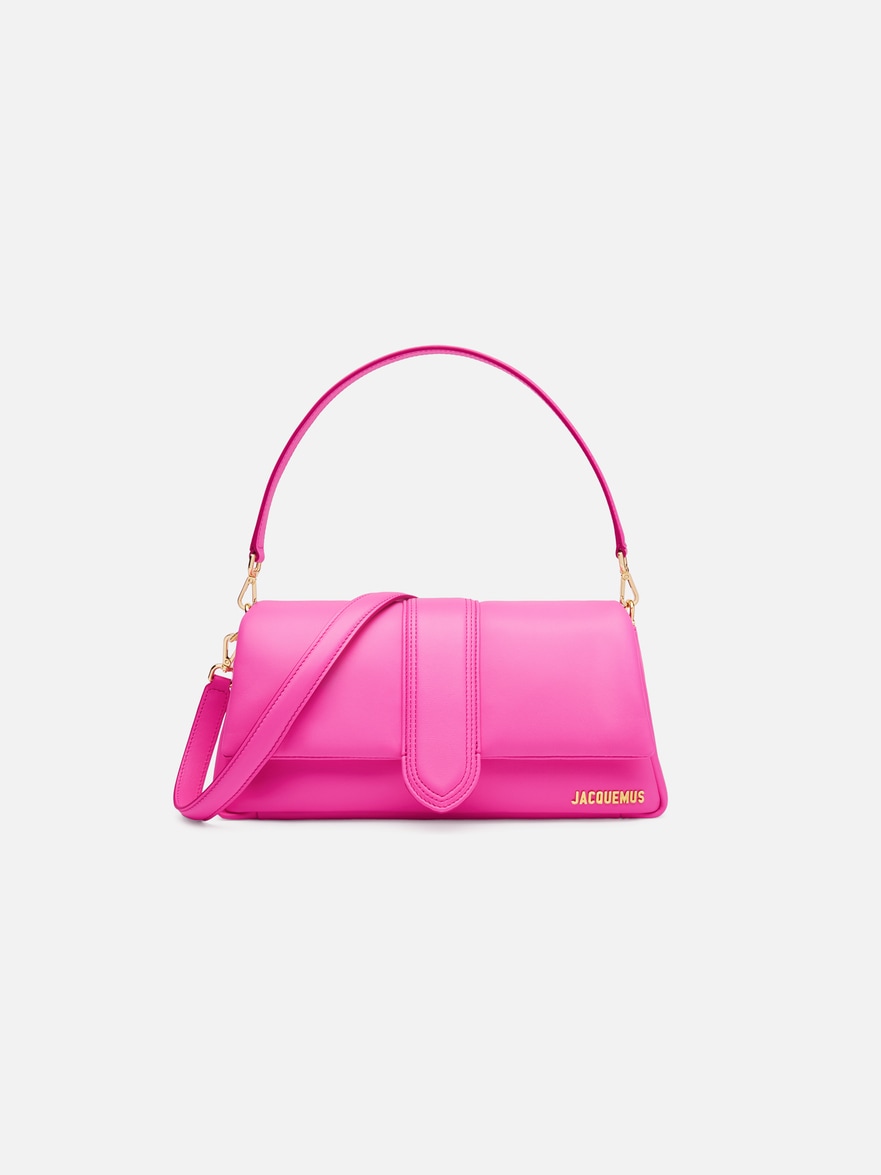
If one had to distill Jacquemus to a single gesture, it would be the Chiquito. Introduced in 2017, the bag measures twelve centimetres across. It holds, by most estimates, a lipstick and a folded bill. It became, almost immediately, the most memed object in fashion. Critics called it absurd. Customers called it genius. By 2019, it was the brand's bestselling accessory.
The Chiquito is instructive not because it is small, but because it is legible. It does one thing — it signals Jacquemus — and it does it at a distance. The same logic governs the house's broader output: the asymmetric necklines, the cutouts at the hip, the bags shaped like hearts or croissants or, in one case, a bamboo basket. These are not subtle gestures. They are designed to photograph well, to circulate on Instagram, to be understood in a glance.
This approach has made Jacquemus one of the most visible brands of the past decade. It has also made it, in the eyes of some, a kind of content factory. The shows are staged in lavender fields, on salt flats, in the middle of wheat farms. They are spectacular. They are also, increasingly, indistinguishable from advertising. The clothes, meanwhile, have become secondary to the spectacle that surrounds them.
The Expansion
In 2022, Jacquemus took on a minority investor: the private equity firm Groupe Bertrand. The terms were not disclosed, but the intent was clear: to scale the business beyond ready-to-wear and accessories, and into categories — fragrance, eyewear, possibly homewares — that require infrastructure the house did not have. The first fragrance, Le Parfum Soleil, launched in 2023. It sold well. A second followed six months later.
The question, for those who have tracked the house since the Marais apartment days, is what gets preserved in this expansion and what gets smoothed away. Jacquemus has always been a personal project — the collections are named after people and places from Porte Jacquemus's childhood, the campaigns feature his friends and, occasionally, his husband. That intimacy is part of the appeal. But intimacy does not scale. At a certain size, a brand becomes a franchise, and the founder becomes a character in his own story.
There are signs, already, of this shift. The ready-to-wear collections, once idiosyncratic and specific, have begun to repeat themselves. The same cutouts, the same asymmetries, the same saturated colours. The shows are still events, but they feel, increasingly, like exercises in brand maintenance rather than genuine exploration. The house has found a formula, and the formula works. Whether it can sustain a second act is less certain.
The Question
Porte Jacquemus is thirty-three. He has built, in less than fifteen years, a house that rivals brands with century-long legacies. He has done it without formal training, without institutional backing, and without, for a long time, any capital beyond what he could borrow or earn. That is a rare achievement, and it deserves acknowledgment.
But the next chapter — the chapter of maturity, of consolidation, of becoming a house rather than a project — is harder. It requires a different set of skills: delegation, systems, a willingness to let go. It also requires a decision about what the brand is for. Is it a vehicle for self-expression, or is it a business designed to generate returns for investors? Can it be both?
The answer, one suspects, will reveal itself in the work. If the collections continue to feel like iterations of a known idea, then Jacquemus will become what so many brands become: a logo, a vibe, a set of recognizable gestures. If, on the other hand, Porte Jacquemus finds a way to surprise himself — to return to the curiosity that drove him to unpick those flea-market garments — then the house may yet have something to say beyond what it has already said.
For now, the linen shirt remains the most honest thing he ever made. Not because it was perfect, but because it was necessary. The rest is still being written.