The fitting room on Via delle Caldaie is smaller than you'd expect
The fitting room on Via delle Caldaie is smaller than you'd expect. Sabato De Sarno stands beside a tailor's dummy draped in rust-coloured silk, one hand adjusting the drape at the shoulder, the other holding his phone at arm's length to check the line in its camera. He steps back. Tilts his head. Steps forward again. The gesture is small, obsessive, private — the sort of thing that doesn't make it into the press materials.
De Sarno has been Gucci's creative director since January 2023, though the appointment was announced the previous November. He is forty-one. He does not come from the usual channels. No Central Saint Martins. No LVMH Prize shortlist. No viral Instagram moment that forced the industry's hand. He comes, instead, from the atelier system — sixteen years at Prada, the last stretch as womenswear design director, a role that kept him largely out of the spotlight. When Kering named him to succeed Alessandro Michele, the reaction in certain quarters was polite bafflement. Who?
The answer, it turns out, is someone who knows how a sleeve should set.
Training: Prada and the Quiet Discipline
De Sarno was born in Apulia, in the south, and studied at the Istituto Europeo di Design in Rome. He joined Prada in 2005, when the house was still in its cerebral phase — nylon reinvented as intellectual armour, hemlines that refused to flatter. Miuccia Prada does not suffer vagueness. The atelier under her watch is a place where you learn to justify every seam, every proportion, every deviation from the expected. De Sarno has said, in interviews with WWD and Business of Fashion, that his years there taught him rigour. One suspects they also taught him restraint.
By the time he left, in 2022, he had overseen collections that leaned into a kind of prim severity — high necklines, boxy jackets, skirts that ended precisely at mid-calf. Not fashion that announced itself. Fashion that assumed you were paying attention.
It is worth noting what he did not do during those sixteen years. He did not launch his own label. He did not stage guerrilla shows in abandoned factories. He did not cultivate a persona. He worked.
The Pivot: Gucci After Alessandro
When Alessandro Michele departed Gucci in November 2022, he left behind a house transformed. Over seven years, Michele had turned the Florentine maison into a kind of magpie's nest — maximalist, referential, unabashedly strange. Embroidered bees. Pussy-bow blouses. Velvet loafers with fur linings. It sold brilliantly, until it didn't. By 2022, revenues had begun to soften. The market, or at least Kering's reading of it, wanted something else.
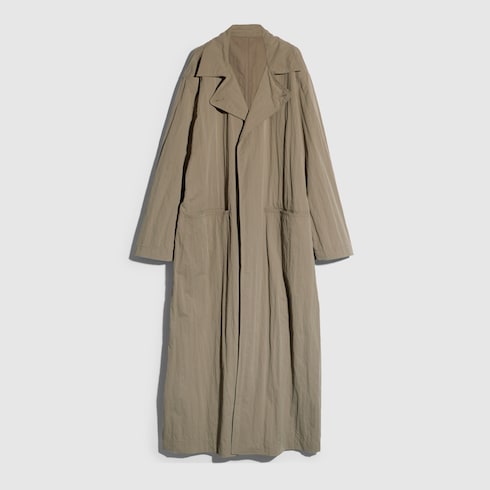
De Sarno's first collection for Gucci, shown in September 2023 during Milan Fashion Week, was a studied rejection of Michele's aesthetic. Out went the embroidery, the clashing prints, the archival pastiches. In came clean lines, saturated colour, and a kind of sensual minimalism that felt, depending on your view, either refreshing or safe. Leather trousers in oxblood. Silk blouses with exaggerated cuffs. Coats in camel, navy, rust. The palette was warm but not loud. The silhouettes flattered without fuss.
The reviews were mixed. Some praised the return to wearability. Others found it anonymous. The New York Times called it "a reset," which is the sort of phrase that can mean anything. What was clear, though, was that De Sarno had no interest in replicating Michele's theatrics. He was after something quieter, more tactile, more rooted in the material itself.
Signature: Colour, Drape, and the Return to Craft
If De Sarno has a signature, it is not a motif or a silhouette but an approach. He is preoccupied with colour — not as decoration but as structure. His second collection, for spring/summer 2024, opened with a series of fluid jersey dresses in shades of apricot, terracotta, and deep plum. The tones were saturated but soft, the kind that shift under different light. He has spoken, in press notes, about wanting clothes that feel "lived-in," a phrase that risks sounding like marketing but, on the runway, translated into fabrics with weight and drape. Silk that moved. Leather that creased.
There is also a renewed attention to Gucci's leather goods, which account for the bulk of the house's revenue. De Sarno has introduced new bag shapes — the Ancora, a top-handle style with a double-ring detail, and the Blondie, a shoulder bag with an interlocking GG clasp — that feel less like statements and more like tools. Functional. Considered. The sort of thing you might carry for a decade without thinking too hard about it.
This is not to say the work is conservative. De Sarno's third collection, for autumn/winter 2024, included shearling-lined leather jackets in electric blue and trousers cut so wide they bordered on architectural. But the provocation, such as it is, comes from proportion and colour rather than from narrative or reference. He is not telling you a story. He is offering you a garment.
The Question of Legacy
It is too early to say whether De Sarno's Gucci will endure. The house's sales have not yet rebounded to Michele-era heights, though Kering has expressed confidence in the "long-term vision." The market, as ever, is impatient. But there is something to be said for a designer who resists the pressure to announce himself in the first season. De Sarno's work at Gucci feels, so far, like a long game — one that privileges craft over concept, evolution over revolution.
In a recent interview with Vogue Italia, he said that he wanted to make clothes "for real life." It is the kind of statement that can sound banal, but watch him in that fitting room on Via delle Caldaie, adjusting the drape of a sleeve for the third time, and the phrase takes on a different weight. Real life, in his vocabulary, is not casual or careless. It is specific. It is intentional. It is the difference between a shoulder seam that sits a quarter-inch too far forward and one that doesn't.
Whether that level of attention will translate into the kind of cultural heat that Michele generated remains to be seen. But it is, arguably, a more sustainable model. Fashion that doesn't need to shout. Fashion that trusts you to notice the details. Fashion that, in the end, is content to be worn.
The fitting continues. De Sarno steps back again, considers the line, adjusts the silk one more time. Outside, Florence hums along, indifferent. Inside, the work goes on.