The fitting room on Via Montenapoleone is smaller than you'd expect
The fitting room on Via Montenapoleone is smaller than you'd expect. A single mirror, a velvet bench worn smooth at the edges, and three photographs pinned to the wall with brass tacks. Not models. Not campaign images. Three women, each caught mid-gesture: a hand adjusting a scarf, a glance over one shoulder, a cigarette held at an angle that suggests the conversation has just turned serious.
These are not Gucci's founders. They did not sketch or cut or stitch. But they shaped the house as surely as any creative director, and their influence — quiet, cumulative, resistant to summary — remains legible in the archive and on the runway.
Grace Kelly: The Accident That Became Architecture
The story, as it has been told in trade journals and repeated at dinner parties, goes like this: Grace Kelly, newly married and photographed incessantly, used a Gucci bag to shield her early pregnancy from the cameras in 1956. The image circulated. The bag sold. Gucci named it after her.
That version is tidy. It is also incomplete.
Kelly had been carrying Gucci since the early fifties, well before Monaco, well before the paparazzi made her condition a matter of international speculation. She favoured structured top-handles in dark leather, pieces that read as discreet in person but graphic in photographs. The Flora scarf, designed for her by Rodolfo Gucci and Vittorio Accornero in 1966, was not a celebrity vanity project. It was a response to a client who had requested something specific: botanically accurate, jewel-toned, large enough to knot decisively at the throat.
What Kelly brought to Gucci was not glamour — the house had that in surplus — but a kind of seriousness. She wore the bags as tools, not trophies. In photographs from the sixties, you can see her holding a bamboo-handle style by its frame, not dangling it from her wrist. The gesture is small, but it matters. It suggests use rather than display, and it aligned Gucci with a particular vision of postwar femininity: capable, composed, unwilling to apologise for taking up space.
The Kelly bag — officially the 0633 — remains in production. It has been reissued, scaled, reinterpreted in python and crocodile and canvas. But the original proportions, that slightly severe rectangular profile, still carry the logic of a woman who needed her hands free.
Jackie Kennedy Onassis: The Patron Who Refused to Perform
If Kelly was discreet, Jackie Kennedy Onassis was deliberate. She began wearing Gucci in the early seventies, after the assassination, after the second marriage, after the years when her wardrobe was parsed as a form of national communication. By then, she had stopped performing. What remained was taste.
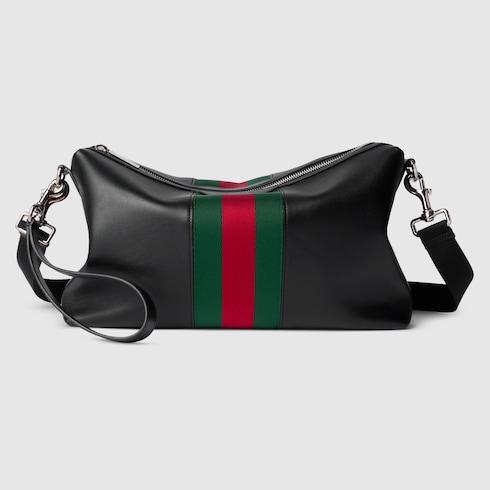
The hobo bag she carried — soft, slouchy, fitted with a single shoulder strap and a piston closure — was not designed for her. It was a men's style, introduced in the sixties and largely ignored by the American market. Kennedy Onassis bought it in cognac and in black. She carried it to lunch, to the office at Doubleday, to the theatre. Paparazzi photographs from the period show her with the bag slung across her body, hands in her coat pockets, moving through Manhattan as though the cameras were not there.
Gucci renamed the style the Jackie in 1999, two years after her death. By then, the house had been through bankruptcy, a family rupture, and a series of creative directors who treated the archive as raw material rather than gospel. Tom Ford, in his final years at Gucci, reintroduced the hobo in pebbled leather and suede, and the bag became — briefly, bafflingly — a fixture of late-nineties minimalism.
What Kennedy Onassis gave Gucci was permission to be worn rather than worshipped. The hobo was not precious. It creased. It softened. It looked better after a year of use than it did in the boutique. That quality — the sense that an object might improve with age, that patina was preferable to shine — ran counter to the house's gilded heritage. But it also opened a line of inquiry that later designers, particularly Sabato De Sarno, have pursued: what does Gucci look like when it stops trying to impress you?
Charlotte Casiraghi: The Muse Who Declines the Term
Charlotte Casiraghi has been a Gucci ambassador since 2021. She is also Grace Kelly's granddaughter, a philosopher by training, a competitive equestrian, and the founder of Les Rencontres Philosophiques de Monaco. She does not, as a rule, give fashion interviews.
What she has given Gucci is a vocabulary. In campaigns and at events, she wears the house's tailoring — wide-leg trousers, double-breasted blazers, shirts with exaggerated collars — as though it were not costume but grammar. The clothes do not announce themselves. They structure the body, and then they recede.
This is a different proposition than what Kelly or Kennedy Onassis offered. Casiraghi is not using Gucci to move through the world unnoticed. She is using it to think. In photographs from the 2023 Cruise presentation, she is seated in a library, legs crossed, a tweed jacket unbuttoned, reading. The staging is almost comically literal. But it works, because the clothes do not compete with the activity. They make it possible.
Sabato De Sarno, who took over as creative director in 2023, has spoken — guardedly, in the trade press — about a return to "natural elegance." The phrase is vague enough to mean nothing, but Casiraghi's presence in the campaigns suggests a direction. Gucci, under De Sarno, is interested in women who have something to do besides be looked at.
What Remains
The three photographs in the Via Montenapoleone fitting room are not there by accident. They are a reminder, or perhaps a provocation: that a house is shaped as much by who wears it as by who makes it. Kelly, Kennedy Onassis, and Casiraghi did not design for Gucci. They did not sit at the atelier bench or approve the season's samples. But they made choices — about proportion, about material, about how a bag should sit against the body — and those choices entered the archive.
Whether that constitutes influence or simply coincidence is, on balance, a question of how one reads history. But the bags remain. And they still look like they have work to do.