## The Five Sisters and the Furrier's Daughter
The Five Sisters and the Furrier's Daughter
A fitting room on Via del Plebiscito, 1946. Adele Casagrande stands at the cutting table, adjusting the fall of a mink collar. Her daughters — Paola, Anna, Franca, Carla, Alda — range in age from eight to seventeen. The eldest is already learning to hand-stitch hems. The youngest watches from a stool, legs swinging. Adele's husband, Edoardo Fendi, manages the books and the clients. The shop, which bears his name, occupies a single room. Furs arrive from Scandinavia and Russia. Adele cuts them herself, working against the nap, a technique she learned from her own mother. There is no atelier yet, only a workshop behind a curtain.
This is not the story one expects when the name Fendi comes up now. The double-F logo, the Baguette, the ready-to-wear shown in vast Roman ruins — these are the visible facts. But the house began as a repair shop for fur coats, run by a woman who married into the trade and five daughters who had no choice but to learn it.
The Inheritance
Adele Casagrande opened her first leather and fur workshop in 1918, on Via del Plebiscito, near the Trevi Fountain. She married Edoardo Fendi in 1925. He was a salesman, good with people, less interested in the technical side. When the shop was renamed Fendi in 1925, it was a practical decision — his surname carried more weight with the Roman bourgeoisie. Adele continued to do the work.
By the time her daughters came of age, the business had expanded into a small atelier. Paola, the eldest, took over design direction in the early 1950s. Anna managed production. Franca handled buying. Carla oversaw customer relations. Alda, the youngest, worked in administration. This division of labour was not sentimental. It was structural. The sisters inherited a functioning business and understood that its survival depended on all five of them staying in harness.
What they did not inherit was a clear sense of where fur belonged in the postwar wardrobe. Mink and sable were still evening materials, heavy and formal. Fendi's clients were Roman women who wanted something lighter, more versatile. The sisters began experimenting — piecing together scraps, dyeing pelts in unconventional colours, treating fur as fabric rather than as trophy. A 1955 coat in pale grey squirrel, cut like a car coat, sold well enough to fund a second workshop. By 1960, Fendi was no longer a repair shop. It was a small maison with a problem: the sisters knew how to make fur modern, but they did not know how to make it fashion.
The Collaborator
Karl Lagerfeld arrived in 1965. He was twenty-one, recently fired from Patou, and looking for freelance work. Paola Fendi met him through a mutual contact in Paris. The brief was simple: make fur feel young. Lagerfeld's first collection for Fendi included a reversible mink jacket, a shearling vest dyed electric blue, and a coat made from strips of fox and rabbit pieced together like a quilt. The techniques were not new — Adele had been piecing scraps for decades — but the proportions were. Lagerfeld cut fur like jersey, close to the body, without the usual bulk. He treated it as a material rather than a status object.
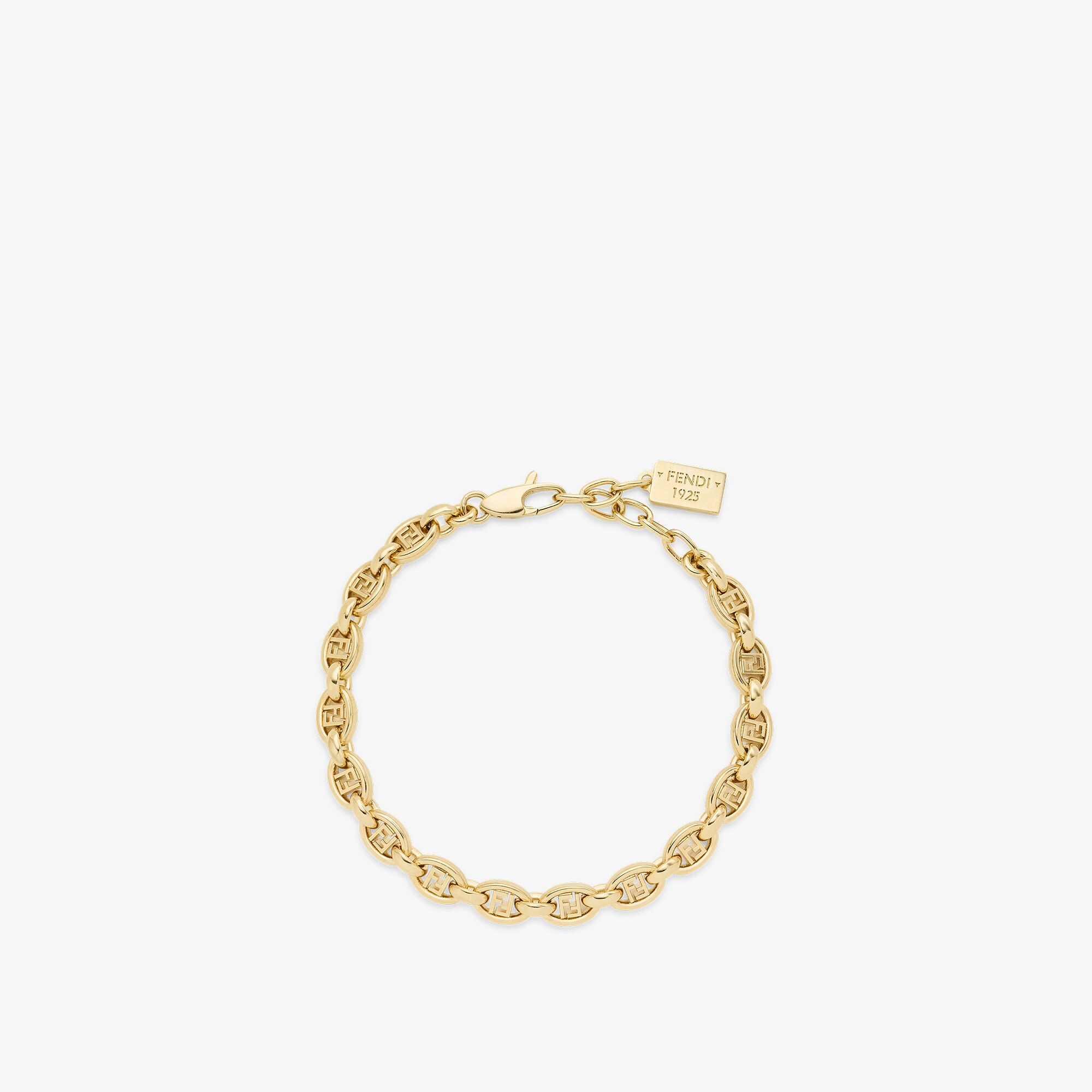
The collaboration lasted fifty-four years. Lagerfeld never took a permanent position. He worked on contract, showing up in Rome four times a year, sketching in the atelier, then returning to Paris. This distance was productive. He brought ideas from ready-to-wear — sporty shapes, graphic prints, a faster pace — and the sisters translated them into fur. The double-F logo, designed by Lagerfeld in 1965, was originally an interior label. It became an exterior signature in the 1970s, stamped onto buckles and stitched into linings. By then, Fendi had moved beyond fur into leather, handbags, and ready-to-wear.
The question of authorship is unresolved. Lagerfeld sketched, but the sisters decided what got made. He proposed, they edited. When Fendi began showing in Paris in the 1980s, Lagerfeld's name appeared on the programme, but the business was still run from Rome, still owned by the five sisters. The arrangement worked because neither side wanted full control. Lagerfeld had other houses to dress. The sisters had a family business to protect.
The Object
The Baguette arrived in 1997, designed by Silvia Venturini Fendi, daughter of Anna. It was named for the way it tucked under the arm, like a loaf of bread. The shape was simple — a small rectangular bag with a short strap and a metal clasp. What made it successful was the variety. Fendi produced the Baguette in hundreds of materials: beaded, sequinned, embroidered, fur-trimmed, printed, plain. A customer could buy one in crocodile or canvas, depending on budget. The bag appeared on Sex and the City in a 2000 episode. Demand spiked. Fendi produced 100,000 Baguettes that year, then 200,000 the next.
The Baguette's success was also its problem. It became so widely copied that the original lost its cachet. By 2005, the bag had largely disappeared from Fendi's advertising. The house moved on to other shapes — the Peekaboo, the Kan I — but none carried the same cultural weight. The Baguette was reissued in 2019, marketed as an archive piece. It sold well, particularly in Asia, but the context had shifted. What was once a status object had become a reference, something to quote rather than to own.
What Remains
Silvia Venturini Fendi is the last family member working at the house. She oversees accessories and menswear. Her aunt Carla, the last surviving sister, died in 2017. The business was sold to Prada in 1999, then to LVMH in 2001. Lagerfeld continued as creative director until his death in 2019. Kim Jones took over menswear and couture. Silvia stayed on, a quiet continuity in a house that has changed ownership twice and lost most of its founding generation.
The atelier is still in Rome, though the corporate offices are in Paris. Fendi still makes fur, though it announced in 2021 that it would stop using animal fur by 2023, shifting to synthetic alternatives. The double-F logo remains. The Baguette remains. The techniques Adele Casagrande developed — piecing, dyeing, treating fur as fabric — remain, now applied to shearling and faux materials.
What does not remain is the structure that made Fendi unusual: five sisters, equal partners, running a house without a single auteur. That model worked for fifty years, but it required a specific set of circumstances — a family business, a shared inheritance, a willingness to cede creative direction to an outsider while retaining financial control. When LVMH took over, the structure dissolved. Fendi became a brand like any other, with a creative director, a CEO, and a board.
One can argue that this was inevitable. The fashion system does not accommodate collectives. It wants names, faces, singular visions. But walking through the Rome atelier now, past the cutting tables and the racks of shearling, it is difficult not to notice what has been lost. The house began with a mother and five daughters, working in a single room, solving problems with their hands. What remains is the logo, the technique, and a question: whether a family business can survive its family.