The Hands Behind Acne Studios's Pink Scarf
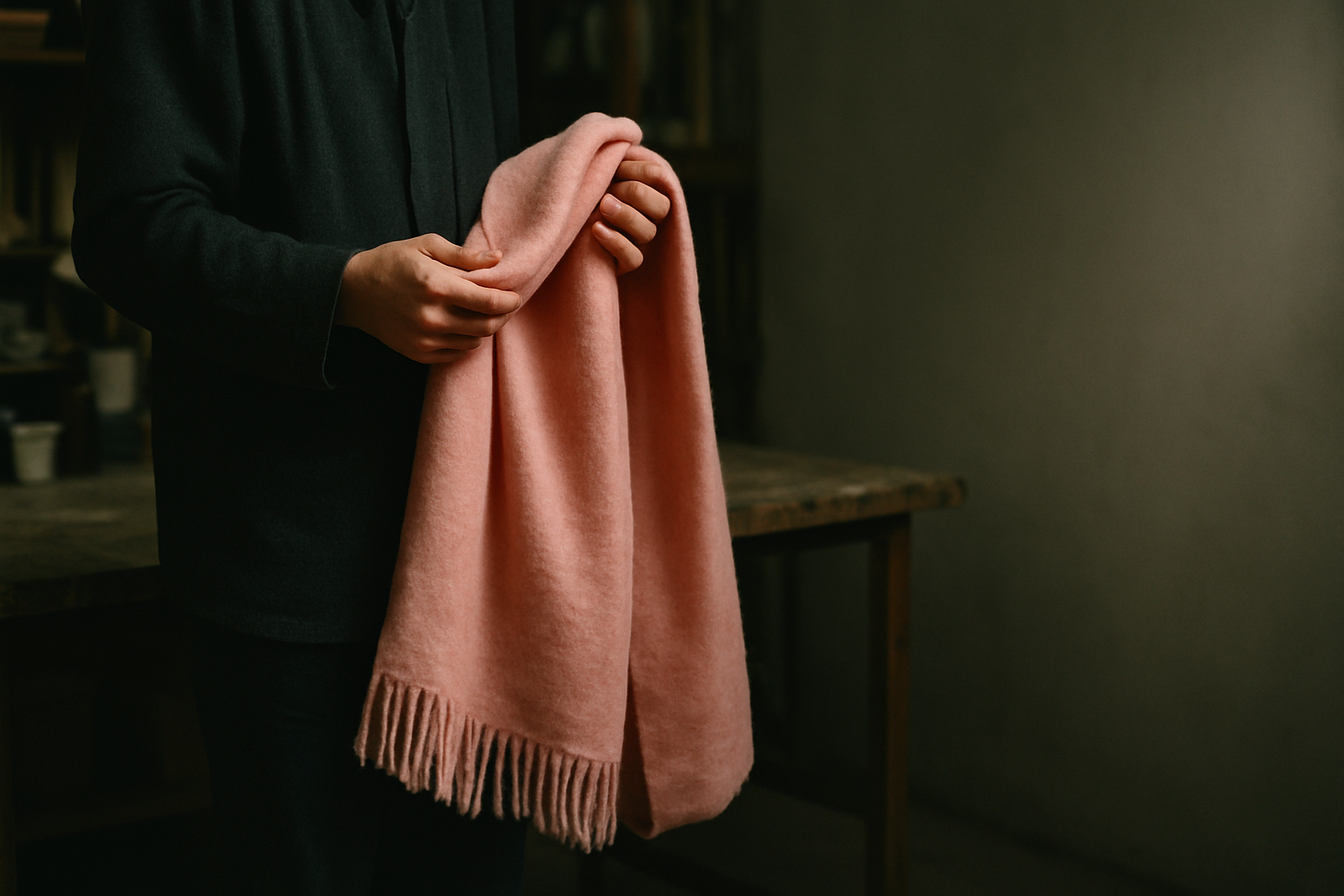
Jonny Johansson stands in the Stockholm atelier on a Tuesday in February, holding a length of wool that has been dyed, washed, and re-dyed until the pink sits somewhere between salmon and coral. He is not alone. To his left is Emma Svensson, head of knitwear development, who has been with Acne Studios for eleven years. To his right is pattern cutter Maja Bergström, who joined in 2017 after training at Beckmans College of Design. Between them, they are responsible for the scarf that has appeared on approximately forty per cent of the brand's campaign imagery since 2019.
The scarf itself is unremarkable in construction. Single-ply merino, brushed on one side, fringed at both ends. No logo. The signature is the colour, which Svensson describes in an interview with Vogue Scandinavia as "the pink you remember from childhood but can't quite place." It took seven months to arrive at that shade. The first batch came back too peachy. The second leaned mauve. The third was right, but the hand felt wrong after washing. Svensson sent it back.
This is not a story about a visionary designer working alone in a garret. It is a story about three people in a room, disagreeing about pink.
Training Ground
Svensson trained as a textile engineer at the Swedish School of Textiles in Borås, where the curriculum still includes a module on industrial looms from the 1970s. She spent her final year on exchange in Japan, working with a small mill in Niigata that produced cashmere for Hermès and Loro Piana. The owner, an elderly man named Takashi Mori, taught her that good knitwear begins with fibre selection, not design. Svensson returned to Sweden in 2012 and applied to Acne Studios because, as she told Elle Sweden in 2021, "they were the only brand in Stockholm that seemed to care about cloth as much as cut."
Bergström's route was less linear. She studied pattern cutting at Beckmans, dropped out after two years to work at a denim factory in Portugal, returned to finish her degree, and spent eighteen months freelancing for COS before Johansson hired her. Her first project at Acne Studios was a men's overcoat that required fourteen fittings. The coat never went into production. Johansson told her it was too safe. Bergström kept the toile in her flat as a reminder.
Johansson himself is the constant. He founded Acne Studios in 1996 as a creative collective, making raw denim and screen-printed T-shirts. The brand's early years are well documented: the red stitching on the back pocket, the unfinished hems, the refusal to show at Fashion Week until 2005. What is less often mentioned is that Johansson has always worked with a small, stable team. Svensson is one of six department heads who have been with the brand for more than a decade. Bergström is part of a younger cohort, but turnover remains low. People stay.
The Breakthrough
The pink scarf was not meant to be a signature piece. It appeared first in the Autumn/Winter 2019 collection as an accessory styled with an oversized grey blazer. Johansson had asked Svensson to develop something soft, warm, and "not beige." Svensson proposed pink. Johansson was sceptical. Pink, he felt, carried too much baggage—Schiaparelli, Valentino, the Barbie industrial complex. Svensson argued that the right pink could feel neutral. Bergström stayed out of it.
The first samples were dyed in-house using a base of madder root and cochineal, which gave the wool an earthy undertone. Johansson liked the colour but wanted it brighter. Svensson switched to synthetic dye, which allowed for more control. The challenge was achieving consistency across batches. Wool takes dye differently depending on the season the sheep was shorn, the pH of the water, the temperature of the vat. Svensson worked with a mill in Biella that specialises in small-batch dyeing, running tests until they found a formula that held across three production runs.
The scarf sold out within two weeks of the collection dropping. Acne Studios restocked it for Spring/Summer 2020, this time in a slightly lighter weight. It sold out again. By Autumn/Winter 2020, the pink scarf had become a fixture, appearing in every seasonal collection alongside new colourways that never performed as well. Johansson told Business of Fashion in 2021 that the scarf's success surprised him. "We didn't set out to make a hero product," he said. "We just wanted something that felt right."
Signature
What makes the scarf work is not the pink, though the pink helps. It is the weight. At 280 grams, the scarf is heavy enough to stay in place without a knot but light enough to drape without bulk. Svensson credits this to the yarn, a single-ply merino spun in Italy that has more loft than the two-ply yarns typically used for scarves. Bergström's contribution was the fringe, which she insisted should be cut by hand rather than knotted. Hand-cut fringe lies flatter and ages better. It also costs more. Johansson approved the extra expense.
The scarf has since appeared on Bella Hadid, Rosalía, and approximately two thousand fashion editors. Acne Studios does not pay for placements. The scarf circulates because it photographs well and works with almost everything. Svensson keeps a running list of items it has been styled with: leather trousers, denim jackets, slip dresses, tailored coats, hoodies. The list is now three pages long.
Bergström's role in the scarf's development was smaller but not insignificant. She cut the first pattern, adjusting the dimensions until the proportions felt balanced. The scarf measures 200cm by 70cm, which is wider and shorter than most scarves on the market. Bergström told Dagens Nyheter in 2022 that the dimensions were chosen to allow for multiple styling options. "You can wear it as a shawl, a neck scarf, or a blanket scarf," she said. "The width gives you flexibility."
What Comes Next
Svensson is currently working on a heavier version of the scarf for next winter, using a two-ply cashmere blend that will retail at nearly double the price of the merino original. Johansson is undecided. He worries that a luxury version will dilute the original's appeal. Svensson argues that customers who want cashmere will buy cashmere regardless. Bergström is staying out of it.
The pink scarf will remain in production for the foreseeable future. Acne Studios has no plans to retire it, though Johansson has floated the idea of limiting it to seasonal drops rather than keeping it in continuous stock. Svensson is opposed. "If people want it, we should make it available," she told Financial Times in 2023. Bergström agrees.
In the Stockholm atelier, the conversation about pink continues. Svensson has proposed a new shade for Spring/Summer 2025, something closer to rose than coral. Johansson is sceptical. Bergström is cutting a new sample. The scarf, for now, remains pink.