## The house that Gianni built
The house that Gianni built
Reggio di Calabria, 1972. A twenty-six-year-old dressmaker drapes jersey across a client's shoulder, pins it at the clavicle, and watches the fabric settle into something between a chiton and a second skin. Gianni Versace is not yet Versace. He has no atelier, no logo, no Via Gesù flagship. What he has is a mother who ran a dressmaking workshop, a brother who understands numbers, and a sister who can sketch faster than he can think. He also has an instinct for what happens when you treat the body not as a mannequin but as architecture in motion.
By 1978, he had a name on a label. By 1982, the house employed over two hundred people. By 1997, he was dead on the steps of his Miami villa, shot by a stranger, and the question of what Versace was — or could be — passed to his sister Donatella, who had spent two decades at his side and never wanted the job.
This is not a story about one designer. It is a story about three siblings who built a house, lost its centre, and then had to decide what a name means when the person who gave it weight is gone.
Atelier education, Calabrian method
Gianni Versace did not attend a fashion school. His training came from his mother, Francesca, who ran a small atelier in Reggio di Calabria and took commissions for local women who wanted dresses that fit. He learned to cut on the body, not on paper. He learned that a dart placed two centimetres too high would ruin a silhouette. He learned, as he later told The New York Times in 1990, that "dressmaking is a conversation between fabric and form."
His younger sister, Donatella, eleven years his junior, grew up in the same workroom. She did not sew. She watched, critiqued, and developed what Gianni called "the eye." His younger brother, Santo, studied economics in Messina and became the house's financial spine. When Gianni moved to Milan in the early 1970s to freelance for Genny, Callaghan, and Complice, Santo followed. Donatella came later, in her twenties, and took a role that had no title: muse, sounding board, enforcer of her brother's vision.
The division of labour was clear. Gianni designed. Santo ran the business. Donatella told Gianni when something was wrong.
The breakthrough, and the body as monument
Versace's first solo collection debuted in 1978 at the Palazzo della Permanente in Milan. The press noted the colour — fuchsia, cobalt, acid yellow — and the metalwork, a technique borrowed from his mother's habit of embellishing with studs and grommets. But the real signature was in the fit. Versace cut for the female form as it moved, not as it posed. Dresses clung at the ribs, flared at the hip, and used bias-cut silk jersey in a way that made the fabric look molten.
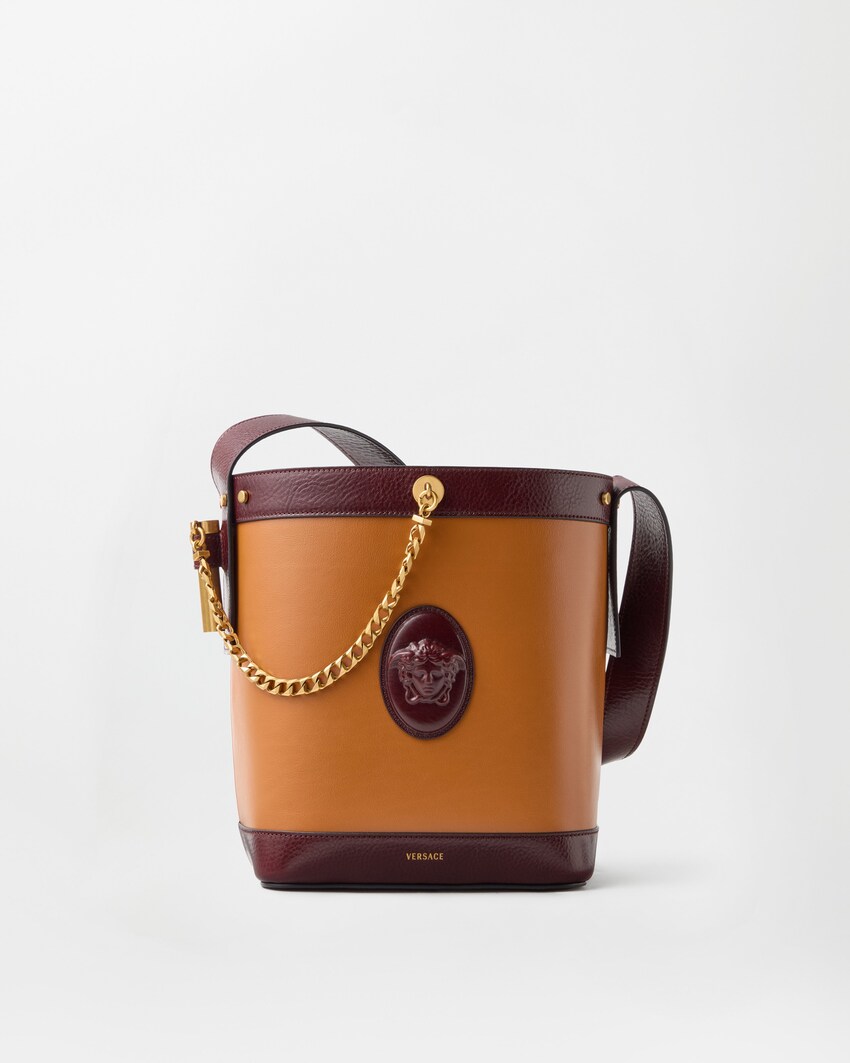
He also understood that fashion, in the 1980s, was becoming a spectacle. He cast supermodels when other designers still used anonymous house models. He soundtracked his shows. He courted celebrities — Elton John, Madonna, Princess Diana — and dressed them in clothes that photographed like armour. The Medusa logo, adopted in 1980, was not subtle. It was not meant to be. Versace wanted a symbol that said: this will turn you to stone, or into stone, depending on how you wear it.
By the early 1990s, the house was generating over $800 million annually. The safety-pin dress that Elizabeth Hurley wore to a film premiere in 1994 — black, held together with oversized gold pins — became one of the most reproduced images of the decade. It was also, in construction, a feat of engineering. The pins were not decorative. They were structural. Remove one, and the dress would not hold.
Donatella in the wings
Donatella Versace did not design collections while her brother was alive, but she ran the Versus diffusion line and art-directed the advertising. She was also the person Gianni called at two in the morning to ask if a hemline was right. In photographs from the 1980s and 1990s, she is often in the background of the atelier, blonde, thin, smoking, wearing black. She looked like a Versace client. She also looked like someone who had spent her entire adult life in the service of someone else's vision.
When Gianni was killed in July 1997, Donatella was forty-two. She had never led a design team. She had never taken a final bow. The first collection she presented, for Spring 1998, was met with polite reviews and private concern. The clothes were loud, the silhouettes familiar, the palette unchanged. Critics asked, not unkindly, whether Versace could survive as a pastiche of itself.
What followed was a decade of turbulence. Donatella hired and fired design directors. She struggled with addiction, a fact she later discussed in a 2007 Vogue interview. She also refused to sell the company, despite offers, because selling would mean admitting that the name was worth more than the work. Santo remained as CEO. The house stayed in the family.
The sale, and what it bought
In 2018, Michael Kors Holdings — later renamed Capri Holdings — acquired Versace for $2.1 billion. Donatella stayed on as creative director. Santo stepped down. The deal was presented as a partnership, but the reality was straightforward: Versace, after four decades, was no longer a family business.
The collections since the acquisition have leaned into logomania, athleisure, and collaborations with brands like Fendi (the 2021 "Fendace" swap, a marketing event disguised as creative communion). The tailoring remains sharp. The metalwork is still there. But the house now operates within a conglomerate structure, and conglomerates have growth targets.
Donatella, now in her late sixties, has become something her brother never was: a celebrity designer. She appears in campaigns, on talk shows, at the Met Gala. She is, in a sense, the product. Whether that represents a betrayal of Gianni's vision or an evolution of it depends on whether you believe a house can survive by staying still.
What remains
Walk into the Versace flagship on Via Montenapoleone today and you will find silk shirts printed with Barocco motifs, leather jackets with Medusa hardware, and evening gowns that still cling like they were cut on the body. The atelier in Novara continues to produce haute couture by hand, though the line is small and the clients are fewer. The safety-pin dress is in the Victoria and Albert Museum.
What is harder to locate is the original instinct — the one Gianni learned in his mother's workshop, where a dress was a conversation, not a statement. Versace was never a quiet house. But it was, once, a house that believed in the intelligence of construction, in the idea that a seam placed correctly could make a woman feel like a monument.
Donatella has kept the name alive. Whether she has kept the vision intact is a question the market has answered with $2.1 billion and a logo on a thousand sweatshirts. Gianni, one suspects, would have opinions. But Gianni is not here. What remains is a house built by three people, run by one, and owned by a holding company in New York. The Medusa still stares. What it sees now is anyone's guess.