The photograph is black and white, shot in 1912
The photograph is black and white, shot in 1912. A young woman stands beside a biplane, wrapped in a belted coat that falls to mid-calf. The fabric is gabardine — a cloth Thomas Burberry had patented sixteen years earlier, tightly woven to shed rain without the weight of rubber or oilskin. The woman is Betty Kirby-Green, aviator, and she is about to fly across the Irish Sea. The coat will keep her dry.
This is how Burberry has always worked. Not by chasing women, but by clothing them when they were doing something difficult.
Betty Kirby-Green and the functional coat
Kirby-Green was twenty-three when she made that flight. She had learned to fly two years earlier, one of fewer than a dozen licensed female pilots in Britain. The coat she wore was not designed for her specifically — Burberry had been supplying aviators, explorers, and military officers since the 1890s. But the image of a woman in flight gear, belted tight against the wind, became one of the house's earliest advertisements.
The gabardine trench, as it evolved through the First World War, was a garment built for men in muddy trenches. Epaulettes held rank insignia. D-rings secured equipment. The storm flap kept rain out of the chest. But women adopted it anyway, and Burberry, to its credit, did not resist. By the 1920s, the house was cutting versions with a higher armhole and a narrower shoulder. The function remained. The silhouette shifted.
Kirby-Green's contribution was not aesthetic. It was proof that a serious coat could move with a woman doing serious work. Burberry has spent the past century forgetting and remembering that lesson in turns.
Julie Christie and the coat as civilian uniform
By 1966, the trench had become so common that it had nearly disappeared. Police detectives wore it. Journalists wore it. Commuters wore it on the District line. It was everywhere, which meant it was nowhere.
Then Julie Christie wore one in a film, and it became something else.
The film was Fahrenheit 451, Truffaut's adaptation of Bradbury. Christie played two roles: a sedated housewife and a fugitive schoolteacher. In the latter role, she wore a honey-coloured trench over a black turtleneck, belted loose, collar turned up. She looked like someone who had left in a hurry and had not looked back.
Burberry did not dress the film. The coat was likely a stock piece, pulled by the costume department. But the image stuck. Christie, who had won an Oscar the year before for Darling, was the kind of actress who made a trench look like a choice rather than a default. She wore it the way Bogart had twenty years earlier — as though she had earned it.
The house took note. By the early 1970s, Burberry's advertising began to shift. Less emphasis on explorers and officers, more on women in cities. The trench was still waterproof, still made from gabardine, still cut with military details. But it was now sold as the coat you wore when you were moving through the world alone.
Christie never became an official face of Burberry. She did not need to. The association was already there, lodged in the space between aspiration and practicality. A trench was not glamorous. But it was reliable, and in 1966, that was starting to mean something again.
Kate Moss and the house as heritage, revisited
When Christopher Bailey cast Kate Moss in Burberry's spring 2001 campaign, the house was in trouble. The check had been licensed into oblivion. Counterfeit versions lined market stalls from Manchester to Manila. The brand had become shorthand for a particular kind of British chav aesthetic — football terraces, nightclub queues, bad behaviour in seaside towns.
Moss, at twenty-six, was both part of that world and entirely above it. She had grown up in Croydon, left school at sixteen, and spent the 1990s as the face of heroin chic. She was also the most photographed woman in Britain, and she knew how to wear a trench without trying.
Bailey's first campaigns with Moss were shot by Mario Testino, outdoors, often in rain. She wore the trench open, over jeans and a T-shirt, or belted tight with nothing underneath. The styling was deliberate: Burberry was not asking you to dress like an aviator or a detective. It was asking you to dress like Moss, which meant dressing like yourself, but sharper.
The campaign worked because Moss understood the coat's tension. It was posh and common at once. It had history, but it was not precious. You could wear it to a premiere or to buy cigarettes at the corner shop, and it would look right in both places.
Bailey spent the next sixteen years rebuilding Burberry around that idea. He brought back the gabardine, recut the shoulder, and tightened the silhouette. He hired Naomi Campbell, Cara Delevingne, and Jourdan Dunn. But Moss remained the template: a woman who wore the house as though she had found it in her mother's wardrobe and decided it was better than anything new.
She left the campaigns in 2014. By then, the work was done. Burberry was no longer a brand trying to remember what it had been. It was a house that knew.
What remains
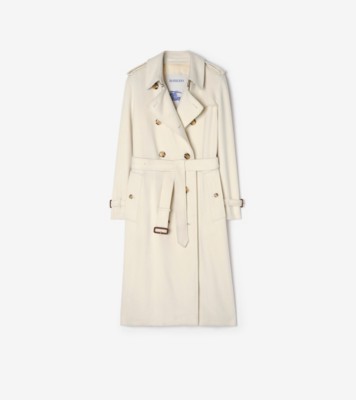
The trench Burberry makes now is not the same coat Betty Kirby-Green wore in 1912. The gabardine is lighter. The lining is removable. The fit has been adjusted a dozen times, each tweak responding to a different decade's idea of how a woman's shoulder should sit.
But the principle has not changed. A Burberry trench is still a coat built for weather, worn by women who do not wait for conditions to improve. It is not a statement piece. It is the thing you reach for when you have somewhere to be and no time to think about what that requires.
The house has had other muses — actors, models, musicians. Some of them wore the trench better than others. But Kirby-Green, Christie, and Moss were not muses in the traditional sense. They were not selling aspiration. They were proving utility. The coat worked because they wore it while doing something else.
That is the part Burberry keeps getting right, when it remembers to.