The photograph is black and white, shot in 1961, and shows a woman in a trench coat standing beside a Jaguar E-Type
The photograph is black and white, shot in 1961, and shows a woman in a trench coat standing beside a Jaguar E-Type. Her name was Jean Shrimpton. She was twenty, already bored of posing, and the coat she wore would become more famous than the car. Burberry didn't invent the muse—every house has had women who carried the work beyond the atelier—but three in particular shaped what the brand means now, long after the gabardine dried and the campaigns wrapped.
Jean Shrimpton and the Trench That Moved
Shrimpton didn't set out to be a symbol. She wanted to model, get paid, and leave. But David Bailey kept shooting her, and Burberry kept dressing her, and by the mid-sixties the trench coat had migrated from military surplus to the thing you wore when you wanted to look like you had somewhere to be.
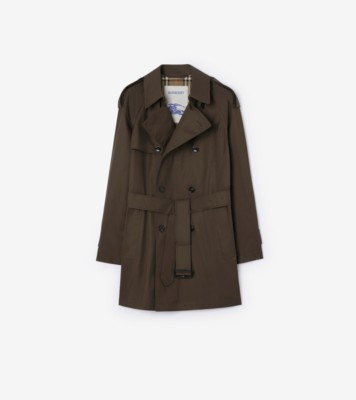
The coat itself hadn't changed much since Thomas Burberry patented gabardine in 1879. It was still double-breasted, still belted, still beige. What Shrimpton did—what Bailey's lens amplified—was strip it of its officer-class formality. She wore it open, sleeves pushed up, over jeans or nothing much at all. The trench became shorthand for a kind of unbothered chic that didn't require effort, or at least pretended not to.
Burberry leaned into it. The brand ran campaigns through the sixties and seventies that placed the coat in motion: on women stepping out of cars, crossing streets, walking away from the camera. Shrimpton's insouciance became the template. She was never trying to sell you anything. That was the point.
By the time she stopped modelling in the early seventies, the trench had calcified into archetype. You bought one because your mother had one, or because you'd seen it in a film, or because it was the only coat that worked equally well over a suit or a T-shirt. Shrimpton moved on—she opened a hotel in Cornwall, avoided interviews, declined to mythologise her own image. The coat stayed.
Kate Moss and the Reinvention Nobody Asked For
When Kate Moss walked into Burberry's spring 2001 campaign, the brand was in trouble. It had been knocked off so many times that the check had become a punchline, synonymous with counterfeit markets and football hooligans. The trench still sold, but it no longer signified anything beyond itself.
Moss didn't fix that—creative director Christopher Bailey did, by paring back the logo and focusing on the gabardine—but she gave the reset a face. More accurately, she gave it a body. Moss in a Burberry trench looked like she'd slept in it, woken up in someone else's flat, and walked out without checking a mirror. It was the opposite of Shrimpton's composed elegance, and it worked because by 2001 nobody wanted to look composed.
Bailey shot her over and over: in the trench, in the check, in barely anything. The campaigns ran for years. Moss became so associated with Burberry that when she left in the mid-2000s, the brand's sales dipped. Not catastrophically—this wasn't Chanel losing Coco—but enough to notice.
What Moss understood, and what Burberry capitalised on, was that the trench had stopped being aspirational. It was now a garment you wore because it implied a certain disregard for fashion itself. You didn't care enough to overthink it. You had other things to do. Moss embodied that better than anyone, mostly because she actually did have other things to do and showed up to shoots looking like it.
She's still in the Burberry orbit—she appeared in a 2022 campaign, older now, still unbothered—but her real work was done by 2005. She made the trench cool again by making it look like she didn't care whether it was cool or not.
Naomi Campbell and the Burberry That Wasn't British Anymore
Naomi Campbell wore Burberry before Burberry knew what to do with her. She showed up in the check in the early nineties, back when the brand was still trying to sell itself as heritage rather than fashion. Campbell didn't care about heritage. She cared about whether the coat photographed well, and it did, so she kept wearing it.
By the time Riccardo Tisci took over as creative director in 2018, Burberry had spent a decade trying to be younger, edgier, more global—code for 'not so British'. Tisci cast Campbell in his debut campaign, shot by Nick Knight, and the message was clear: this is no longer your mother's trench. Campbell wore the new logo—a serif monogram that replaced the equestrian knight—and looked directly at the camera with the expression of someone who had been famous for thirty years and was not interested in explaining herself.
The campaign split opinion. Some critics called it a betrayal of Burberry's identity. Others argued the brand had no choice—heritage doesn't pay the rent when LVMH and Kering are swallowing everything else. Campbell didn't weigh in. She posted the images on Instagram, collected her fee, and moved on.
What she represented, though, was a shift Burberry had been circling for years. The trench was no longer a British garment worn by British women in British weather. It was a global signifier, worn by women who moved between cities and didn't owe allegiance to any of them. Campbell—Jamaican-British, raised in Streatham, based nowhere in particular—embodied that fluidity better than anyone Tisci could have cast.
She didn't redefine Burberry the way Shrimpton or Moss did. She confirmed what the brand had already become: a house that traded on Britishness without requiring you to be British, or even to care.
What's Left
Burberry rotates through muses now the way most houses rotate through creative directors. Cara Delevingne, Lily James, Zhang Ziyi, Shygirl—each gets a campaign, each wears the trench, each moves on. None of them carry the weight Shrimpton, Moss, or Campbell did, mostly because the brand doesn't need them to. The trench sells itself.
But something was lost in that transition. Shrimpton made the coat modern. Moss made it cool. Campbell made it borderless. The women who wear it now are famous, accomplished, well-dressed—and utterly interchangeable. You could swap any of them into any campaign and the trench would look the same.
Maybe that's the point. Burberry has spent 140 years making a coat that doesn't need a muse. It just took three extraordinary women to prove it.