## The Room on Floragatan
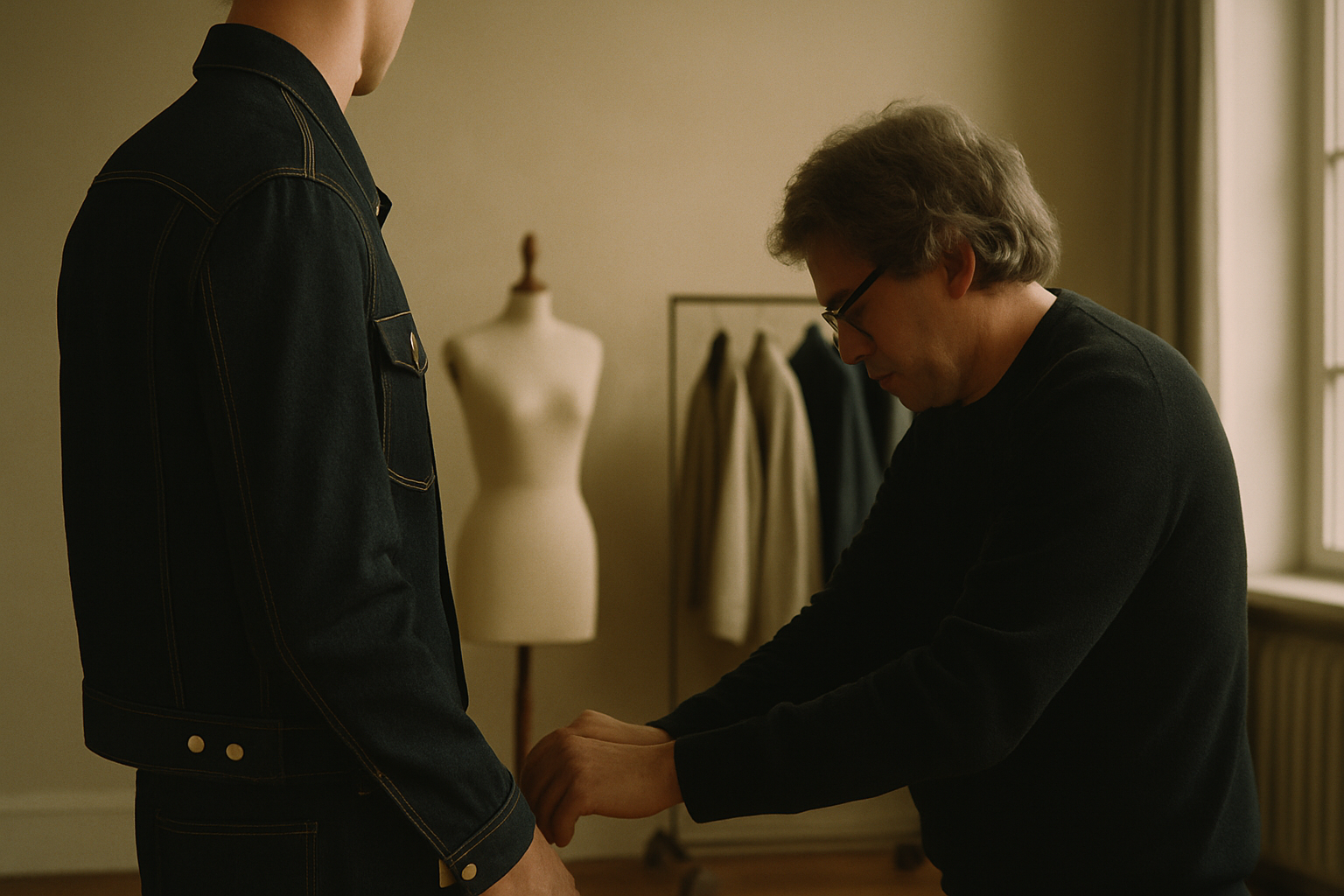
The Room on Floragatan
Jonny Johansson stands in a studio on Floragatan in central Stockholm, midway through a fitting. The model wears a raw-denim jacket with sleeves that land just past the wrist, a proportion Johansson has been adjusting for twenty-three years. The denim is rigid, unwashed, dark enough to stain. He tugs at the shoulder seam, steps back, says nothing for a moment. Then: "It should feel like you borrowed it, but it fits."
This is the contradiction Acne Studios has built itself around. The borrowed and the precise. The unfinished and the considered. A house that began as a creative collective in 1996 and became, by accident or design, one of the most influential European labels of the early twenty-first century.
The origin story is well-rehearsed but worth revisiting for what it reveals. Four friends — Johansson, Mikael Schiller, Tomas Skoging, and Jesper Kouthoofd — founded Acne as an acronym: Ambition to Create Novel Expressions. The name was meant to sound vaguely corporate, vaguely ironic. They worked in advertising, graphic design, and film production. Fashion was not the plan.
In 1997, they produced a hundred pairs of raw-denim jeans with red stitching down the outseam. The jeans were given to friends. The friends wore them. Other people noticed. A year later, Acne was selling denim across Scandinavia, and Johansson — who had studied at Stockholm's Konstfack but never trained formally in fashion — was designing full collections.
What set those early pieces apart was not innovation in the traditional sense. Acne did not invent a silhouette or pioneer a technique. Instead, it understood something about how young Europeans wanted to dress in the late nineties: with a certain intellectual remove, a studied carelessness, a refusal of obvious luxury. The jeans looked like workwear but fit like tailoring. The knitwear was oversized but never sloppy. The palette was muted — grey, black, navy, the occasional flash of millennial pink before it had a name.
By the mid-2000s, Acne had become a fixture at Paris Fashion Week. Johansson's approach was consistent: take a familiar garment — the bomber jacket, the trench coat, the Oxford shirt — and alter it just enough to make it strange. Lengthen the sleeves. Widen the lapels. Use a fabric that shouldn't work but does. The result was clothing that looked effortless but required a great deal of effort to produce.
The Scandinavian Paradox
There is a tendency, when discussing Acne, to lean on the word "Scandinavian" as if it explains everything. The minimalism, the restraint, the muted tones. But Johansson has always resisted that framing. In a 2014 interview with System, he said: "I don't think about being Swedish when I design. I think about what I want to wear."
Still, the geography matters. Stockholm in the late nineties was not a fashion capital. There were no established ateliers, no centuries-old tailoring houses, no infrastructure for luxury production. Acne had to build its supply chain from scratch, sourcing mills in Italy and Portugal, learning garment construction through trial and error. The result was a house unencumbered by tradition, free to borrow from streetwear, from tailoring, from sportswear, without concern for which category a piece belonged to.
This fluidity became Acne's signature. A wool overcoat with the proportions of a parka. A leather jacket with the structure of a blazer. Trousers that sat somewhere between chinos and sweatpants. The clothes refused to announce themselves. They required a second look.
The brand's aesthetic was codified in the early 2010s, when Acne opened its first flagship stores and launched a full accessories line. The interiors — designed in-house — were spare, almost clinical. Concrete floors, steel fixtures, blond wood. The bags and shoes followed the same logic: clean lines, minimal hardware, materials that aged well. A leather tote in grained calfskin. A Chelsea boot in polished black. Nothing that would date itself.
By 2015, Acne was generating annual revenue north of 150 million euros. Johansson remained the creative director, but the company had expanded far beyond the original four founders. Schiller had left in 2006. Kouthoofd departed in 2012. Skoging stayed on, overseeing brand development, but the vision was now Johansson's alone.
The Sale and What Followed
In 2015, Acne sold a majority stake to Investcorp, a Bahrain-based private equity firm, for an undisclosed sum. The deal was met with the usual concerns: Would the house lose its identity? Would Johansson stay? Would the clothes become more commercial?
The short answer is: some, yes, and somewhat. Johansson remained as creative director, and the collections continued to bear his imprint. But the pace changed. Acne opened more stores — over fifty by 2020 — and expanded its product range. There were sneakers, sunglasses, fragrances. The price points crept upward. A wool coat that once retailed for €800 now approached €1,200.
The clothes themselves became more polished, more obviously luxurious. The raw denim gave way to washed finishes. The oversized knitwear was joined by tailored blazers and pleated trousers. The palette expanded to include jewel tones and pastels. It was still recognisably Acne, but the edges had softened.
Some of this was inevitable. A brand cannot remain small and scrappy forever, not if it wants to survive. But the shift raised questions about what Acne was for, and whom it was speaking to. The early collections had felt like a conversation among friends. The newer work felt like a broadcast.
Johansson, for his part, has been pragmatic. In a 2019 interview with Vogue Business, he acknowledged the tension: "You have to grow, but you have to grow in the right way. I don't want to make clothes for everyone. I want to make clothes for the people who understand them."
What Remains
Today, Acne Studios operates as a mid-sized luxury house, somewhere between the scale of Lemaire and the reach of Acne's Swedish contemporary, Totême. The collections still show in Paris. Johansson still designs them. The aesthetic — that studied carelessness, that refusal of obvious luxury — remains intact, if somewhat diluted by commercial necessity.
The question is whether that aesthetic still matters. The fashion landscape has shifted. The oversized proportions and muted palettes that once felt subversive are now ubiquitous. Every contemporary brand offers a version of what Acne pioneered: the borrowed blazer, the elongated sleeve, the raw-denim jean with the red topstitch.
But return to the object itself. A wool coat from the Autumn/Winter 2023 collection, cut long and loose, with sleeves that extend past the wrist and a collar that stands just high enough to disrupt the silhouette. It is not a radical garment. It is not trying to be. What it is, on balance, is considered. The fabric — a double-faced wool from Biella — has weight and drape. The construction is clean, the seams pressed flat, the lining cut from viscose that slides over a shirt without catching. It is the work of a house that understands facture, even if it no longer needs to prove it.
Whether that is enough — whether craft and proportion can sustain a brand in an era that rewards spectacle over subtlety — remains to be seen. For now, Johansson continues to adjust the sleeve, to step back, to say nothing for a moment. The fit, as ever, is the thing.