## The Saddler's Son
The Saddler's Son
Guccio Gucci did not set out to build an empire. He set out to make luggage that wouldn't embarrass a man stepping off the Rome sleeper. The distinction matters.
By most accounts, he spent his twenties working the halls of the Savoy in London — porter, bellhop, the sort of role that involves carrying other people's belongings and noticing how they're made. Crocodile cases. Brass corners. The way a well-cut travel trunk sits square on a cart. When he returned to Florence in 1921, he opened a small shop on Via della Vigna Nuova selling imported leather goods and horse tack. Within a year, he'd begun producing his own pieces. Saddle leather. Bamboo handles salvaged from wartime material shortages. A green-red-green ribbon adapted from the girth strap of a saddle.
It is worth pausing here. Gucci — the house, the double-G logo, the loafer worn to redundancy by three generations of finance professionals — began as a workshop solving a practical problem: how to make a bag when the usual materials are rationed. The bamboo handle on the 1947 top-handle bag wasn't a design flourish. It was what they had.
The Sons Take Over
Guccio had six children. Five survived. Three sons — Aldo, Vasco, Rodolfo — entered the business in the 1930s and 40s. Aldo, the eldest, had the sharpest commercial instincts. He opened the first shop outside Italy, in Rome's Via Condotti, in 1938. After the war, he pushed into New York, opening a Madison Avenue location in 1953. The American market didn't just accept Gucci; it lionised it. Grace Kelly carried the Flora scarf. Jackie Kennedy carried a shoulder bag that would later bear her name, though not in her lifetime. The loafer with the snaffle bit became a kind of shorthand for transatlantic taste.
But the internal structure was medieval. Guccio divided the business among his sons with no clear succession plan. When he died in 1953, control fractured along family lines. Aldo ran the international expansion. Rodolfo managed the Milan operation and raised his son Maurizio in the business. Vasco, quieter, kept to production. For two decades this arrangement held, more or less, because the revenue kept climbing.
The Unraveling
By the 1980s, the seams were showing. Aldo's sons — Giorgio and Roberto — clashed with their cousin Maurizio, Rodolfo's heir. The disputes were not philosophical. They concerned money, control, and who had the right to license the name. In 1982, Maurizio discovered that Aldo had been siphoning company funds through a Hong Kong subsidiary. He informed the IRS. Aldo, then in his late seventies, was convicted of tax evasion in 1986 and served a year in prison.
Maurizio, meanwhile, inherited his father's 50 per cent stake in 1983 and spent the next decade trying to buy out his cousins and modernise the house. He hired Dawn Mello from Bergdorf Goodman, brought in Tom Ford as a design director in 1994, and attempted to reposition Gucci as a luxury brand rather than a logo factory. The effort nearly bankrupted the company. By 1993, Maurizio had sold his remaining shares to Investcorp, a Bahraini investment firm, for $170 million. Two years later, he was shot dead outside his Milan office by a hitman hired by his ex-wife, Patrizia Reggiani.
The story is sordid, and it has been told many times, often with more relish than clarity. What tends to get lost is this: by the time Maurizio was killed, Gucci was no longer a family business. It was a publicly traded entity being turned around by a creative director who had never met the founders.
What Remains
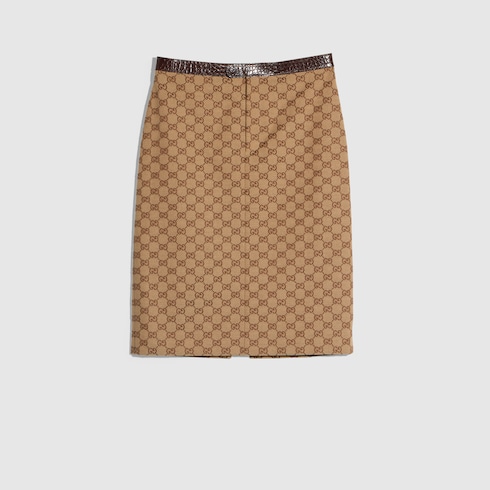
Tom Ford's tenure — 1994 to 2004 — is well documented. Velvet hipsters. Satin shirts unbuttoned to the navel. The autumn 1995 show that announced, in no uncertain terms, that Gucci would be about sex and surface and the kind of precision tailoring that makes both possible. Ford didn't reference the archive so much as use it: the horsebit became a buckle on a heel, the double-G a clasp on a chain-strap bag. He understood that heritage is only useful if you're willing to deform it.
Since Ford's departure, the house has cycled through Frida Giannini, who leaned into equestrian codes and a softer, more accessible aesthetic, and Alessandro Michele, who turned Gucci into a kind of magpie fantasia — Victoriana, 1970s Hollywood, teenage bedrooms, all collaged together with the house's original motifs used as recurring glyphs. Michele's exit in 2022 brought Sabato De Sarno, whose first collections have gestured toward a cleaner, more body-conscious line. Early days.
The question, nearly a century in, is whether any of this connects to what Guccio Gucci made in Florence. The materials have changed. The customer has changed. The structure — now owned by Kering, the French conglomerate — bears no resemblance to a family atelier. And yet certain elements persist. The bamboo handle still appears, season after season, on bags that cost what a used car might. The horsebit loafer, introduced in 1953, remains in production, barely altered. The green-red-green stripe shows up on sneakers, on luggage, on runway pieces that will never be worn outside a showroom.
One suspects this is not continuity so much as brand management. But there is something to be said for a house that knows which symbols to keep in circulation, even when the meaning has long since detached. Guccio Gucci wanted to make a good suitcase. His sons wanted to sell it in New York. Their heirs wanted to kill each other over the proceeds. And now, a hundred years later, the name survives because a series of designers understood that you can do almost anything with a logo, as long as you never let it rest.
Whether that constitutes a legacy is another question entirely.