## The Coat Problem
The Coat Problem
A winter evening out in New York—or London, or anywhere the temperature drops below forty and you're expected somewhere that matters—presents a specific wardrobe friction. You need warmth that holds through a twenty-minute walk and a forty-minute wait for the car service that said it was three minutes away. But you also need to look like you weren't dressed by a concerned parent. The coat can't read as survival gear. It can't add bulk where you don't want it. And when you take it off inside, what's underneath has to hold its own.
Burberry understands this tension better than most houses working at this level. They've been making weather-appropriate tailoring since 1856, which means they know how to engineer warmth without volume, and how to cut cloth so it moves with a body instead of against it. Their winter evening pieces don't announce themselves. They just work.
The Trench, Lined
Start with Burberry's heritage trench, but take it in the insulated version—the Chelsea or Kensington, both cut slim through the body with a quilted liner you can zip in and out. The shell is their signature gabardine, tightly woven cotton that sheds light rain and wind without looking technical. The liner adds warmth without changing the coat's silhouette. You still get the clean line through the shoulder, the defined waist, the length that hits mid-thigh.
This works because the structure is already there. A trench is inherently formal—it was an officer's coat before it was anything else—so it doesn't need embellishment to read as intentional. Wear it over a suit, over a dress, over wide-leg trousers and a fine-gauge knit. It's warm enough for February in Manhattan if you're moving between car and door. It's not a parka. It's not trying to be.
The key is fit. Burberry's trench sizing runs true, but you want enough room through the shoulders to layer a blazer or a chunky knit underneath without pulling at the seams. If you're between sizes, go up. A trench that's too tight reads as costume.
The Cashmere Scarf, Oversized
Burberry's check scarf is possibly the most recognizable textile accessory in circulation, which makes it easy to dismiss. Don't. The oversized cashmere version—30 by 168 centimeters, substantial enough to wrap twice and still have drape—does actual work. It fills the gap between coat collar and chin. It adds a second layer of insulation at the neck and chest, where you lose heat fastest. And because it's cashmere, not wool, it doesn't itch or bulk under a coat collar.
The check itself is a question of appetite. If you want the classic camel base with black, red, and white, it's there. If you prefer something quieter, Burberry runs the same scarf in solid charcoal, navy, or a pale oatmeal that works under almost anything. Either way, the weight is what matters. This is eight-ply cashmere. It has heft. When you wrap it, it stays.
Styling is simple: loop it once loosely, or fold it in half lengthwise and pull the ends through the loop for a cleaner line. Don't knot it like a necktie. Don't let it puddle. The scarf should look like it's doing something, not decorating.
The Quilted Jacket, Tailored
If a trench feels like too much ceremony for the evening, Burberry's tailored quilting is the move. Think of the Fernleigh or the Cresswell—diamond-quilted shells with a defined waist, a stand collar, and enough structure through the shoulders that they don't read as puffer jackets. These sit closer to a blazer than to outerwear. They're warm because of the quilting and the synthetic fill, but they're slim enough to wear under a wool coat if the temperature drops further.
This is the piece that works for dinner when you're walking more than a block. It's also the piece that works inside if the restaurant runs cold. Quilted tailoring has come back into circulation in the last five years, and Burberry's versions are among the most considered—no logo, no branding beyond a small label at the interior neck, no shine to the shell fabric. Just clean stitching and a fit that assumes you have a body underneath.
Wear it over a rollneck and trousers. Wear it over a slip dress with boots. It's androgynous in the way good tailoring often is.
The Knit, Fine-Gauge
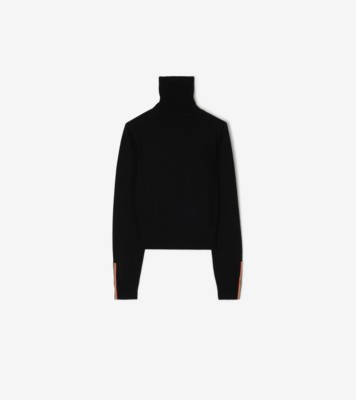
Underneath everything, you need a layer that insulates without adding visible bulk. Burberry's merino and cashmere-blend knits—crewnecks, rollnecks, fine-gauge cardigans—do this quietly. They're thin enough to sit under a blazer or a quilted jacket without pulling at the seams, but they're knit tightly enough to hold warmth close to the body.
The house's knitwear tends toward classic cuts: set-in sleeves, ribbed cuffs and hems, no extraneous detail. Some pieces carry a small embroidered logo at the chest. Others are completely plain. Both work. The fabrication is what you're paying for here—Italian-milled yarn, finished in Scotland, with enough elasticity that the knit doesn't lose its shape after a full evening's wear.
Colour matters. Burberry's winter knits come in navy, charcoal, camel, black, and occasional seasonal shades like deep olive or burgundy. For evening, stay in the darker end of the range. A black merino rollneck under a grey wool blazer is warmer than it looks and cleaner than a button-front shirt.
What Not to Do
Don't layer so much that you can't move your arms. Don't wear a puffer that makes you look twice your actual width. Don't assume that looking warm and looking considered are mutually exclusive. And don't wear a trench that's too long—anything past mid-thigh starts to read as bathrobe, not outerwear. Burberry's tailoring is specific. Respect the line it's cut on. If the fit isn't right, size up or size down. Don't just live with it.