## The Friction
The Friction
The office is not neutral ground. It asks you to show up with authority while leaving room for the people around you to do the same. It wants polish but not performance. And if you wear Maison Margiela to work, you're walking a specific line: the house's codes are strong enough that they can overwhelm a Tuesday morning meeting if you let them.
The friction is this: Margiela's vocabulary — the Tabi, the cut-out, the deconstructed shoulder, the numbered label stitched on the outside — carries weight. It signals fluency. But fluency at work shouldn't announce itself before you've said a word. The goal is to dress with Margiela's rigor without turning your outfit into a monologue.
What follows is a wardrobe in six pieces. Each one borrows from the house's language without leaning so hard into it that your colleagues remember what you wore more than what you said.
The Trouser
Start with the maison's tailored trouser in a mid-weight wool gabardine. Not the deconstructed wide-leg from the runway — the straight-leg version that sits at the natural waist and breaks cleanly over the shoe. Margiela's tailoring carries a particular tension: it's structured, but the structure doesn't insist. The waistband is slightly higher than contemporary norms, which changes your posture in a way that reads as intention, not costume.
Look for the version in charcoal or navy, not black. Black tailoring at Margiela can tip ceremonial, and the office doesn't need ceremony. It needs clarity. The trouser should have a front pleat — just one, pressed sharp — and a clean hem that doesn't pool. Wear it with the four-stitch label visible at the back waistband if you want the reference point, but only if the rest of the outfit stays quiet.
Pair it with a flat leather loafer or a low block heel. The trouser does enough. Let it.
The Shirt
The white poplin shirt with the oversized cuff. You know the one. It's been in the maison's lineup since the Nineties, and it works because the proportion is off by just enough to register as a choice without reading as a statement. The cuff extends past the wrist by an inch, maybe two. It folds back when you reach for something. It doesn't stay in place, and that's the point.
The body of the shirt is slim through the torso but not fitted. It skims. The collar is a standard point, nothing exaggerated. The fabric has enough body to hold a clean line under a jacket but enough drape to work on its own when you take the jacket off at your desk.
This is the piece that does the work of signaling fluency without making anyone else feel like they need a reference guide. It's just a white shirt until someone who knows sees the cuff and understands what you're doing. Tuck it fully into the trouser. No half-tuck, no French tuck. Commit to the line.
The Knit
The fine-gauge merino crewneck in ecru or soft grey. Margiela's knitwear has a specific hand: it's light but not insubstantial, and it sits close to the body without clinging. The neckline is slightly higher than standard, which means it layers cleanly under a coat or works on its own without looking unfinished.
The four-stitch label appears at the back neck, small and unobtrusive. This is the version of the house code that works best in a professional context — visible if you're looking, invisible if you're not. Wear it over the poplin shirt on days when the air conditioning is unforgiving, or on its own with the tailored trouser when you don't have client-facing meetings.
Avoid the distressed knits, the ones with visible darning or pulled threads. That's a weekend gesture. At work, the knit should look like you've thought about it, not like you're making a point.
The Bag
The small Snatched bag in smooth calfskin, carried by the top handle. Not the puffy nylon version, not the oversized tote. The structured leather bag that holds a laptop, a notebook, your phone, and nothing else.
Margiela's bags can skew sculptural, but this one stays functional. The silhouette is clean, the hardware is minimal, and the four-stitch label is debossed into the leather rather than appliquéd on top. It's present without being loud. Carry it in black or a deep brown that doesn't compete with the rest of the outfit.
The Snatched works because it has a point of view — the gathered top, the slightly flattened body — but it doesn't ask anyone to stop and decode it. It just works.
The Coat
The single-breasted wool coat in camel or navy, cut long enough to hit mid-thigh. Margiela's outerwear often plays with deconstruction, but the office coat should do the opposite. It should be the most resolved thing you're wearing.
Look for the version with a notched lapel, a single-button closure, and a clean shoulder line. No oversized proportions, no raw hems, no visible stitching on the outside. The four-stitch label can appear at the back neck or the interior lining, but it doesn't need to be the first thing someone sees when you walk into a room.
The coat is your frame. It should make everything under it look more considered, not compete with it.
The Tabi (or Not)
The Tabi boot is the house's most recognizable code, and that's exactly why it's tricky at work. If you wear it, wear the flat ankle boot in black leather, not the patent version, not the heel. And only if the rest of the outfit is so quiet that the boot is the only thing doing any talking.
Most days, though, skip it. Wear a slim Chelsea boot or a leather derby instead. The Tabi is a piece that demands context, and the office doesn't always have room for that kind of demand.
What Not to Do
Don't wear the deconstructed blazer with the exposed seams and the Tabi and the Glam Slam bag all at once. That's not dressing for work. That's dressing for the archive.
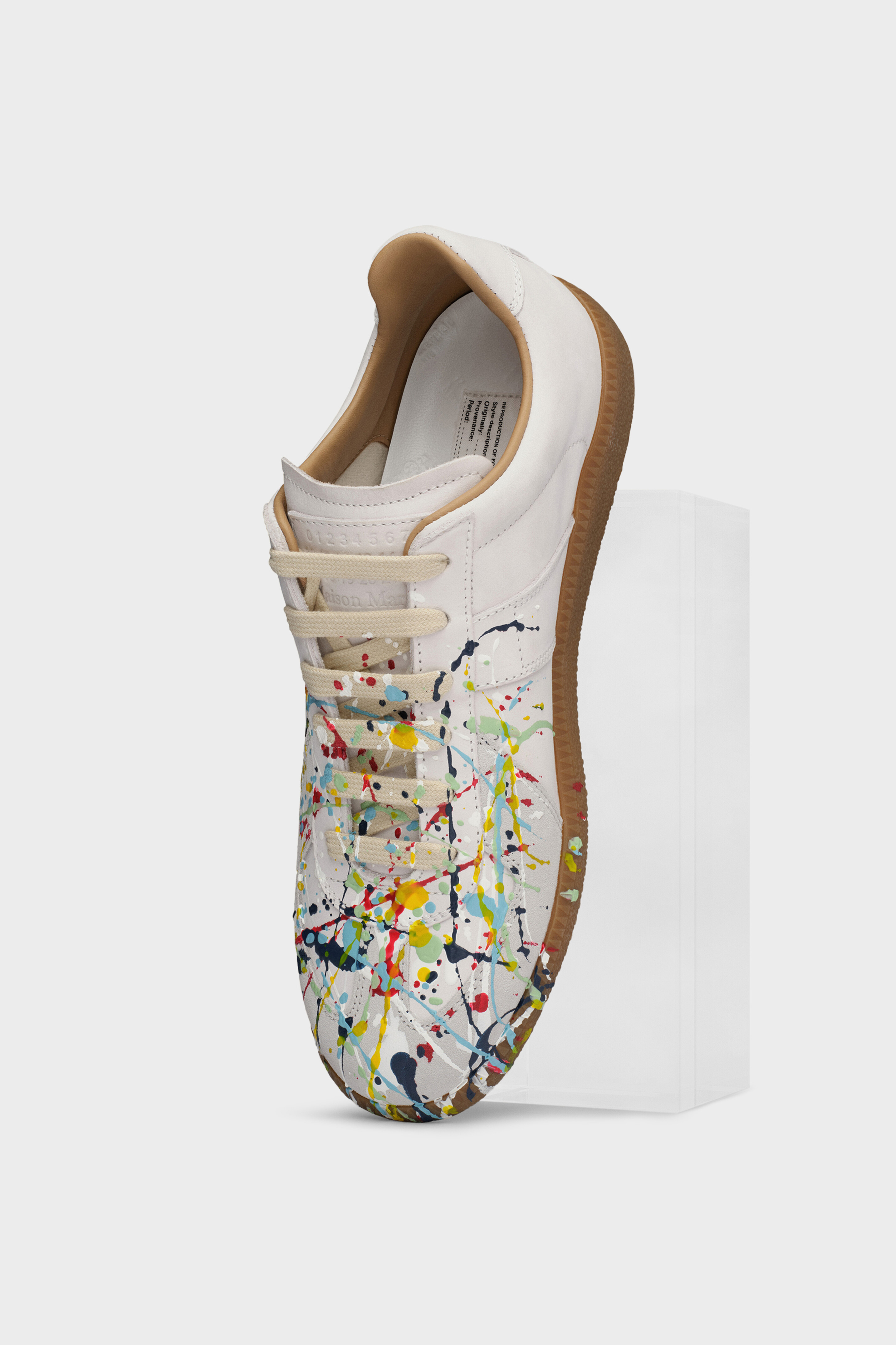
Don't reach for the Replica sneakers. They're too casual for this context, and they undercut the rigor of the tailoring.
Don't try to explain the references. If someone asks about the four-stitch label, answer briefly and move on. The work is in wearing it well, not in narrating it.
And don't forget: Margiela at work is about borrowing the house's discipline, not performing its entire vocabulary. You're there to work. Dress like it.