## The Suitcase Test
The Suitcase Test
Travel exposes garments. What holds in the controlled environment of a closet fails in the trunk of a car, the overhead bin, the humidity of a coastal evening. Gucci's archive is deep, but not everything in it survives transit. The pieces that do share a quality: they refuse to apologise for being folded.
This is not about packing cubes or capsule logic. It is about five things that arrive intact and perform across contexts—a lunch in Kyoto, a dinner in Marrakech, the twelve-hour window between landing and needing to be seen.
Horsebit Loafer
The loafer was introduced in 1953. It has been copied so many times that the original now reads as both reference and completion. Gucci's version—calfskin, metal bit across the vamp, low stacked heel—occupies no space in a bag and asks nothing of the wearer except that they walk.
It works because it holds a formal register without insisting on it. Pair it with a linen suit in Puglia or raw denim in Seoul. The bit catches light. The leather creases where your foot bends. By day three it has begun to conform, and by day seven you have forgotten you are wearing shoes that cost what they cost.
The loafer does not arrive creased because it cannot crease. This is the advantage of a shoe that has already committed to its shape. Pack it in a dust bag or don't. It will be fine.
Silk Twill Scarf (90cm)
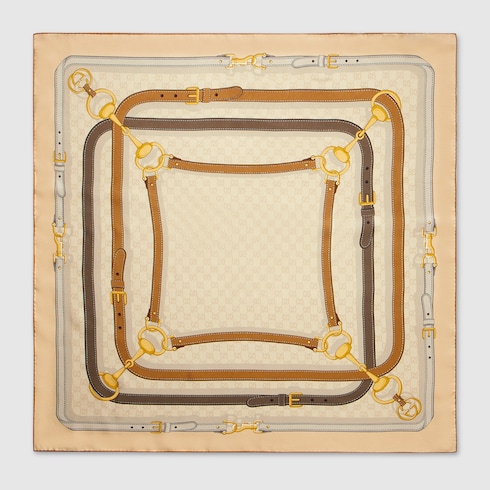
Gucci's scarves tend toward archival prints—Flora, the stirrup and bit motif, interlocking Gs rendered in forty colours. The 90cm square is large enough to knot at the neck, wrap as a turban, or fold into a belt. Silk twill holds a shape and releases it without protest.
The scarf is a garment that transforms in your hands. At the airport it is a neck scarf. On the train it becomes a headscarf. At dinner it is knotted through the handle of a bag. This is not versatility in the aspirational sense. It is a piece of cloth that has been printed and hemmed, and because it weighs sixty grams, you can carry three.
Silk does not wrinkle in the way cotton or linen does. It remembers being flat. A scarf pulled from the bottom of a suitcase shakes out and resets. If it does not, steam it in the bathroom while you shower. Two minutes.
Wool Cardigan with Web Stripe
The cardigan Gucci produces each season is not new. It is the same V-neck silhouette, the same green-red-green web stripe running down the placket and cuffs, the same merino or cashmere depending on the line. It is a piece that exists to layer, and layering is the grammar of travel.
Cardigans compress. They fold into a quarter of their hanging volume and emerge with only the gentlest creasing along the sleeves, which disappears after twenty minutes of wear. Wool is warm on a plane and breathable at ground level. It works over a T-shirt in California and over a button-down in Copenhagen.
The web stripe is legible but not loud. It says Gucci without requiring the viewer to know Gucci. In this way it functions as both signifier and garment, which is rarer than it should be.
Leather Belt, 4cm Width
A belt is structural. It holds trousers at the waist and defines the line where a shirt tucks. Gucci's leather belts—calf or grained, with the interlocking G buckle or a simpler brass square—do this without flourish.
The 4cm width is narrow enough to thread through most trouser loops and substantial enough to register as intentional. Leather improves with wear. It darkens where it bends. The buckle will scratch, and the scratches become part of the surface.
Pack the belt rolled, not folded. It takes the same space as a pair of socks. You will wear it four days out of seven, possibly more. A belt is the fastest way to make borrowed or wrinkled trousers look considered.
Canvas Tote with Leather Trim
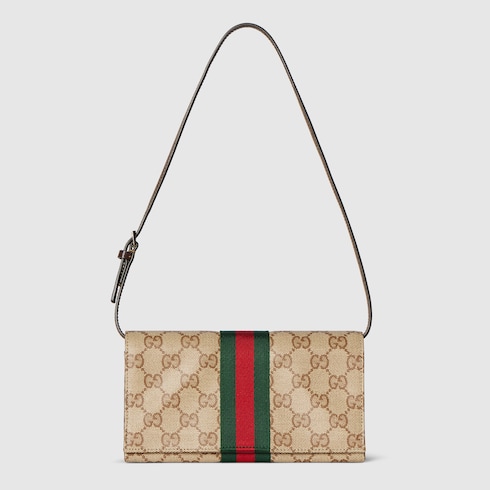
Gucci's GG canvas tote has been in production since the 1970s. It is not precious. The coated canvas resists water and abrasion. The leather trim at the top and handles will patina, but slowly. The tote holds a laptop, a book, a change of shoes, and the debris that accumulates between hotel and meeting.
It folds flat when empty, which is the test of whether a bag is actually useful. Canvas does not hold memory the way unstructured leather does. Creases from packing disappear the moment you load the bag again.
The tote also solves the problem of needing a second bag once you have arrived. It works as a day bag in Lisbon and a market bag in Bangkok. It is large enough to be functional and plain enough not to announce itself.
What Not to Do
Do not pack embellished knits. Sequins catch, beading shifts, appliqué warps under pressure. Do not pack pleated trousers unless you are prepared to have them pressed on arrival. Do not pack anything in jacquard that you cannot steam yourself. Do not assume a garment bag will protect structure—it will not.
Travel requires garments that have already made peace with being worn. Gucci produces many things. Pack only the ones that do not need your help.