## The Shoulder Line Moves North
The Shoulder Line Moves North
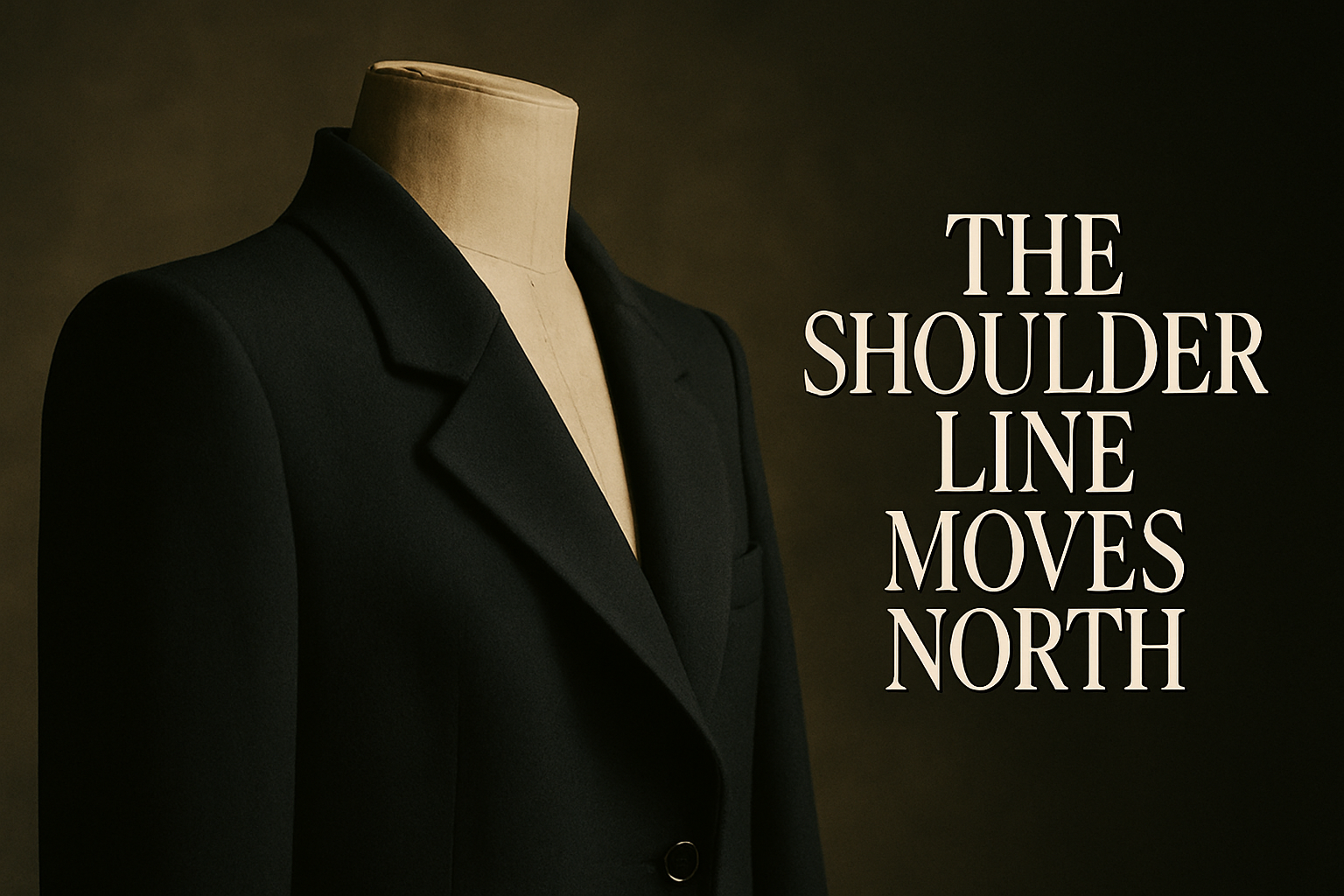
Acne Studios is raising the shoulder. Not dramatically — this is not the fortressed silhouette of the eighties — but deliberately. The drop that defined the house's tailoring for the last five years is lifting by two centimetres, sometimes three. The jacket now meets the body where the arm begins, and the sleeve head sits clean against the bone. This is the shift happening across the Spring/Summer 2024 and Autumn/Winter 2024 collections, and it changes how the garment holds space around the torso.
The clearest example is the double-breasted blazer from the SS24 runway. The shoulder is set, not extended. The line is narrow. There is no padding, but there is structure — a canvas interlining that lets the wool hold its own weight without collapsing inward. The result is a jacket that looks like it was cut for a specific body, not a category of bodies. Acne Studios has always worked in this territory, but the house is now committing to a fitted shoulder as the default, not the exception.
This is consistent with what appeared in the AW24 men's show. The overcoats there carried the same raised shoulder, paired with a longer body and a single-button closure. The proportions read almost like a robe, except the shoulder keeps the garment from feeling unmoored. It is that fixed point at the top of the sleeve that makes the rest of the volume legible. Without it, the coat would be a different object.
The women's tailoring is following the same logic. The blazers in the current season are cut with a higher armscye — the seam that connects sleeve to body. A higher armscye means less ease, which means the jacket moves with the wearer rather than around her. This is a return to the principles of mid-century tailoring, where fit was understood as a relationship between cloth and skeleton. Acne Studios is not reproducing that era, but it is borrowing its geometry.
What Changed
For context: the house spent the better part of the 2010s working with a dropped shoulder. The silhouette was soft, often unstructured, with sleeves that began several centimetres below the natural shoulder point. That cut was part of a broader movement in Scandinavian design, where ease and androgyny were expressed through loose, low-slung tailoring. It worked. It also became ubiquitous.
The shift now is toward a fitted shoulder, but not a stiff one. The jackets are still made from supple wools and lightweight blends. The structure comes from the cut, not from layers of horsehair and padding. This is a technical distinction, but it is what separates the current Acne Studios shoulder from the power shoulder of other houses. There is no armour here. The jacket is close to the body, but it does not announce itself.
The trousers are also adjusting. The wide-leg trouser that dominated the last three seasons is narrowing slightly, and the rise is moving up. The waistband now sits at the natural waist, which is higher than the hip-slung trousers that were standard until recently. This changes the proportions of the entire outfit. A higher waist and a fitted shoulder create a longer vertical line, which reads as more formal even when the fabrics are casual.
The Ripple Effect
Other houses are working in this direction. Lemaire has been refining the shoulder for several seasons, though their version is rounder and more draped. The Row continues to cut a high, narrow shoulder, but with more ease in the body. Acne Studios is distinct because the house is pairing the fitted shoulder with a relaxed lower half — wide trousers, long skirts, oversized shirting. The tension between the two creates the silhouette.
This is not a return to traditional tailoring. The house is not interested in reproducing a suit from 1955. But it is engaging with the idea that structure can be subtle, and that a well-cut shoulder does specific work that cannot be replicated by drape alone. The jacket becomes an anchor. Everything else can move around it.
What It Means
To dress in this silhouette for the next twelve months is to accept that fit is coming back into the conversation, not as constriction but as clarity.