## The Trench, the Check, the Bag
The Trench, the Check, the Bag
Burberry is building a uniform. Not in the corporate sense — there are no mandates here — but in the way a uniform clarifies intent. The autumn/winter 2024 collection, shown in February under Daniel Lee's direction, distilled the house codes into three repeating forms: the trench coat, the check, and a new structured bag. These are not new inventions. They are old ones, remade with enough precision that they feel like instructions.
The trench is cut closer than it has been in years. Shoulders sit where shoulders sit, not two centimetres beyond. The belt is narrow, functional, tied rather than buckled. The cloth is still gabardine, still waterproof, but the silhouette has lost the volume that dominated outerwear for the last five seasons. This is not the oversized trench of Phoebe Philo's Céline or the exaggerated drop-shoulder of Demna's Balenciaga. It is tailored to the body, not around it. The effect is immediate: the wearer looks like they know where they are going.
Burberry is not alone in this tightening. The Row's spring 2024 collection showed narrow belted coats in navy wool. Toteme's autumn lineup centred on a single-breasted trench with a high armhole and a clean shoulder line. At Loro Piana, the outerwear was quieter still — cashmere car coats with no excess fabric, no drama. The message across these houses is the same: structure has returned, and it is not decorative.
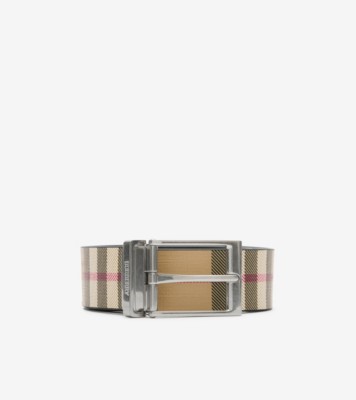
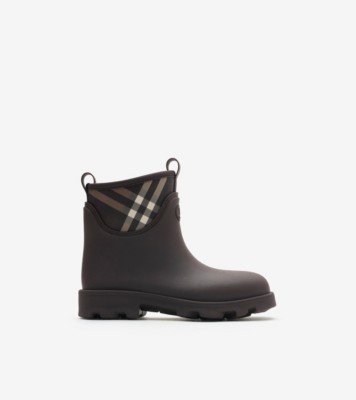
The check, Burberry's founding pattern, appears this season in two weights. The first is the classic beige-and-black register on cotton twill, used for trench linings and bucket hats. The second is a larger-scale iteration in camel and Archive Beige, rendered on wool coats and blanket scarves. Lee has not reimagined the check. He has simply placed it where it is most legible: on outerwear, on accessories, on pieces that move through public space. The check is not hidden inside a jacket or reduced to a logo tab. It is the surface.
This is a departure from the last decade of Burberry's output, which often treated the check as a problem to solve — something to abstract, invert, or bury under layers of streetwear reference. Riccardo Tisci's tenure from 2018 to 2022 leaned into monogram prints and logo-heavy knitwear. The check appeared, but it was secondary to the TB monogram and the animal kingdom motifs. Lee has reversed this. The check is primary again, and it is doing the work it was designed to do: identifying the wearer.
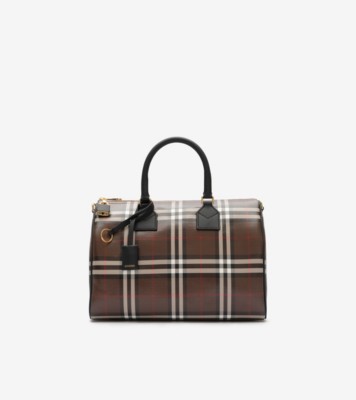
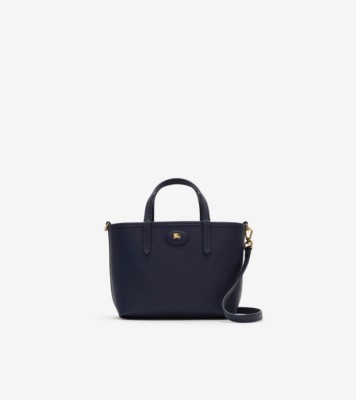
The bag is new. It is called the Knight, and it is a structured top-handle in leather with a metal clasp. The proportions are deliberate — wide enough to carry documents, tall enough to stand upright, flat enough to sit against the body without bulk. The handle is a single piece of leather, stitched at the base, designed to be carried by hand or in the crook of an arm. There is no shoulder strap, no crossbody option, no concession to hands-free carry. This is a bag for people who do not need their hands for anything else.
The Knight sits in a category that has been dormant for several years. Structured top-handles were everywhere in the early 2010s — Céline's Box Bag, Hermès's Kelly, Delvaux's Brillant — but the last five years have favoured soft shapes and shoulder bags. The Loewe Puzzle, the Bottega Veneta Jodie, the Khaite Lotus: all soft, all designed to drape. The Knight does not drape. It holds its shape, and it asks the wearer to adjust accordingly.
Burberry is not the only house returning to structure. Ferragamo's autumn 2024 collection, under Maximilian Davis, featured boxy top-handles in patent leather. The Row continues to produce the Margaux and the Half Moon, both rigid, both hand-held. At Loewe, Jonathan Anderson has introduced the Squeeze, a frame bag with a metal clasp and a single handle. The category is reopening.
What this means for the next twelve months: dressing will require more decisions and fewer gestures, and the trench coat will once again be the coat that ends the conversation.