## Three Pieces, One Read: Gucci's Quiet Pivot
Three Pieces, One Read: Gucci's Quiet Pivot
Gucci showed in Milan last month with a collection that felt less like a statement and more like a recalibration. The house has spent the last two seasons under Sabato De Sarno trying to locate a register that isn't Alessandrocore but also isn't anonymous. This season, the answer came in three pieces that repeat across the line: a boxy cropped jacket with a high armhole, a mid-rise trouser cut wide through the leg but clean at the waist, and a top-handle bag in structured calf with no visible hardware.
Not revolutionary. Not meant to be. What's interesting is how deliberately Gucci is stepping out of the conversation it used to dominate. No logomania. No irony. No borrowed codes from the archive recontextualised for the feed. Just proportion, fabric, and a kind of Milanese restraint that feels almost seditious coming from this house.
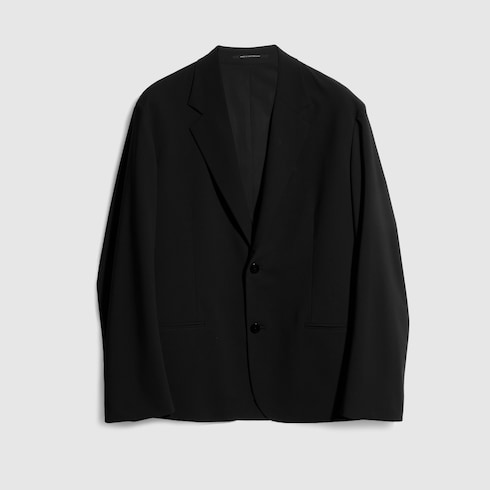
Start with the jacket. It's cropped above the natural waist, boxy through the shoulder, with sleeves that taper slightly at the cuff. The armhole sits high enough that you can't layer a chunky knit underneath without the whole thing riding up. It's a silhouette that requires the wearer to stand differently — shoulders back, ribs lifted. You see versions of this at Prada, at The Row, at Toteme. Gucci's iteration is softer in the shoulder, less architectural, and comes in a wool-cashmere blend that photographs matte. The house showed it over slim rollnecks and with those mid-rise trousers, but the piece works because it resets the waistline higher than we've worn it in five years.
The trousers are doing most of the work here. They're wide-legged but not voluminous. The rise sits just below the navel, which is higher than the dropped waists we've been wearing since 2019 but not so high it reads vintage. The leg is straight from hip to hem, no taper, no flare. Shown in charcoal wool, in navy, in a Prince of Wales check that didn't feel like a reference to anything. These aren't statement trousers. They're the trousers you wear when the statement is that you're done making statements.
Pair them with the bag. Gucci called it the 'Ancora' — anchor, in Italian, though the name hasn't stuck outside the press notes. It's a structured top-handle in smooth calf, no intrecciato, no monogram, no visible hardware except a discreet turn-lock under the flap. The handle is a single piece of leather, rounded and slightly thicker than you'd expect, which makes it comfortable to carry but also keeps it from looking precious. The bag sits upright on a table. It closes all the way. It holds a laptop if you angle it right.
What's notable is how little this bag asks of you. The Dionysus asked you to buy into a mythology. The Marmont asked you to recognize the double-G and want in. The Horsebit 1955 asked you to know your references. The Ancora asks you to need a bag. It's a shift in how Gucci is thinking about desirability, and it's consistent with what's happening across the three pieces: the brand is rebuilding from the object outward, not from the narrative down.
You see echoes of this approach at Loro Piana, where the proposition has always been material first. You see it at Brunello Cucinelli, though Gucci's price point is lower and the hand is less precious. You even see it at Khaite, which has spent the last four years refining a similar language of clean tailoring and structured leather goods. The difference is that Gucci is a house with thirty billion in revenue and a back catalogue that includes Tom Ford's satin shirts and Alessandro Michele's maximalist bricolage. Choosing restraint isn't neutral when you're Gucci. It's a position.
The risk is that the work reads as too quiet. Retail doesn't reward quiet. Algorithms don't reward quiet. But there's a growing segment of the market — call it the post-logo customer, call it the 35-to-50 demographic with disposable income and no interest in being read from across the room — that wants exactly this. A jacket that fits. Trousers that don't require an explanation. A bag that works.
De Sarno is betting that segment is large enough to carry a house this size. He's also betting that the people who bought Gucci under Michele have either aged into wanting something else or were never the core customer to begin with. It's a long play. The pieces won't move the same volume as a logo belt or a Marmont bag did in 2017. But they might move consistently, season over season, without the house needing to reinvent itself every eighteen months.
What it means to dress in this for the next twelve months: you're opting out of the conversation about what fashion is supposed to signal, and back into the older question of whether the thing you're wearing actually works.