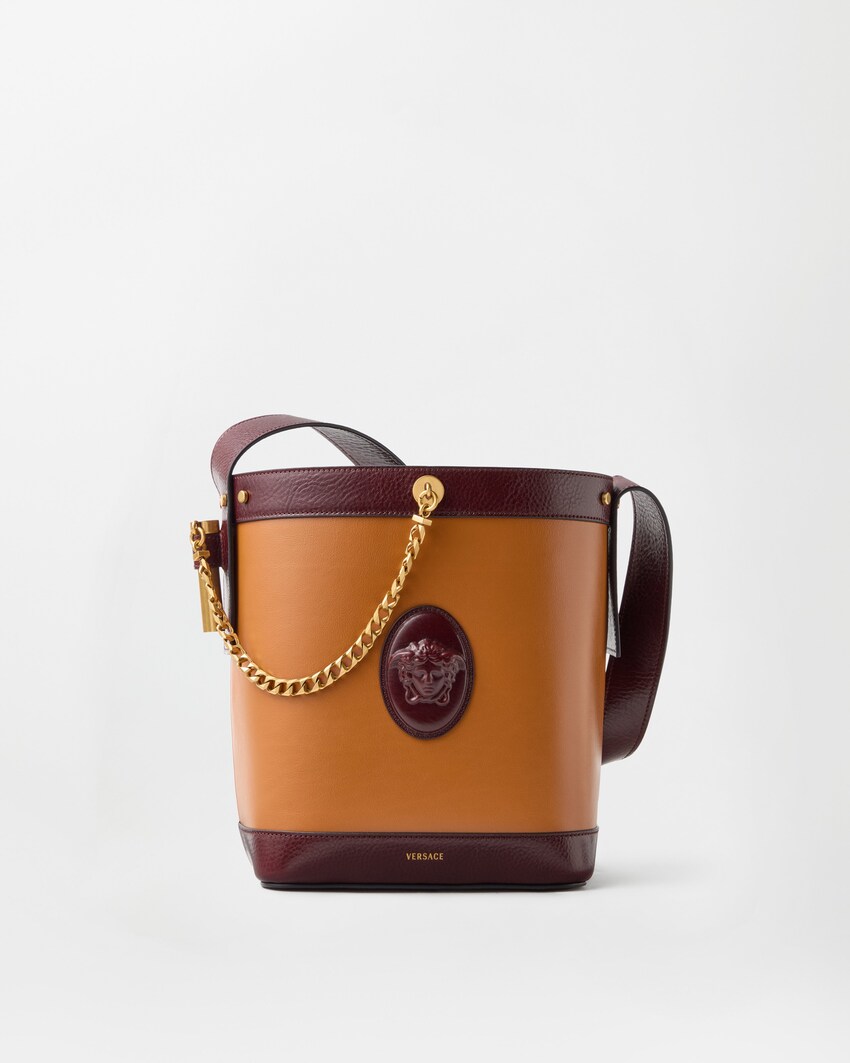
Versace has opened the vault
Versace has opened the vault. Not in the vague way brands talk about "inspiration" — actual reissues. The Medusa '95 bag returned last autumn. The safety-pin dress got a Spring 2024 iteration. And now the baroque print blouses from 1992, the ones Christy wore with jeans in Milan, are back in production with the original silk supplier in Como. This isn't homage. It's re-manufacturing.
The question isn't whether archive reissues are happening. They are, across half the industry. The question is which pieces Versace chose, and what that says about where the house thinks its authority still sits.
The pieces in question
Three references anchor the current programme. First: the Medusa '95, a structured top-handle in black calf with the house's signature hardware rendered at a scale that photographs clearly. It debuted in Donatella's pre-fall collection and moved 11,000 units in the first six months, which for Versace — a house that sells spectacle more reliably than accessories — is notable. The bag codes as Nineties in proportion but works now because the silhouette is boxy, not slouched. It doesn't ask you to dress like 1995. It asks you to carry something that isn't trying to be discreet.
Second: the safety-pin dress. Versace didn't reissue Liz Hurley's exact 1994 version — the one held together with oversized gold nappy pins — but it did produce a black column dress for Spring 2024 with the same construction logic. Pins at the side seam, not decorative but structural. It's been done in jersey now, not silk, which makes it less precarious and slightly less interesting. But it sold. Pre-orders were strong enough that Versace added a second colourway in ivory for resort.
Third: the baroque print shirting. This one required the most work. The original 1992 run used a silk twill from a Como mill that had since pivoted to automotive interiors. Versace brought them back on contract, re-archived the print file, and produced the blouses in a near-identical weight. The result photographs exactly like the Christy Turlington editorials, but the hand is slightly crisper — contemporary finishing standards don't allow for the same degree of softness. It's close enough that most customers won't notice. It's different enough that anyone who owns a vintage piece will.
Why these, why now
Versace's archive strategy is narrower than Prada's or Margiela's, and that's deliberate. Where Prada can pull from sixty years of intellectual rigour, Versace has a tighter band: roughly 1991 to 1997, the span when Gianni's maximalism aligned with a particular moment in celebrity, media, and the globalisation of Italian luxury. Before that, the house was still finding its register. After, it was managing his absence.
The pieces being reissued all come from that six-year window. And they all share a trait: they're legible. The Medusa bag reads as Versace from across a room. The safety-pin dress has a single, repeatable image attached to it. The baroque print doesn't require context — it simply looks like more.
This is a different approach than Bottega's Sardine or Loewe's Puzzle, both of which require a degree of literacy to decode. Versace's reissues don't ask you to know anything except that you've seen them before. That's the point. The brand is banking on recognition, not discovery.
It also reflects where Versace sits in the Capri Holdings structure. The house doesn't have the same margin flexibility as LVMH's smaller ateliers. It needs volume. A reissued Medusa bag can move units in a way a conceptual new silhouette can't, because it comes pre-sold. The customer already knows what it is.
What the market is doing with it
The reissues are performing, but unevenly. The Medusa '95 works because it's an accessible entry point — €1,400 positions it below Bottega's Cassette but above most contemporary labels. The safety-pin dress, at €2,800, is harder to justify unless you're dressing for an event that specifically wants that reference. It's occasion-dependent in a way the bag isn't.
The baroque shirting is the surprise. It's doing well in Asia, particularly in Seoul, where the print reads as archival European luxury without the stuffiness of, say, a Ferragamo scarf print. It's also moving among a younger Milan cohort who weren't alive in 1992 and therefore don't carry any fatigue about the reference. For them, it's new.
What's not selling: the derivative pieces. Versace also produced several "inspired by" items — a tote with a smaller Medusa emblem, a slip dress with a baroque print on the bias. These have stalled. The customer who wants the archive wants the actual thing, not a toned-down version. The customer who doesn't want the archive won't be convinced by a compromise.
The call
Wearing a Versace reissue in 2025 is a bet that recognisability matters again — that after a decade of quiet luxury and insider signalling, there's room for a bag or a print that announces itself. It's not a subtle season.