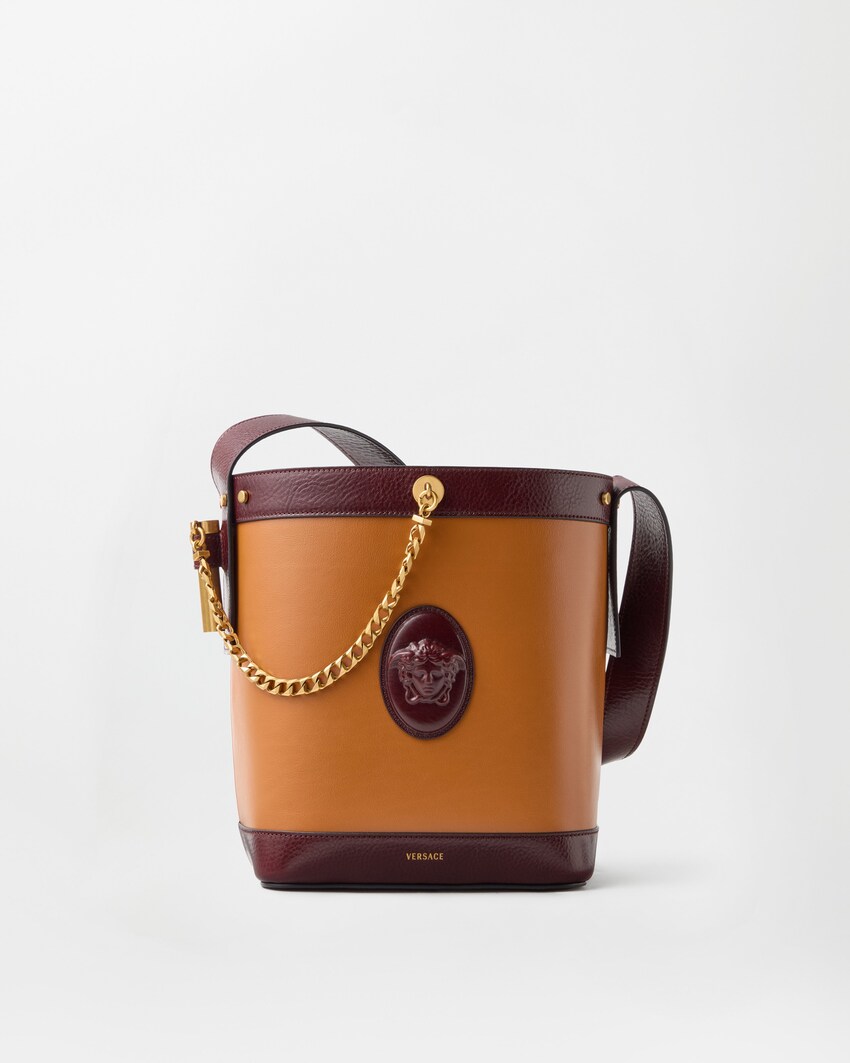
Versace's archive comes back
Versace is putting its Nineties and early Aughts archive back into production — not as capsule reprints, but as mainline pieces with SKUs that run through three seasons. The reissues started quietly last autumn: the Medusa '95 bag, the safety-pin dress remade in five colourways, the Barocco print on silk shirts that used to live only in collector wardrobes. Now they're in-store alongside the new collections, priced within ten per cent of equivalent contemporary pieces.
This isn't nostalgia merchandising. It's margin arithmetic. Versace has discovered that its own archive sells at full price in a way most new designs don't. The Medusa '95, reissued at €2,150, moved faster in its first six weeks than the new chain-strap style developed for the same season. The safety-pin dress — originally worn by Elizabeth Hurley in 1994, now remade in stretch silk — sold through at 87 per cent full price across European doors. For a house that has spent the last decade chasing streetwear adjacency, the old work is suddenly doing better business than the new.
The selection isn't arbitrary. Versace is pulling from three specific moments: the 1991–1997 Gianni era, the 2000–2004 Donatella transition, and a narrow slice of 2009–2012 when the house was still designing for a customer who dressed at night. What those periods share is a version of sexiness that photographs clearly — high contrast, body-conscious, unapologetic about being looked at. The pieces that aren't coming back are just as telling: nothing from the athleisure years, nothing that required explaining in a press release, nothing that sold primarily to wholesale.
Other houses are watching. Mugler reissued its spiral-seamed dresses last year and saw them move faster than its new tailoring. Alaïa — technically always in production, but newly amplified under Pieter Mulier — has leaned into the archive-as-product model, with the original Eighties knit dresses restocked every quarter. Dior brought back its saddlebag in 2018 and hasn't stopped producing it since. The difference is that Versace is doing this at scale. The reissues aren't limited drops or anniversary moments. They're permanent collection, sitting next to the new bags and dresses as though they were designed last season.
The why-now is straightforward: the secondary market proved the demand before the house did. For three years, the original Medusa bags have been trading on resale platforms at double their 1995 retail, adjusted for inflation. The safety-pin dress, when it appears, sells within hours at four figures. Versace realised it was leaving money on the table — and worse, leaving it to resellers who weren't paying royalties or controlling quality. Reissuing the archive lets the house compete with its own past at margin it actually captures.
There's a production advantage, too. The archive pieces already have patterns, graded specs, and supplier relationships that go back decades. A new bag requires twelve to eighteen months of development. An archive reissue requires a pattern pulled from storage and a conversation with the same Italian atelier that made it thirty years ago. The lead time collapses. The risk drops. If a piece didn't sell in 1995, it's already survived one round of market selection.
The clothes themselves have changed slightly. The new safety-pin dress uses a stretch silk blend instead of pure silk crepe, because the original fabric house shut down in 2003. The Medusa '95 bag has an interior pocket the first version didn't, because customer service requested it often enough to justify the pattern adjustment. The Barocco print now comes on a lighter-weight twill, because the original weave was too heavy for the way people wear printed shirts now — open over ribbed tanks, not buttoned to the collar. These aren't compromises. They're the minimum updates required to make a thirty-year-old design work in a contemporary wardrobe without pretending the last three decades didn't happen.
What's unclear is whether this works past the first wave. The initial reissues had the advantage of genuine scarcity — pieces that hadn't been in production for twenty years, that carried specific pop-culture references, that people remembered wanting and couldn't have. The second wave, rumoured for next spring, pulls from deeper in the archive: 2002, 2003, years that weren't peak Versace. The question is whether the customer is buying the archive because it's Versace's best work, or because it's the work they already know.
For now, the house is betting on the former. The autumn 2025 collection, shown in February, included fewer new bags than any Versace runway in a decade. The investment is going into archive production, not new development. If you're dressing in Versace for the next twelve months, you're dressing in a version of the house that's decided its past designs are better bets than its future ones.