Fendi sits in a strange place inside the Italian luxury hierarchy
Fendi sits in a strange place inside the Italian luxury hierarchy. It's not the quiet, cerebral proposition of Bottega. It's not the overt branding exercise of Prada's nylon reissues. Fendi operates somewhere in between: Roman craft tradition, yes, but also a willingness to let a logo do work when it needs to. The house built its reputation on fur—an expertise that now manifests in leather manipulation, in the way a hide is split, bevelled, dyed twice. That technical depth is still there. The question, for most people beginning with the house, is where to enter without landing in the wrong decade.
A good first Fendi piece should feel like Fendi, not like an accessory that could have come from anywhere. That means either the interlocking FF—used intelligently, not as wallpaper—or a specific construction language the house owns. The Baguette, the Peekaboo, the Fendigraphy: these are shapes Fendi invented or sharpened into something unmistakable. A logo-free tote in grained calf might be beautiful, but it won't teach you what the house does better than its peers. Start with something that couldn't have been made elsewhere. Start with a shape or a surface treatment that has a surname attached.
What follows isn't ranked by importance. It's segmented by entry point—by what you're willing to spend, and what you're after in return.
Budget serré : la ceinture Fendigraphy
The Fendigraphy belt starts around €390. It's not trying to be discreet. The logo buckle is cast metal, about four centimetres across, and it will read from across a room. That's the point. Fendi's logo has been in circulation long enough that it no longer feels try-hard—it feels like a house signature, the way Hermès's H or Gucci's double-G does. The leather strap is reversible, usually black on one side, tobacco or deep brown on the other. The calf is smooth, not embossed, and breaks in without creasing into ugly lines.
This is the least expensive way to own something Fendi makes well. Belts don't carry the same cachet as bags, but they also don't suffer the same scrutiny. No one's checking the stitching on your belt. What they see is the buckle, and whether you wear it like you meant to. The Fendigraphy works best at the natural waist, over tailoring or a heavy knit. It doesn't work over denim at the hips—that's a different gesture, and the buckle's too assertive for it.
Expect this to last a decade if you're not rotating it daily. Two decades if you are. The buckle won't tarnish unless you're swimming in it. The leather will darken, especially along the holes you use most, and that's fine. A belt should look like it's yours.
Milieu de gamme : le Baguette en cuir grainé
The Baguette is Fendi's most legible shape. Introduced in 1997, it predates the current wave of archival revivalism by two decades, which means it's not riding a trend—it set one, watched it crest, and stayed in production anyway. The silhouette is compact, underarm-carry, with a short shoulder strap and a flap closure. It's not practical in the way a crossbody is practical. It's practical in the way a clutch with a strap is practical: it holds what you actually carry, and nothing else.
The grained calf version starts around €2 700. That's the one to begin with. Not the embroidered canvas, not the shearling, not the sequinned limited-edition nonsense that shows up each December. Grained calf in black, tobacco, or one of the deeper seasonal colours—aubergine, forest, burnt orange if you're certain. The grain hides surface scratches. The structure holds without internal reinforcement. The flap sits flush because the leather's been skived thin at the fold line, a detail you won't notice until you compare it to a poorly made knockoff.
Fendi's updated the Baguette's hardware over the years. The current magnetic closure is quieter than the original turn-lock, and it's easier to operate one-handed. The chain strap option is new as of 2021, and it changes the bag's posture—makes it dressier, a little more evening-appropriate. The leather strap is still the better daily choice. It softens faster, and it doesn't dig into your shoulder when the bag's loaded.
This bag will not age gracefully if you treat it poorly. The corners will scuff. The flap will loosen. But if you rotate it out of heavy rotation after two years, if you store it upright, if you don't overfill it, it will look like a bag you've had for fifteen years in the way that makes people ask where you bought it.
Investissement sérieux : le Peekaboo ISeeU Medium
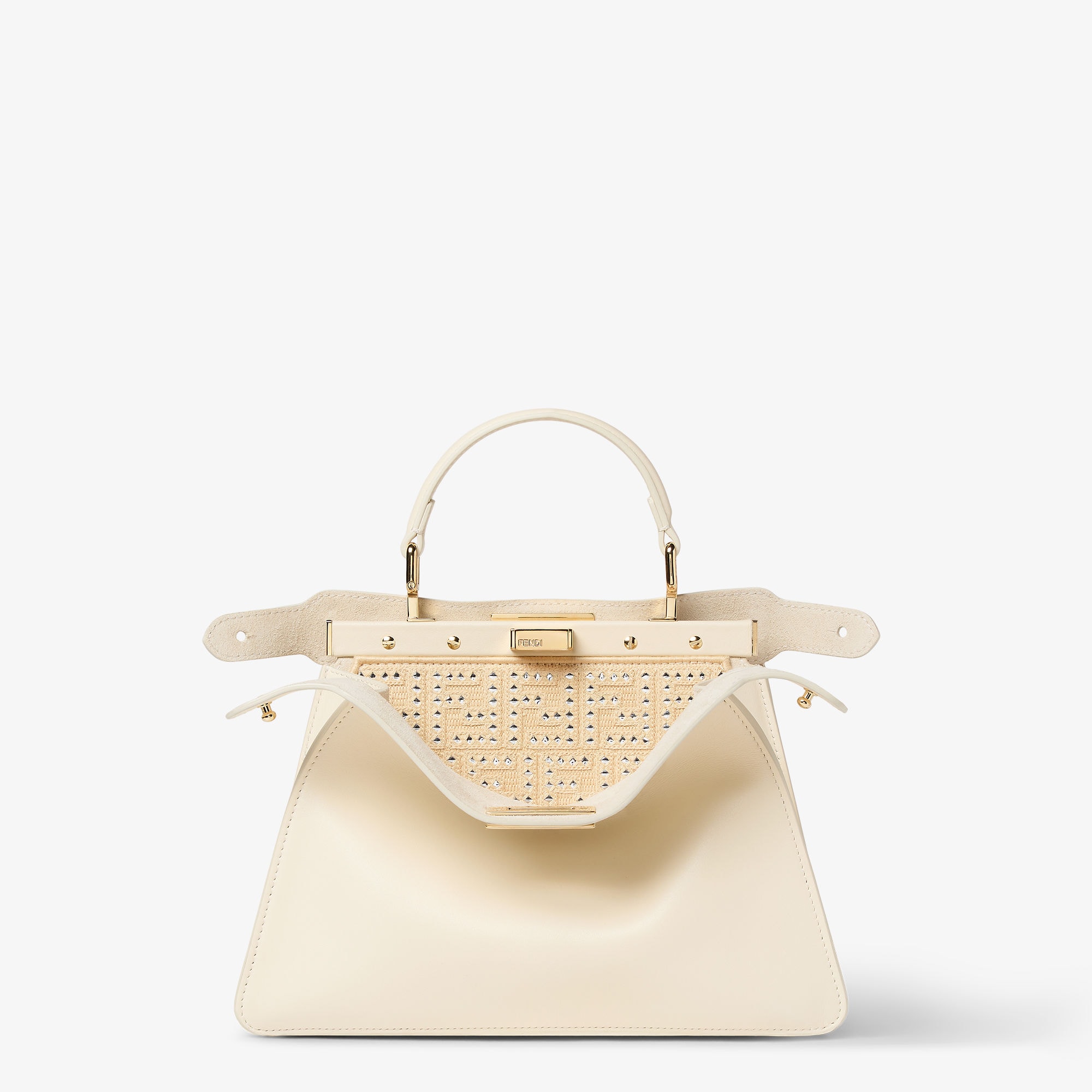
The Peekaboo is Fendi's other house icon, and it's the one that signals you've moved past entry-level. The ISeeU Medium starts around €4 900 in smooth calf. It's a structured top-handle bag with a double compartment and a twist-lock closure that lets you open either side independently. The name comes from the fact that the bag's interior is often lined in a contrasting colour—open it, and you get a flash of saffron or cobalt against black calf. It's a small gesture, but it separates the bag from the more austere propositions coming out of Valextra or Delvaux.
The Medium is the size that works. The Mini is too precious unless you're attending something that requires a clutch but allows a handle. The Large is a work bag, and it telegraphs that a little too clearly. The Medium holds a wallet, a phone, keys, a small notebook, sunglasses. It holds what you need without announcing that you're hauling things around.
The construction is rigid. The bag doesn't slouch. The calf is drum-dyed, which means the colour goes all the way through the hide, and any scratches won't show white underlayer. The twist-lock is machined metal, not plated, so it won't flake. The handles are reinforced with an internal dowel, which is why they don't collapse when you set the bag down.
This is a bag that looks better in year five than in year one. The calf develops a slight sheen where your hand grips the handle. The base corners darken from being set on surfaces. The structure stays, but the newness goes, and what you're left with is a bag that looks like it's been somewhere.
Entretien et longévité
Fendi's leather doesn't need much. Wipe it down every few months with a barely damp cloth—no product, no conditioner unless the leather's gone genuinely dry, which takes years. Store bags upright, stuffed lightly with tissue, not in their dust bags unless you're trying to keep dust off. Dust bags trap moisture, and moisture is what breaks down calf over time.
Hardware tarnishes slower if you're not handling it with wet hands or storing the bag somewhere humid. If a buckle or twist-lock dulls, a jeweller's polishing cloth will bring it back. Don't take these bags to a standard cobbler for repair. Fendi's atelier services are expensive—sometimes a third of the bag's original price—but they're the only place that stocks the exact hardware and has the patterns on file. A poorly executed repair is worse than honest wear.