Gucci makes a great many shoes
Gucci makes a great many shoes. Most people buy them for the logo, the horsebit, the stripe—for what they signal, not what they do. Fair enough. But some of them also happen to last, which is less often discussed and more interesting. Longevity in fashion footwear is not a given. Construction standards have slipped across the board. Cemented soles pass for acceptable, leather linings disappear, and shoes that cost four figures fall apart after eighteen months of regular wear. It's tiresome and expensive.
The question, then, is not whether Gucci makes beautiful shoes—it does—but whether any of them survive contact with actual pavement. I've worn three styles hard over the past two years: the Horsebit loafer, the Jordaan loafer, and the Brixton loafer. Different construction, different tolerances, different results. What follows is not a celebration but a field report. These are the ones that held up, the ones that didn't, and what you ought to know before you spend your money.
Horsebit Loafer (1953 Original)
The 1953 Horsebit is the house's most famous shoe and, inconveniently, its best-made. It is a Blake-stitched loafer with a leather sole, a structured vamp, and a brass bit that weighs more than you expect. The leather is typically a calf or a soft suede, both of which crease predictably and age well if you rotate them. I've put about 250 days into a pair in dark brown calf over two years. The uppers are still tight. The lining has not torn. The sole has been replaced once—at 18 months—and the stitching held through the resole without complaint.
Blake construction is not as robust as Goodyear welting, but it is repairable, and that matters. The shoe flexes with your foot rather than against it, which makes it comfortable from day three and means it will not last forever if you walk five miles daily in the rain. But worn sensibly—dry days, smooth surfaces, the occasional rest—it behaves like a proper shoe. The bit stays put. The heel counter keeps its shape. The insole compresses but does not collapse.
The caveat is price. You are paying for heritage and hardware as much as construction. At $890, it is expensive for a Blake-stitched loafer, but it is also one of the few Gucci shoes built to a standard that predates the 1990s logo boom. If you want a pair of loafers that will look correct in five years and can be resoled twice, this is the one.
Jordaan Loafer
The Jordaan is the Horsebit's younger, cheaper sibling. It appeared in 2015, carries the same bit, and costs about $200 less. The difference is in the construction. Where the Horsebit is Blake-stitched, the Jordaan is cemented—sole glued to upper, no stitching through the insole. This is not inherently bad. Cemented shoes can last if the bond is strong and the leather is decent. But they cannot be resoled in the traditional sense, and when they go, they go quickly.
I bought a pair in black leather in early 2022. They were comfortable immediately, which should have been a warning. The leather was thinner than the Horsebit, softer, more forgiving. The bit sat flatter against the vamp. They looked nearly identical on the foot, and for the first six months, they performed well. Then the sole began to separate at the ball of the foot. Not catastrophically—just a slight lift, a creak when I walked. By month nine, the separation had spread to the waist, and the shoe felt loose in a way that no amount of polish could disguise.
A cobbler can re-glue a cemented sole, and mine did, but it is a temporary fix. The upper leather had stretched by then, the heel counter had softened, and the shoe no longer held its line. I got 14 months of solid wear, then another four of diminishing returns. For $730, that is not good enough.
The Jordaan is a fine-looking loafer, and if you wear shoes gently or infrequently, it may serve you well. But if you walk to work, if you travel, if you expect a shoe to last two years of regular rotation, buy the Horsebit instead. The $200 difference pays for itself in durability.
Brixton Loafer
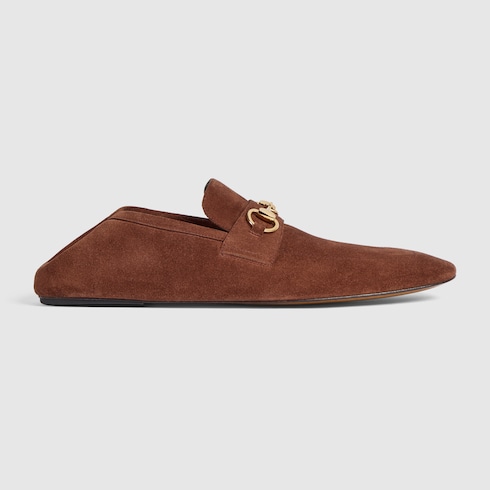
The Brixton is a backless loafer—a mule, essentially—with a collapsible heel and the same horsebit hardware. It has become Gucci's best-selling shoe, which tells you more about convenience than construction. I tested a pair in tan leather for 18 months, wearing them primarily indoors and for short errands. They are not built for distance.
The upper is soft, unstructured, and designed to fold at the heel. This makes them easy to slip on and pleasant for an hour, but it also means they have no support and limited lifespan. The sole is cemented, thinner than the Jordaan's, and wears through quickly at the toe if you drag your feet even slightly. Mine developed a hole at 11 months. The leather upper, meanwhile, stretched and sagged, particularly around the vamp, where the bit pulled against the soft calf.
The Brixton is not meant to be a serious shoe. It is a house slipper that you can wear outside, and in that context, it succeeds. But at $680, it is an expensive house slipper, and it will not survive the kind of use that a proper loafer can handle. If you want a backless option and you wear shoes hard, look elsewhere. If you want something pretty for the summer and you accept that it will look tired by the following spring, the Brixton is perfectly pleasant.
A Note on Care
None of these shoes will last if you ignore them. Leather soles need rest between wears—24 hours minimum. Cedar shoe trees prevent the upper from collapsing and wick moisture from the insole. A horsehair brush and occasional polish keep the leather supple and slow the creasing. If you wear the same pair daily, even the Horsebit will fail.
Gucci's after-care service is inconsistent. Some stores will refer you to a cobbler, others will send shoes back to Florence for repair, and the turnaround can stretch to eight weeks. Find a competent local cobbler who works with Blake-stitched shoes, establish a relationship, and save yourself the wait. The hardware—the bits, the webbings—can be replaced or tightened if you ask. The leather can be reconditioned. But the sole, once worn through, is the end of a cemented shoe and merely an expense for a stitched one. Know which you're buying.