Gucci's archive is a mess of contradictions
Gucci's archive is a mess of contradictions. Michele's maximalism, Ford's minimalism, Frida Giannini's quiet leather goods that nobody remembers until they see one at a vintage dealer and realise it's held up better than half the runway pieces. The house has pivoted enough times that its current leather goods lineup reads like a family reunion where nobody quite agrees on what the brand is supposed to mean.
That's not a weakness. It means there's range. You can buy into Gucci at the level of a monogrammed canvas tote that telegraphs exactly what it is, or you can go deeper—into the structured top-handles that reference the equestrian line from the Seventies, into the softer shoulder styles that feel like they've been sitting in an atelier for decades waiting for their moment. The good pieces share a few qualities: they're not trying to be anything other than what they are, they use materials honestly, and they age into themselves rather than against you.
What follows isn't a hierarchy. It's five silhouettes that represent different ways into the house. One word per bag, because if a piece needs more explanation than that, it's probably working too hard.
Horsebit 1955
Structured.
The shoulder bag that pulls directly from the 1955 archive piece—hence the name, though Gucci didn't bother with that level of literalism until recently. It's built around the horsebit hardware, which in this iteration sits flat against a magnetic flap rather than dangling as ornament. The shape is a compact half-moon, slightly deeper than it looks in press images, with a single adjustable strap that sits just under the shoulder or crosses the body depending on how you set the hardware.
The leather here is what matters. Gucci uses a matte calfskin that doesn't photograph as well as patent or high-shine finishes, but in hand it reads quieter, more considered. It's supple enough to give slightly when the bag is full, structured enough that it doesn't collapse when empty. The interior is suede-lined—not microfibre, actual suede—which is the kind of detail that used to be standard and now functions as a differentiator.
This works best in the small size, where the proportions hold. The larger version tips into something more functional than elegant, which isn't necessarily wrong, but it's a different bag. Colour-wise, the black and dark brown move through the world without announcing themselves. The reds and greens Gucci periodically releases are for people who already know what they're doing.
Jackie 1961
Soft.
Another archive pull, this one from the Sixties hobo that Lee Radziwill carried and Jacqueline Kennedy made famous, though the name didn't get attached until later. The current iteration keeps the original's slouch and single curved handle but tightens the silhouette just enough that it doesn't look like you're carrying a pillowcase.
The piston closure—a metal bar that slots through a loop of leather—is the piece's signature and also its occasional frustration. It's secure, but it's not fast. If you're the kind of person who needs to get into your bag in three seconds while holding a coffee, this will annoy you. If you're fine with a deliberate gesture, it's part of the appeal.
Gucci offers this in several leathers. The pebbled calf is the safest, the one that weathers daily use without showing every fingerprint. The smooth calf is more refined and also more precious—it will mark, it will scratch, and if that bothers you, don't buy it. There's also a suede version that appears sporadically, which is beautiful and wildly impractical unless your life involves very little weather.
The Jackie works because it's genuinely soft. Not 'soft-structured,' not 'relaxed but holds its shape'—it's a bag that folds when you set it down. That's the point. It's meant to look like it's been in your wardrobe for years, even when it hasn't.
Dionysus
Scaled.
The tiger-head closure is either the reason you buy this bag or the reason you don't. There's no middle position. It's large, it's three-dimensional, and it sits at the centre of the flap doing exactly what it was designed to do: make the bag recognisable from across a room.
Underneath the hardware, the Dionysus is a straightforward shoulder bag with a chain strap and a structured body. What makes it interesting is the material range. Gucci has run this silhouette in everything from GG Supreme canvas to python, but the versions that work best are the ones in textured calf or embossed leather. The scaling—whether it's actual exotic or embossed to look like it—adds depth the smooth leathers don't have. It makes the bag feel less like a logo delivery system and more like a considered object.
The chain strap is heavier than it looks. That's intentional. It keeps the bag stable when worn, but it also means this isn't something you'll forget you're carrying. If you want a bag that disappears on the shoulder, this isn't it.
The small and medium sizes are the ones that move. The large version exists mostly for travel or for people who need to carry a laptop and don't mind announcing it.
Marmont
Quilted.
The GG hardware here is oversized and sits on a chevron-quilted leather body that telegraphs 'Gucci' faster than almost anything else in the lineup. It's been ubiquitous for nearly a decade, which means it's either past its moment or settled into permanence, depending on how you read these things.
What's often overlooked: the Marmont is exceptionally well-constructed for a piece at this price point. The quilting is actual stitching through layered leather, not embossed or heat-pressed. The chain strap—leather-wrapped, not bare metal—sits flat and doesn't tangle. The interior is clean, with a single zip pocket and enough room for the essentials without becoming a void.
The matelassé leather softens with wear in a way that makes the bag look better at two years than at two weeks. The quilting hides minor scuffs and scratches, which is either a feature or a way of admitting the leather isn't precious enough to baby. Either way, it's practical.
This exists in multiple sizes and several variations—top-handle, belt bag, tote. The shoulder bag in small or medium is the version that works. The others feel like extensions of a successful idea rather than ideas in themselves.
Ophidia
Monogrammed.
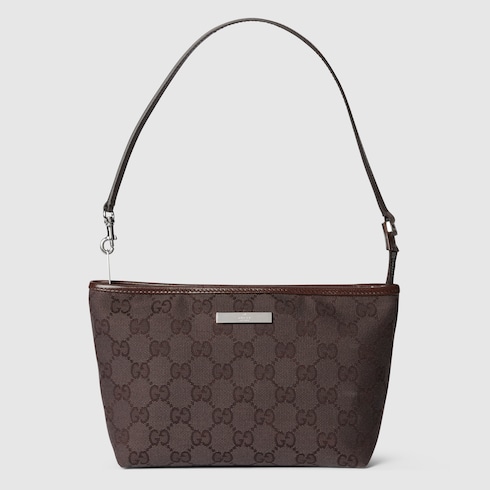
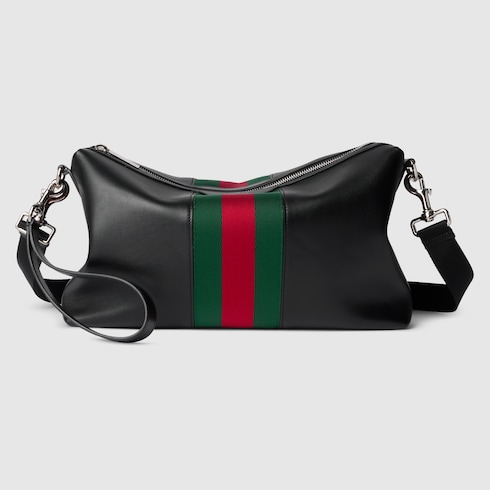
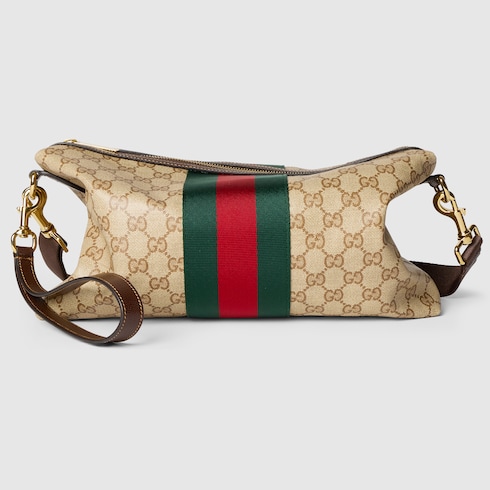
The GG Supreme canvas with the green-and-red web stripe is Gucci's most direct nod to its own archive, and the Ophidia is where that material shows up in its most straightforward form. It's not trying to reinterpret or update—it's just using the house codes the way they were used in the Seventies, on a structured top-handle bag with a zip closure and a detachable shoulder strap.
The canvas is coated, which makes it weather-resistant and also slightly stiff when new. It breaks in, but slowly. The leather trim—vacchetta, which darkens and develops patina over time—is where the bag's character lives. Fresh Ophidias look uniform and a bit corporate. Ophidias that have been carried for a year look like they belong to someone.
The top-handle shape is formal enough for work, casual enough for weekends, and sized to actually be useful—this isn't a bag you buy and then realise is too small for your phone and wallet. The double-G hardware is subtle, at least by Gucci's current standards, which means the bag reads as Gucci without reading as only Gucci.
The Ophidia also comes in solid leather, which is cleaner and more expensive and also less interesting. The canvas version has texture and reference. The leather version is just a nice bag.
Gucci's leather goods hold up if you let them. The canvas pieces need almost nothing—wipe them down, keep them dry, don't overstuff them. The smooth calf and suede need more attention. A soft cloth after each wear, a leather conditioner twice a year, and storage that isn't a pile on the floor. The hardware tarnishes, especially on the chain straps. That's not a flaw—it's brass or aged metal doing what it does. If you want it bright, a jeweller's cloth will bring it back. If you don't, let it go dark. Both are fine.