Maison Margiela doesn't do entry points
Maison Margiela doesn't do entry points. There is no starter pack, no logo tote to ease you in. The house built its reputation on anonymity—blank labels, numbered lines, garments that ask you to notice cut before branding. That remains true today, even as the Tabi boot has become legible shorthand for a certain kind of taste. If you're considering your first piece, the question isn't what signals Margiela loudest. It's what works hardest in your wardrobe while carrying the house's particular logic: deconstruction that doesn't announce itself, proportion that reads avant-garde until you wear it three times and realise it's just correct.
The smart move is to start with something you'll actually wear. Margiela makes extraordinary showpieces—painted leather jackets, inside-out tailoring, boots that look like hooves—but those aren't beginnings. They're arrivals. You want the piece that makes sense in your rotation now and still feels considered in five years. That usually means knitwear, footwear, or one of the house's reworked shirting pieces. It also means accepting that Margiela doesn't come cheap, but it does come considered. The stitching is visible because it's meant to be. The sizing runs slim because the cut assumes you'll move carefully. And the white label stitched to the outside? That's the only logo you're getting.
The accessible entry: Tabi socks
If you're testing the water, start with Tabi socks. They run around €95 and they do exactly what Margiela does best: take a reference—in this case, traditional Japanese footwear—and make it wearable without sanding off the strangeness. The split toe looks absurd on the hanger. It makes sense the second you pull on a pair of Tabis. You can wear them with the boots, obviously, but they also work under loafers or alone around the house, where they'll prompt more questions than any logo sweatshirt ever will.
The socks are made in Italy, usually in a cotton-nylon blend that holds its shape through repeated washing. They come in black, grey, navy, occasionally cream. Buy black first. If you find yourself reaching for them every week, the boots make sense as a next step.
The signature move: Tabi boots
The Tabi boot is Margiela's most recognised silhouette, and for good reason. It's been in production since 1989, which makes it older than most of the people now wearing it. The split toe derives from fifteenth-century Japanese workwear; Martin Margiela simply elevated it to a 7cm heel and added a side zip. What you get is a boot that photographs like a statement piece but wears like a refined Chelsea. The leather is usually calfskin or patent, occasionally suede. The sole is stacked leather with a rubber toplift. The heel is blocked, not tapered, which gives it stability you don't expect from the height.
Retail sits around €995 for the standard leather version, closer to €1,200 for patent. They fit narrow—size up if you're between sizes—and they break in over a month, not a week. The toe box will crease where it splits. That's correct. If you're precious about pristine leather, these aren't your boot.
They work with slim trousers, cropped trousers, occasionally under a wider leg if the break is clean. They don't work with shorts. They do work with bare ankles in summer, which sounds affected until you try it and realise the split toe makes visual sense when you can see skin.
The wardrobe constant: Elbow-patch sweater
Margiela's elbow-patch sweaters are deceptively simple. They look like something your uncle wore to the golf club in 1987, which is part of the appeal. The house takes a crewneck or V-neck silhouette, usually in merino or a merino-cashmere blend, and adds tonal suede patches at the elbows. The patches are functional—they reinforce the wear point—but they also break up the expanse of knit in a way that makes the whole garment feel considered without trying.
Expect to pay around €650 for merino, closer to €900 for cashmere blends. The fit is slim through the body, slightly cropped at the hem, with sleeves that run long enough to push up without looking accidental. Colours skew neutral: grey, navy, camel, black, occasionally a muted olive. The suede patches are usually a shade darker than the body.
This is the piece that works hardest. It layers under tailoring, sits well over a T-shirt, travels without complaint. The merino holds its shape better than you'd expect at this weight—probably 12-gauge, though Margiela doesn't publish specs. After a season of wear, the elbows will show a slight patina where the suede compresses. That's the point.
The tailoring entry: Décolleté shirt
Margiela's Décolleté shirts take a classic poplin button-up and cut away the shoulders, leaving a neckline that sits somewhere between a shirt and a slip dress. It sounds unwearable. It isn't. The house has been refining this cut since the '90s, and the current version—usually in crisp cotton poplin—manages to look both undone and precise. You wear it with the collar open, sleeves rolled, often under a blazer where the exposed shoulder reads as intentional rather than accidental.
Pricing hovers around €590. Sizing is European and runs true, though the cut assumes a narrow shoulder line. The fabric is typically Italian poplin, sometimes with a slight stretch, finished with visible topstitching and the signature white label at the back neck. It works best with high-waisted trousers or a slim skirt, where the abbreviated shoulder doesn't compete with volume below.
This isn't a first piece unless you're already comfortable with proportion. But if you've worn Comme or Yohji and want something that nods to deconstruction without requiring a full wardrobe around it, the Décolleté shirt makes sense.
The investment: Replica sneakers
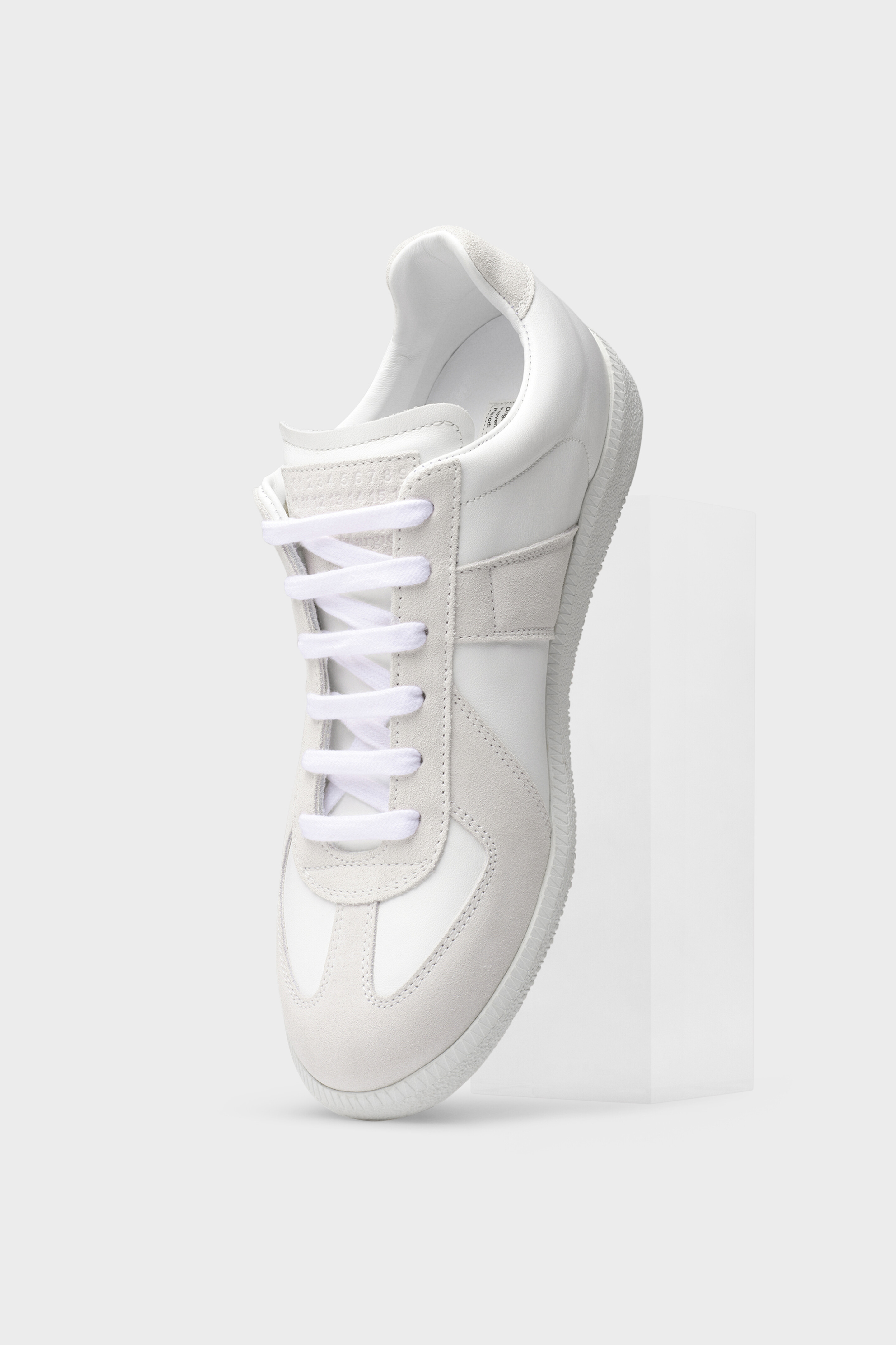
The Replica sneaker is Margiela's answer to the German Army Trainer: a low-profile court shoe with a slightly bulbous toe and minimal branding. It launched in 2016 as part of the house's Replica line, which recreates archival sportswear with subtle updates. The upper is usually calfskin or suede, occasionally canvas. The sole is margom rubber. The laces are flat waxed cotton. The only branding is a small numeric code printed on the tongue and a tonal logo at the heel.
Retail is around €475, which is steep for what looks like a no-frills trainer until you handle the construction. The leather is supple but structured, the toe box is reinforced without visible stitching, and the insole is cushioned enough for all-day wear. They come in white, grey, black, occasionally seasonal colours like burgundy or forest green. White is the default, and it's the version that makes the most sense—clean enough to work with tailoring, casual enough for denim, substantial enough that they don't read as minimal white sneakers.
They crease at the toe box. The sole yellows slightly with wear. Both are fine. These are meant to look worn in, not kept pristine.
The grail: Oversized blazer
If you're ready to commit, Margiela's oversized blazers are where the house's tailoring philosophy becomes legible. The shoulder extends past your natural line by several centimetres, the sleeves run long enough to cover half your hand, and the button stance sits low enough that the whole garment reads as borrowed. Except it isn't. The proportions are calculated—the extended shoulder balances the dropped button, the long sleeve counterweights the short body length—and the result is a blazer that looks unconstructed but behaves like proper tailoring.
Expect to pay upwards of €1,800, depending on cloth. The house uses Italian wool, usually a lightweight worsted or a textured hopsack, occasionally linen for spring. The lining is partial, sometimes absent entirely, with exposed seams at the shoulder and armhole. The label is stitched to the outside at the back neck. The buttons are usually horn, occasionally corozo, always functional.
This is a piece that requires confidence. It doesn't work if you're tentative about the fit. But if you've spent time with the house's other pieces and understand how Margiela uses volume, the oversized blazer becomes the logical centre of a wardrobe. You'll wear it over T-shirts, over knits, occasionally over other shirts with the sleeves pushed up. It works because the cut is specific, not because it's directional.
Longevity and care
Margiela pieces aren't precious, but they do require attention. The Tabi boots benefit from regular conditioning—use a neutral cream on leather, a suede brush on napped finishes. The knitwear should be hand-washed or dry-cleaned, never machine-washed, and stored flat to prevent shoulder distortion. The Replica sneakers can be wiped down with a damp cloth; don't put them in the washing machine. Tailoring should be pressed with a cloth between the iron and the fabric, especially if the seams are exposed.
The house builds for longevity, not indestructibility. The white labels will fray. The leather will crease. The knits will pill slightly at friction points. All of this is fine. Margiela's appeal has always been in the wearing, not the preserving. If you buy a piece and it still looks untouched after a year, you've bought the wrong thing.