Margiela doesn't make shoes that announce themselves
Margiela doesn't make shoes that announce themselves. The house makes shoes that become legible after you've worn them for six months—after the sole has scuffed in a particular pattern, after the leather has creased where your foot actually bends, after the paint on a Tabi toe has chipped in a way that looks like intention. This is not an accident. The atelier has always been more interested in time than trend, in the garment as it ages rather than the garment as it ships.
The problem is that most of what passes for 'experimental' footwear collapses under regular use. A deconstructed heel that photographs beautifully often can't survive a cobblestone commute. Paint-splattered calfskin looks compelling until the paint flakes off in sheets after three wears. Margiela's reputation rests on making pieces that look unfinished but are built to last—a harder trick than it sounds. The house uses Vibram soles where others use cemented rubber. The Tabi's split-toe construction, which seems like pure provocation, actually distributes weight more evenly than a conventional toebox. These are choices that matter at month eight, not at checkout.
What follows are three models that hold. Not in the aspirational sense—in the mechanical sense. Tested over seasons, repaired when necessary, still in rotation.
Tabi Boot
The split toe is the obvious part. What's less obvious is that the Tabi's leather upper is a single piece, wrapped and stitched with minimal seaming. Fewer seams mean fewer failure points. The boot sits on a stacked leather heel and a Vibram half-sole that can be replaced when it wears through. Most boots in this price range use a full rubber sole that has to be stripped and rebuilt—more expensive, more invasive. Margiela's construction assumes you'll resole it.
The shaft height varies by season, but the 35mm heel and the 8mm toe split remain constant. That consistency matters. If you're committing to a Tabi, you're committing to a silhouette that doesn't shift every six months. The house has made them since 1988. The current iteration uses the same last.
Two years in, the leather around the ankle softens enough that the boot stops fighting your gait. The split toe, which initially feels like wearing someone else's feet, becomes neutral. You stop thinking about it. The heel stack weathers to a matte patina that looks better than the original black polish. If the topstitching frays, a cobbler can reinforce it without disrupting the upper. I've had mine resoled once. The boot looks more itself now than it did new.
Retail starts around €890 for calf, closer to €1 100 for patent or treated finishes. Used market is active but not reliable—fakes are common, and a Tabi that's been worn hard by someone else won't conform to your foot the way a new pair will.
Replica Sneaker
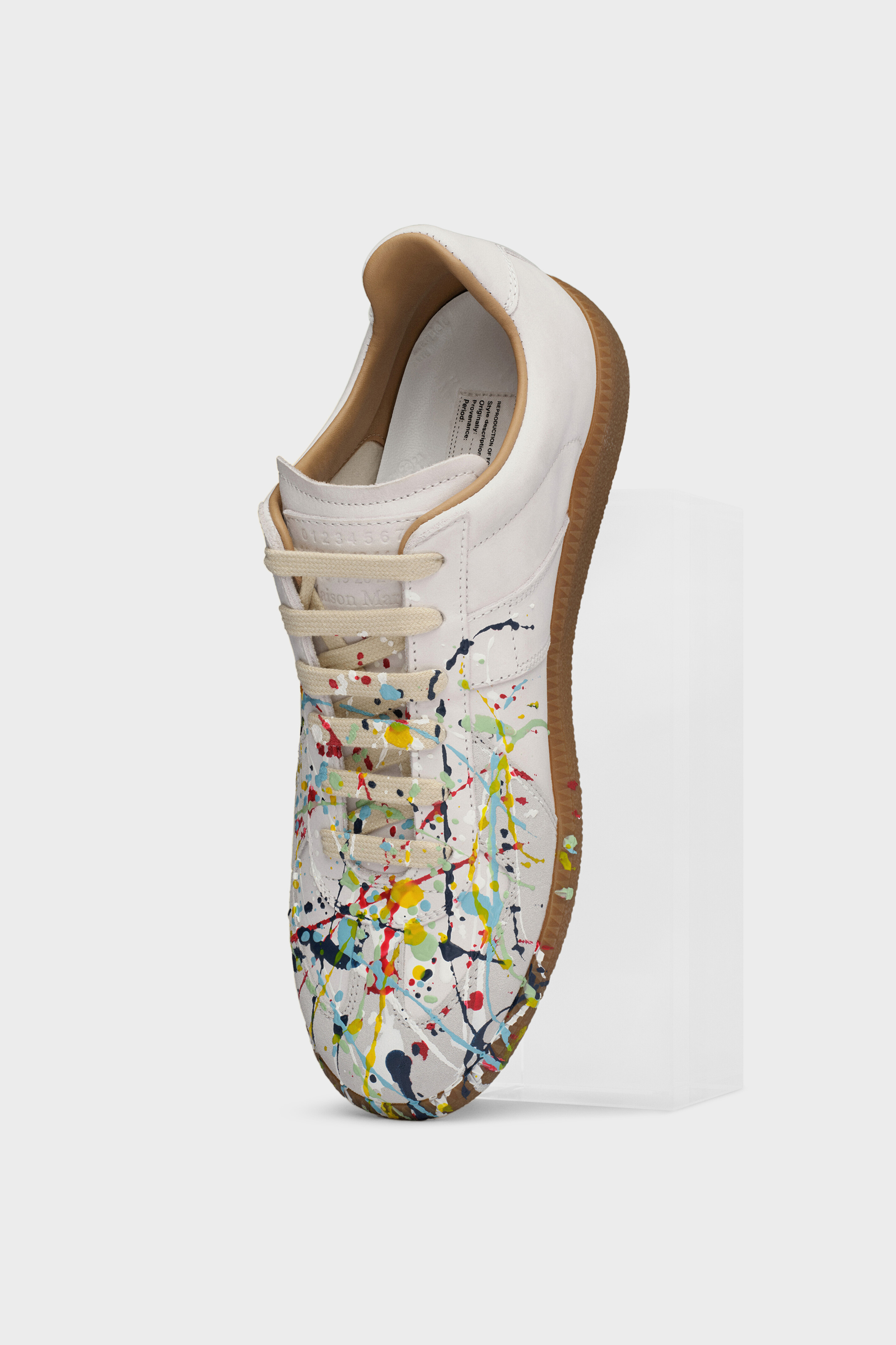
The Replica is Margiela's answer to the German Army Trainer, which is to say it's a direct copy with better materials and a higher price. The house doesn't pretend otherwise. The name is printed on the tongue. The silhouette is borrowed, the construction is not.
The upper is Italian calfskin, not the coated textile most GATs use. The sole is a Vibram Gumlite compound, thicker and more shock-absorbent than the rubber slab on a vintage trainer. The toe cap is reinforced with an internal thermoplastic counter that holds its shape after repeated flexing. These are not details you notice in the first month. They're details you notice when the shoe is still wearable after the first year.
The Replica doesn't look precious. It looks like a gym shoe that someone made too well. That's the point. It ages into itself—the calf scuffs, the sole yellows slightly, the heel counter compresses where your Achilles sits. None of this reads as damage. It reads as use.
The fit runs narrow, especially through the midfoot. If you're between sizes, go up. The leather will give, but not enough to compensate for a half-size gap. I've worn mine three or four days a week for eighteen months. The sole shows wear at the ball of the foot but hasn't separated from the upper. The calfskin has darkened a shade, particularly around the laces. A sneaker cleaning service can reset the colour, but I haven't bothered.
Retail sits around €475. The resale market is flooded with early-season colourways, some of which used a thinner sole. Check the production code on the tongue—anything post-2021 uses the current Vibram spec.
Security Boot
This is Margiela's steel-toe work boot, stripped of the steel and rebuilt in waxed calf. It's heavier than it needs to be, which is part of the appeal. The boot weighs about 650 grams per shoe. You feel it when you walk. That weight comes from a full-grain leather upper, a Goodyear-welted sole, and an internal shank that runs the length of the footbed. The welt means the sole can be replaced without touching the upper. Most boots at this price use a Blake stitch, which is lighter and sleeker but can't be resoled as many times.
The lace hooks are cast metal, not stamped. The tongue is gusseted, so water doesn't run straight into the boot. The insole is vegetable-tanned leather that moulds to your foot over time, not foam that compresses into nothing after a season. These are choices that add cost and weight but extend the boot's working life by years.
The waxed finish repels water and stains until it doesn't—usually around month four, when the wax starts to wear through at the flex points. You can reapply wax or let the leather darken naturally. Either way, the boot ages visibly. It's not for everyone. If you want footwear that looks the same at year two as it did at purchase, buy patent.
I've had mine for three years. Resoled once, re-waxed twice, still structurally sound. The leather has creased heavily across the vamp, and the eyelets have worn smooth where the laces pass through. The boot looks used. That's what it's built for.
Retail around €795. Occasional markdowns at end of season, but the house doesn't discount heavily. Used pairs are worth inspecting closely—if the welt stitching is frayed or the shank is audibly loose, walk away.
On Longevity
Margiela footwear is built to be repaired, not replaced. That means finding a cobbler who works with Goodyear welts and Vibram soles, ideally one who's seen a Tabi before and won't try to talk you into a conventional toe. Most major cities have at least one atelier-level repair shop. Expect to pay €80–120 for a resole, more if the welt needs rebuilding.
Clean leather uppers with a damp cloth and saddle soap, never a solvent-based cleaner. Condition waxed finishes every few months if you wear them regularly. Store boots with shoe trees—cedar if you can, plastic if you can't. The shape matters more than the material. A boot that collapses between wears will crease wrong and wear unevenly.
Most of what Margiela makes is designed to show its age. Let it.