Versace doesn't do quiet
Versace doesn't do quiet. The house has spent four decades making sure of that. But underneath the Medusa hardware and the Barocco prints, there's a bag construction logic that's surprisingly considered—structured frames, thoughtful compartment layouts, leathers that hold shape season after season. The bags you see on the runway often arrive in stores six months later with the proportions adjusted, the chain shortened by two links, the interior re-engineered to accommodate a phone that didn't exist when the sample was made. That's the part that doesn't photograph.
The five bags below represent different registers within the house vocabulary. Some lean into the iconography. Others pull back just enough to let the construction speak. All of them share a common trait: they look like Versace made them, which means they look like nothing else in your wardrobe. If you're buying into the house, you're buying into that specificity. There's no point in half-measures. The question isn't whether a Medusa plaque is too much—it's whether you're ready to wear the bag that earns it.
What follows is one word per bag. The word that does the work.
Emblème
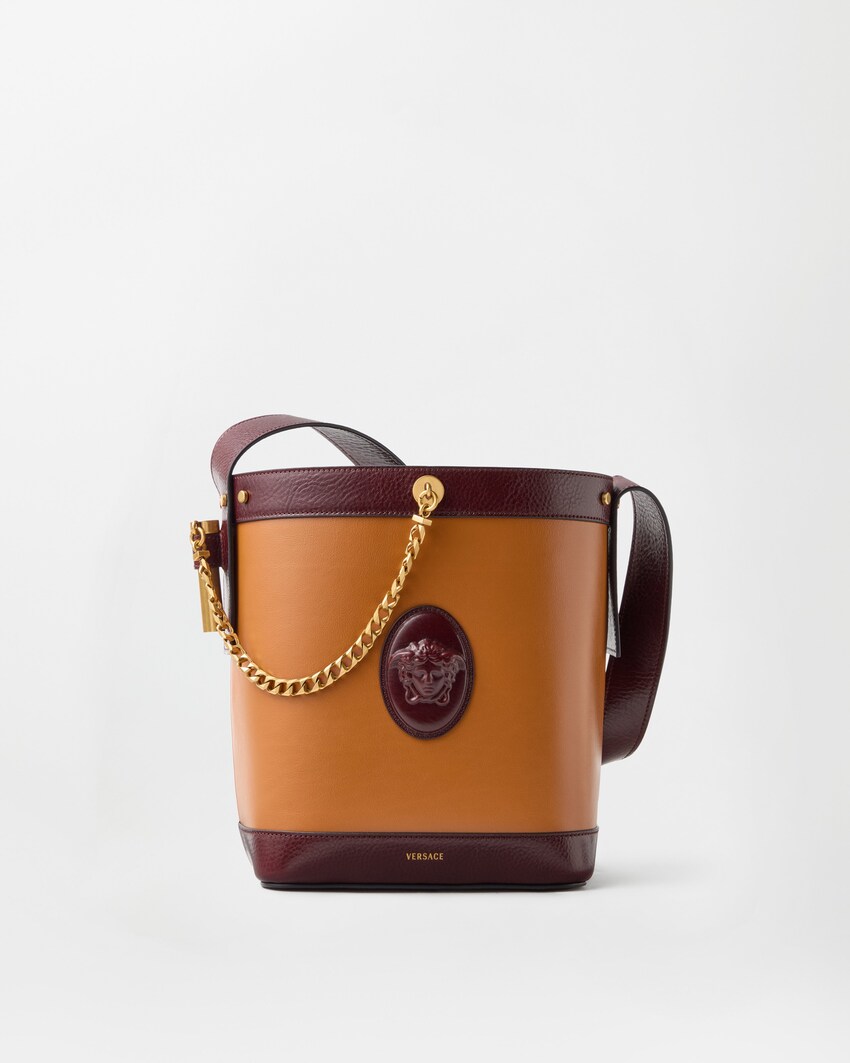
The La Medusa bag carries the house codes without apology. The Medusa head sits centred on the flap, cast in metal that catches light from across a room. It's not subtle. It's not trying to be. The bag exists because Versace decided a generation ago that its mythology belonged in three dimensions, and the Medusa—pulled from the floor mosaics of Reggio Calabria—was the mark that could carry that weight.
The frame is structured calf, usually in black or a deep jewel tone. The interior is partitioned: a central zip compartment flanked by two open pockets. The chain strap is thick enough to feel like hardware, not jewellery. You can shorten it to sit under the shoulder or extend it to cross-body, though the bag's width makes the latter less practical than it sounds. This is a bag built to be seen from the front.
It works best in contexts where the rest of the outfit can absorb the visual load—solid knits, tailored trousers, nothing competing for attention. The Medusa does that on its own. In Milan, you see this bag on women who've been buying Versace since the Nineties, and on women who discovered the house last year. Both groups wear it the same way: as the loudest thing they're carrying.
Souplesse
The Virtus tote surprised people when it launched. Versace had spent years refining its evening and occasion bags, and here was something designed for the commute. The tote is unlined grained calf—supple enough to compress when empty, structured enough to hold shape when full. The top stays open unless you zip the interior pocket, which some buyers do and others ignore entirely.
The handles are a single loop of leather, reinforced where they attach to the bag body. There's no shoulder strap. This is a hand-carry piece, and the proportions reflect that. It's wider than it is tall, which makes it practical for laptops and files but less so for anything requiring vertical space. The Virtus plaque—a smaller, simplified Medusa—sits low on the front, almost an afterthought.
What makes the bag work is the leather. Versace sources a matte vacchetta that softens with use but doesn't lose structure. After six months, the handles develop a slight patina where your hand grips. After a year, the bag looks like it's been somewhere. It's one of the few pieces in the Versace lineup that improves with age rather than simply enduring it.
You see this bag in the Quadrilatero on weekday mornings, usually in black or a neutral tan. It's the choice for buyers who want the house's construction standards without the full iconographic load. The Medusa is there, but it's not leading.
Contraste
The Barocco-print bags are the house at full volume. The print itself—a dense tangle of acanthus scrolls, Medusa heads, and gold filigree—was developed in the early Nineties and has been reissued in different scales and colourways ever since. When it's applied to a bag, it transforms the leather into something closer to tapestry.
The print works best on smaller formats: crossbody styles, top-handles, evening clutches. Anything larger risks becoming illegible, the pattern collapsing into visual noise. Versace knows this. The Barocco bags in current production tend to hover around twenty to twenty-five centimetres in width, small enough that the print reads as deliberate rather than overwhelming.
The construction underneath is usually a rigid frame with minimal hardware—the print does enough work on its own. Interiors are clean, often a single compartment with a zip pocket. The chain straps are fine-gauge, closer to jewellery than the heavy links on the Medusa bags. This is a bag you wear when the rest of the outfit is edited down: black trousers, a white shirt, nothing that competes.
It's not for everyone. But if you're buying Versace, you're presumably comfortable with the house's maximalist streak. The Barocco print is that streak distilled.
Discrétion
The Icon bag pulls back. It's still Versace—there's a small Medusa charm on the zip pull—but the overall silhouette is restrained. Smooth calf, minimal hardware, a clean rectangular shape that could almost pass for anonymous if it weren't for the leather quality.
The bag comes in two sizes: a small crossbody and a medium shoulder style. Both use the same construction: a structured base that tapers slightly toward the top, a single-compartment interior, an adjustable strap that's leather rather than chain. The Medusa charm is the only overt branding, and it's small enough that you'd miss it from a distance.
This is the bag for buyers who want Versace's atelier standards without announcing it. The leather is the tell—supple, matte, with a hand that's distinctly Italian. It's not the same calf you'd find on a contemporary brand's crossbody. It's denser, more substantial, the kind of material that holds a crease and then releases it.
In practice, the Icon works as a daily bag in a way the Medusa and Barocco styles don't. It's quiet enough to wear five days a week, but specific enough that it doesn't disappear into the wardrobe. You're still buying into the house. You're just not leading with it.
Héritage
The Greca-border bags reference the house's earliest visual language. The Greek key motif—Versace's Greca pattern—runs along the edges of the bag, either embossed into the leather or rendered as a metal trim. It's a quieter code than the Medusa, but it's been part of the house vocabulary since Gianni founded the label in 1978.
The bags that carry the Greca tend to be structured top-handles or small shoulder styles. The pattern works best as a border, framing the bag rather than covering it. When Versace applies it well, the Greca adds a architectural quality to the silhouette—clean lines, right angles, a sense of deliberate geometry.
The leather is usually smooth calf in a solid colour. Black, ivory, deep burgundy. The Greca pattern provides enough visual interest that the bag doesn't need additional hardware or embellishment. Interiors are simple: one or two compartments, a zip pocket, nothing extraneous.
This is the bag for buyers who know the house history. The Greca doesn't announce itself the way the Medusa does, but it's arguably a deeper reference. It's the pattern Gianni used on the first runway invitations, the detail that appeared on column hems and belt buckles before the Medusa became ubiquitous. If you're buying a Greca bag, you're buying into a specific chapter of the archive.
Entretien
Versace bags are built to last, but they require maintenance. The structured styles—Medusa, Icon—should be stored upright with the interior stuffed to hold shape. The softer leathers on the Virtus and some Greca styles will develop patina; that's intended, but if you want to slow it, keep them out of direct sun and condition the leather twice a year with a neutral cream.
Hardware tarnishes. The Medusa plaques and chain straps are metal, not plated, which means they'll dull over time. A jeweller's cloth brings back most of the shine. For the Barocco-print bags, avoid water—any moisture will darken the print permanently. If you're caught in rain, blot immediately and let the bag dry flat, unstuffed.
Versace offers repair services through its boutiques, though turnaround can stretch to three months depending on the work required. Most buyers I know take their bags to independent leather specialists in Milan for strap replacements and edge recolouring. It's faster, and often better. The house builds well, but it doesn't always service well. Plan accordingly.