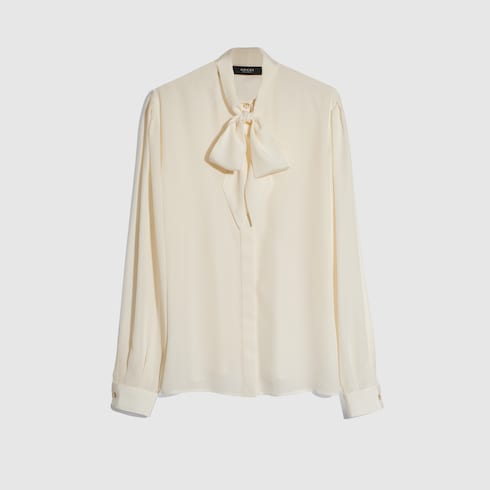
Gucci : les artisans qui font le travail
The atelier sits on the fifth floor of a converted silk factory in Florence, and if you arrive at seven in the morning — which is when the light is best — you will find Lucia Moretti already at her bench, a Horsebit loafer half-assembled in front of her. She has been with Gucci for thirty-two years. The loafer in question, a women's size thirty-seven in black calfskin, will carry her initials on a small leather tag inside the insole, though almost no one who buys the shoe will ever notice it.
This is not an oversight. It is policy.
For decades, Gucci operated under a model common to most large maisons: the work was collective, the signature singular. The atelier produced; the creative director received credit. One can argue that this arrangement made sense within the structure of twentieth-century fashion, where a house name functioned as both trademark and mythos. But it also rendered invisible the people who cut the patterns, stitched the canvas, and heat-set the metal hardware that gives a Horsebit its satisfying click.
That began to shift, quietly, around 2019. Not with fanfare — Gucci is not in the habit of announcing incremental change — but with a series of decisions that, taken together, amount to something like a reckoning. The house began crediting individual artisans in certain press materials. It launched an internal initiative, Gucci Artisan Corner, which pairs junior leather workers with senior craftspeople for two-year apprenticeships. And it started placing those small leather tags, each bearing an artisan's initials, inside select pieces from the core collection.
The loafer is one of them.
Formation
Moretti did not set out to make shoes. She trained, initially, as a patternmaker for women's tailoring, a three-year programme at Florence's Istituto Marangoni in the late eighties. The curriculum was traditional: draping, grading, hand-finishing. She graduated with decent marks and no clear direction. A friend's mother worked in Gucci's leather goods division and mentioned an opening in the footwear atelier. Moretti applied, was hired, and spent her first six months learning to skive leather — the process of thinning an edge so two pieces can be joined without visible bulk.
"It is the least romantic part of the work," she told Il Corriere della Sera in a 2021 profile, one of the few interviews she has given. "You stand at a machine for hours. Your hands smell of tannin. But if you cannot skive a clean edge, you cannot make a shoe that will last."
She stayed.
The Horsebit loafer, in its current form, descends from a design introduced in 1953. The original was a men's style, low-heeled and slip-on, distinguished by a metal snaffle bit across the vamp — a reference to the house's equestrian roots, which at the time were less metaphor than fact. Guccio Gucci had worked as a porter at the Savoy in London before returning to Florence to open a leather goods shop, and the clientele he served in those early years were landed families who required saddles, bridles, and luggage sturdy enough to survive the journey between city and country estate.
The loafer was a commercial success almost immediately. By the nineteen-sixties it had been adopted by a particular slice of the American upper-middle class — the kind of people who summered in the Hamptons and used 'summer' as a verb — and by the seventies it had become, for better or worse, a signifier. Wealth, yes, but also a certain worldview: understated, Anglophile, discreetly branded.
Moretti works on the women's version, which was introduced in the early nineties and differs from the men's in heel height, last shape, and the width of the bit itself. She estimates she has made somewhere between eight and ten thousand pairs. She does not keep count.
Process
A Horsebit loafer requires forty-three discrete steps, beginning with the cutting of the upper and ending with the application of a protective sole guard. Moretti is responsible for steps twelve through twenty-seven, which cover the assembly of the upper, the attachment of the bit, and the lasting — the process by which the leather is stretched over a wooden form and held in place while the sole is stitched.
The bit itself is die-cast in a facility outside Arezzo, then plated and polished by hand. It arrives at the atelier in batches of five hundred, each one inspected for surface flaws before it is approved for use. The attachment is deceptively simple: two screws, countersunk and covered with leather caps. But the placement must be exact. If the bit sits even two millimetres off-centre, the shoe will look wrong in a way that is difficult to articulate but impossible to ignore.
Moretti uses a jig, a small metal template that she positions against the vamp before marking the screw holes with a fine awl. She has done this so many times that she no longer needs to measure twice. The jig goes down, the awl goes in, the bit is screwed into place. Four minutes, start to finish.
"People ask if it is boring," she said in the Corriere interview. "I tell them it is like playing scales. You do not play scales because they are interesting. You play them so that when the time comes to play something difficult, your hands know what to do."
The others
Moretti is not the only artisan whose initials now appear inside Gucci's core pieces. There is Marco Bellini, a leather cutter in the Scandicci workshop, who has spent twenty-eight years cutting the panels for the house's structured handbags. There is Alessandra Conti, who embroiders the floral motifs that appear on certain evening bags, working from drawings that are sometimes centuries old. And there is Stefano Ricci — no relation to the Florentine menswear designer of the same name — who operates the hydraulic press that embosses the interlocking-G logo onto leather goods.
Each of them has been with Gucci for more than two decades. Each of them was trained, in part, by someone who is no longer there.
This is the unspoken fact beneath the house's recent attention to craft: the people who know how to do this work are aging out, and the pipeline to replace them is not what it was. In the nineteen-eighties, a young person in Florence or Milan could expect to find steady work in a fashion atelier, with wages that, while not extravagant, were sufficient to build a life. That is no longer the case. Rents have risen. Wages have not kept pace. And the work itself — manual, repetitive, requiring years of apprenticeship before one is trusted with anything consequential — does not hold the same appeal it once did.
Gucci's Artisan Corner programme is, in part, an attempt to address this. The house now recruits directly from technical schools, offering two-year contracts that include housing stipends and a guarantee of full-time employment upon completion. The first cohort, which began in 2020, included eleven people. Eight of them are still with the house.
What remains
On a practical level, the initialled tags change very little. The loafers are made the same way they have always been made. The price — €850 for the women's style, as of this writing — reflects the labour involved, though one suspects it would be the same with or without the tag. And the customer who buys the shoe is, in most cases, buying it for reasons that have nothing to do with Lucia Moretti's thirty-two years at a bench in Florence.
But the tag is there. And that, on balance, is worth noting.
It does not solve the structural problems facing artisanal production in Italy — the wage stagnation, the rising cost of living, the fact that a young person with Moretti's aptitude might now choose software engineering over leatherwork, and who could blame them. But it does, at minimum, acknowledge that the work is done by someone. That the loafer does not materialise fully formed in a boutique on Via Condotti, but is assembled, piece by piece, by a person whose hands smell of tannin and who has spent three decades learning to skive a clean edge.
One can argue that this is the least a house can do. One can also argue that, until recently, most houses were not doing it.
Moretti will retire in four years. She has already begun training her replacement, a woman named Chiara Bianchi, who joined the atelier eighteen months ago and is currently on step nine of the forty-three-step process. When Moretti leaves, Bianchi's initials will go inside the shoe.
The work continues. The names change. The loafer, for now, remains.