Les fondateurs de Burberry
Thomas Burberry opened his first shop in Basingstoke in 1856, at twenty-one, selling outdoor clothing to farmers and sportsmen. He was not a tailor in the Savile Row sense. He was a draper with a practical bent, and his customers needed things that worked in wet fields and cold mornings. The shop did well. Within fifteen years, he had outgrown it.
What set him apart was an obsession with cloth. In 1879, Burberry patented gabardine, a tightly woven twill made from worsted yarn that had been waterproofed before weaving. The result was a fabric that shed rain without the weight or stiffness of rubberised cotton. It breathed. It moved. It was, by the standards of Victorian outerwear, a revelation. Gabardine became the house signature long before the check ever did.
The early customer base was military and exploratory. Burberry supplied coats to officers heading to the Boer War, to Shackleton's Antarctic expeditions, to Amundsen at the South Pole. The Tielocken coat, introduced in 1912, was a precursor to the trench. It had a belt, storm flaps, and a throat latch. It was designed for men who spent time outside in bad weather and needed both hands free. Function dictated every detail.
The trench coat itself arrived during the First World War, developed for officers in the trenches. Burberry's version—officially the Tielocken, unofficially the trench—had D-rings for grenades, epaulettes for rank insignia, a storm shield across the right shoulder to shed water from a rifle. It was a piece of kit that happened to have a clean line. After the war, men kept wearing it. So did women. By the 1920s, the trench had migrated from the front to the street, and Burberry had a silhouette that would outlast every other thing it made.
Thomas Burberry died in 1926. The company passed to his sons, then to professional management. The house continued to make raincoats and expand into sportswear, but it lost the plot somewhere in the middle of the twentieth century. By the 1980s, Burberry was a sleepy heritage brand with a loyal but aging customer base and a licensing strategy that had diluted the name beyond recognition. The check—originally a coat lining, introduced in the 1920s—was everywhere. Scarves, umbrellas, dog leads, baseball caps. It became shorthand for a certain kind of British aspiration, and then for a certain kind of British excess. The brand was in trouble.
Rose Marie Bravo arrived as CEO in 1997, recruited from Saks Fifth Avenue. She hired Christopher Bailey the following year. Bailey had trained at the Royal College of Art, worked at Donna Karan, then spent two years as a senior designer at Gucci under Tom Ford. He was twenty-seven when he joined Burberry as design director. His brief was to make the house relevant again without erasing what it actually was.
Bailey's first collection for Burberry Prorsum—the runway line—debuted in 1999. It was not a revolution. It was a careful edit. He kept the trench, the gabardine, the military references. He tightened the cuts, updated the proportions, and used the check sparingly. The approach was conservative in the best sense: he treated the archive as a working resource, not a museum. Within a few seasons, Burberry had a younger customer and a clear design language. By 2004, Bailey was creative director. By 2014, he was also CEO.
His tenure was defined by consistency. The trench remained the anchor. Each season brought variations—leather trenches, lace trenches, trenches in technical nylon or shearling—but the silhouette stayed legible. Bailey understood that Burberry's strength was not in reinvention but in refinement. He also understood digital. Burberry was early to livestream shows, early to integrate e-commerce with editorial, early to treat social media as a primary channel rather than an afterthought. The strategy worked. Revenue grew from £600 million in 2002 to over £2.5 billion by 2016.
But the formula had limits. By the mid-2010s, the trench-and-check playbook felt exhausted. The brand was visible, profitable, and stuck. Bailey's collections were accomplished but predictable. The runway became a showcase for product rather than a point of view. In 2017, he stepped down as CEO. In 2018, he left the company entirely.
Riccardo Tisci took over as chief creative officer in March 2018. His background—Givenchy, couture, a gothic sensibility—seemed at odds with Burberry's polite Britishness. His first collection, shown that September, replaced the house's serif logo with a sans-serif monogram designed by Peter Saville. The check was nowhere. The clothes leaned into streetwear, oversized silhouettes, and a younger, more urban customer. It was a sharp turn, and the reaction was mixed.
Tisci's Burberry never quite cohered. The monogram felt like a rebrand for its own sake. The clothes were competent but lacked a clear narrative. The trench appeared, but it was no longer the centre of gravity. By 2022, sales were flat, and the house was searching again.
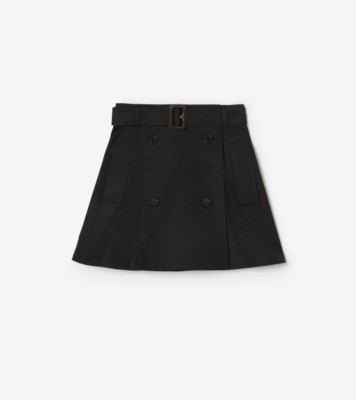
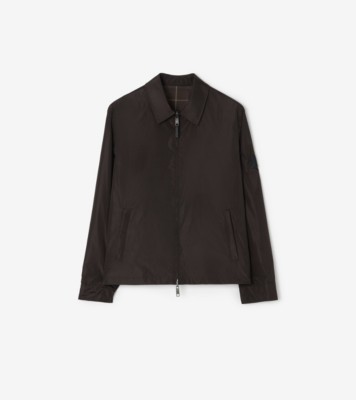
Daniel Lee arrived in September 2022, hired from Bottega Veneta. His first show, in February 2023, was a reset. The check returned, but abstracted—enlarged, cropped, reworked into jacquard and knitwear. The trench was there, but so were parkas, peacoats, and utilitarian outerwear that referenced Burberry's early sportswear rather than its military heritage. Lee's approach was less about nostalgia and more about utility. He spoke, in interviews, about making clothes that people would actually wear. The collection felt like a house remembering what it used to be good at.
What remains of Thomas Burberry's original vision is not the check or the monogram or the runway spectacle. It is the gabardine. It is the idea that a coat should do something before it means something. Burberry has spent the last thirty years trying to be a fashion house, and it is one, but its foundation is in function. The trench works because it was designed to work. Everything else is decoration.
The question for Lee, and for whoever comes next, is whether that foundation is enough. Burberry is not a small atelier trading on craft. It is a publicly traded company with shareholders and quarterly targets. It needs to sell more than coats. But the coats are still the reason anyone cares. The trick is to remember that.