Les muses de Acne Studios
Jonny Johansson stands in the Stockholm atelier on a February afternoon in 2019, pinning a sleeve that refuses to sit flat. The woman wearing it—tall, angular, utterly still—is not a model. She is a friend, a photographer, someone whose posture he has studied for years. "I don't design for an idea of a woman," he told System that season. "I design for the three or four I actually know."
This is not modesty. It is method.
Acne Studios, founded in 1996 as a denim collective and formalised as a ready-to-wear house in the early 2000s, has never trafficked in the aspirational feminine. No goddess on a runway. No muse in the nineteenth-century sense—passive, decorative, other. Instead, Johansson has built a vocabulary around women who move through his orbit: collaborators, artists, faces whose lives bleed into the work. Three in particular have shaped the house's silhouette, its palette, its way of seeing. Not because they wore the clothes well, though they did. Because they made him rethink what the clothes could be.
Sofia Coppola: The Collaborator Who Taught Restraint
Sofia Coppola appeared in Acne's universe in the mid-2000s, not as a hired ambassador but as a customer who happened to direct films. The connection was informal at first—she wore the jeans, the oversized blazers, the flat boots that telegraphed a certain kind of unbothered chic. By 2015, the relationship had deepened into something closer to a dialogue. Johansson began consulting her on colour, on proportion, on the question of how much detail a garment could bear before it became fussy.
What Coppola brought to Acne was a filmmaker's sense of frame. She understood negative space. Her own aesthetic—pale pink suede, cream cashmere, the occasional slash of black—mapped neatly onto Johansson's instinct for understatement, but she pushed him further toward quietness. The pre-fall 2016 collection, shot in Los Angeles with Coppola's input on location and casting, leaned hard into this restraint: wide-leg trousers in camel, a single-breasted coat with no visible closures, knitwear so fine it read as second skin.
"She doesn't want to be looked at," Johansson said in a Business of Fashion interview that year. "She wants to look." The distinction matters. Coppola's influence codified what had been latent in Acne's DNA—a wardrobe for women who observe rather than perform. The house's palette softened. Hemlines dropped. Shoulders, once aggressively padded in the Scandinavian tradition, began to slope.
One suspects Coppola would resist the term muse. She was never on a mood board. But her presence recalibrated the work, and the work, in turn, became a kind of uniform for a generation of women who wanted to be taken seriously without trying visibly hard.
Viviane Sassen: The Artist Who Fractured the Image
If Coppola taught Johansson about restraint, Viviane Sassen taught him about disruption. The Dutch photographer, known for her surreal, often unsettling fashion images, began collaborating with Acne in 2011. Her work—bodies obscured by shadow, faces turned away, colour deployed like a weapon—ran counter to the clean-lined minimalism the house was known for. Johansson hired her anyway.
Sassen's influence was not about wearability. It was about permission. Her campaigns for Acne, particularly the spring 2012 series shot in Senegal, introduced a visual language the house had not yet spoken: high contrast, deliberate awkwardness, compositions that refused to flatter. A model crouched in a pink dress, her face hidden by a scarf. Another stood in a field, her body bisected by hard light. The clothes were recognisable—Acne's signatures remained intact—but the context had shifted. Fashion, in Sassen's frame, became something stranger, less legible.
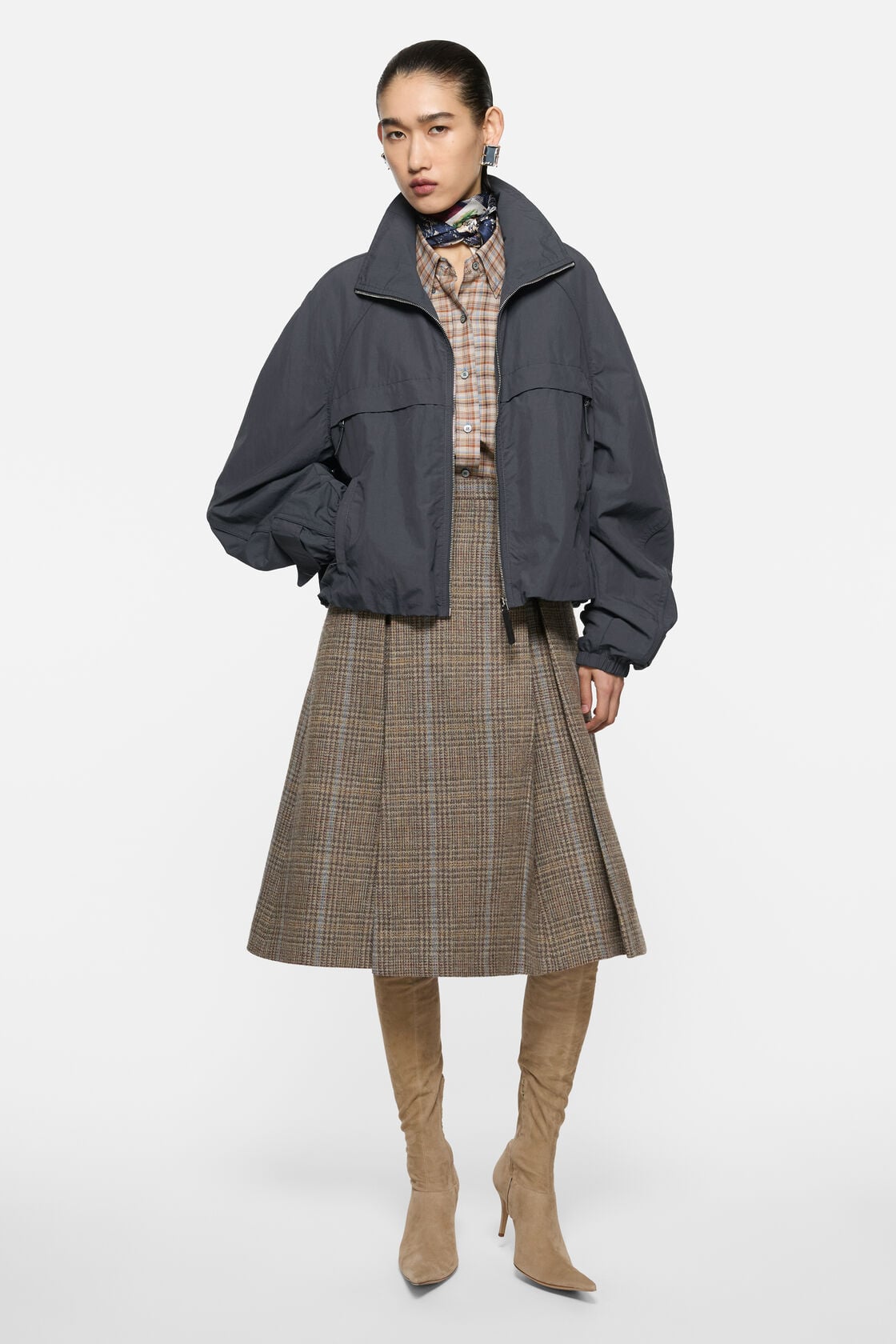
This opened a door. Johansson began experimenting with silhouettes that didn't resolve neatly. Asymmetric hems. Sleeves that bunched. Trousers that pooled at the ankle in a way that suggested accident rather than design. The autumn 2013 collection, shown in Paris, leaned into this new vocabulary: models walked in oversized parkas paired with delicate slip skirts, their proportions deliberately off. It was not quite deconstruction—Acne has never been an avant-garde house—but it was a loosening, a willingness to let the garment behave unpredictably on the body.
Sassen's campaigns ran through 2014, and her aesthetic fingerprints remain. Acne's lookbooks still favour odd crops, stark backdrops, models who seem caught mid-thought rather than mid-pose. The house learned, through her lens, that beauty could be oblique.
Beca Lipscombe: The Stylist Who Defined the Uniform
Beca Lipscombe is less known outside the industry, which is precisely the point. A London-based stylist who has worked with Acne since the late 2000s, Lipscombe does not court visibility. She builds wardrobes. Her clients—actors, writers, women who move between industries—wear Acne as a default, not a statement. Johansson has called her "the person who understands how the clothes actually live."
What Lipscombe brought to the house was pragmatism. She styled the pre-fall 2018 collection, and her influence is evident in the lineup: trench coats cut long enough to cover boots, sweaters with sleeves that didn't ride up, trousers with proper pockets. These are not revolutionary gestures, but in a market saturated with impractical runway pieces, they register as radical. Lipscombe's clients wear Acne to meetings, to dinners, to the school run. The clothes do not announce themselves.
This is the wardrobe Johansson has spent two decades refining, and Lipscombe has been its most articulate translator. She understands the house's codes—the oversized scarf, the flat leather boot, the blazer worn open over a T-shirt—and she knows how to deploy them without fuss. Her work is invisible in the best sense. The women she dresses look like themselves, only slightly more considered.
Acne's commercial success, particularly in the UK and US markets, owes much to this wearability. The house has never chased the avant-garde, and Lipscombe's influence ensured it wouldn't need to. She made the case, season after season, that a well-cut coat and a pair of jeans could be enough.
What Remains
Johansson sold a majority stake in Acne Studios to a private equity firm in 2019, and the house has since expanded aggressively—more stores, more categories, a broader customer base. The question, as always with growth, is whether the original vision holds.
On balance, it does. The autumn 2024 collection, shown in Paris, still bore the marks of these three women: Coppola's restraint in the muted palette, Sassen's strangeness in the styling, Lipscombe's pragmatism in the cut. The clothes were not revolutionary. They were considered, intentional, made for women who have better things to do than perform femininity.
Johansson no longer pins sleeves in the Stockholm atelier—he has a team for that now—but the method remains. He still designs for the women he knows. And they, in turn, have shaped a house that refuses to shout.