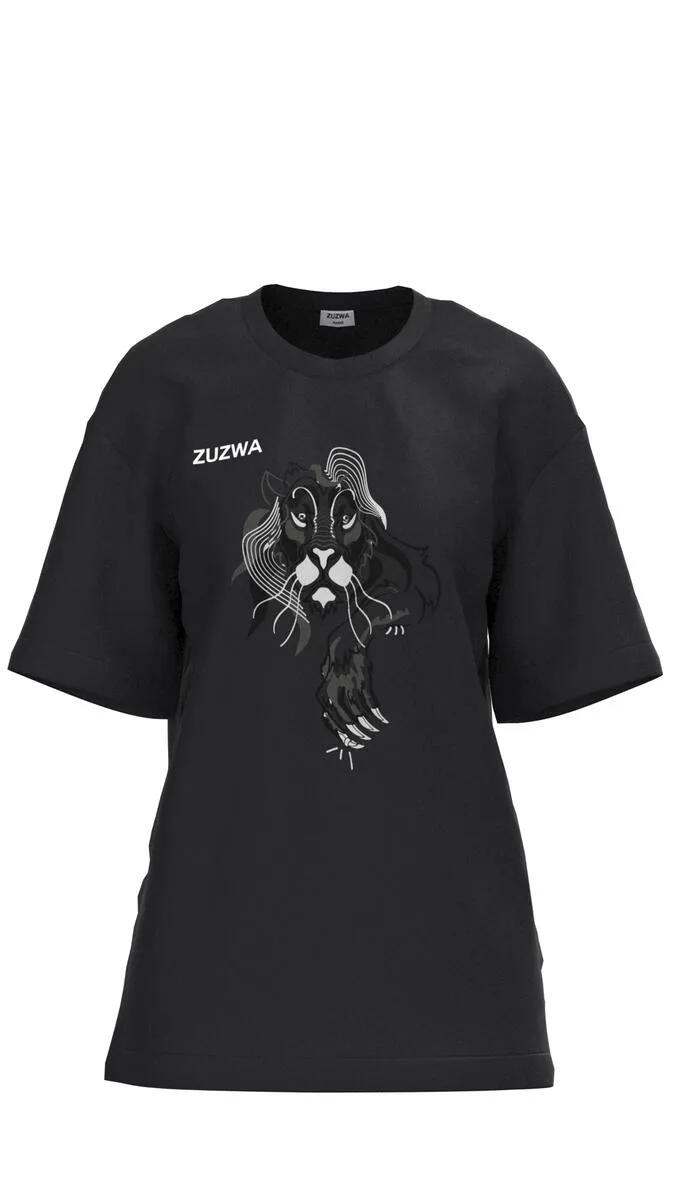
Les muses de ZUZWA
The fitting room at ZUZWA's Paris atelier smells of pressed linen and something sharper — bergamot, maybe, or the faint trace of a client's perfume from the morning session. Zuza Wachowska stands behind a woman in her late fifties, adjusting the fall of a sleeve. The garment is ivory, cut wide through the shoulder, narrowing at the wrist. It moves when the woman lifts her arm, then settles without fuss. Wachowska steps back, nods, says nothing. The client exhales.
This is how ZUZWA works. Not through manifesto or mood board, but through the accumulated intelligence of women who have worn the clothes, tested them, and returned with notes. Since the house launched in 2018, Wachowska has built her reputation on a particular kind of conversation — one conducted in cloth, not words. And while she is the designer, the house has been shaped as much by three women who became its unwitting architects. They are not models. They are not ambassadors. They are muses in the original sense: sources of instruction, not decoration.
Anna Kowalska: the pragmatist
Anna Kowalska met Wachowska in 2016, two years before ZUZWA existed as a registered entity. Kowalska was then the head of strategy at a Warsaw-based tech firm, a role that required her to move between boardrooms, client dinners, and long-haul flights with no time to think about what she was wearing. She had money but no patience for fashion that demanded maintenance. When a mutual friend introduced them at a gallery opening, Kowalska mentioned, in passing, that she had not found a blazer that worked for her body in five years.
Wachowska offered to make one.
The result was a single-breasted jacket in charcoal wool, cut with a high armhole and a soft shoulder that required no padding. The lapel was narrow, the pockets functional, the lining silk but not slippery. Kowalska wore it twice a week for a year. She asked for another in navy. Then one in linen for summer. By the time ZUZWA debuted its first collection, Kowalska had commissioned eight pieces, each one a refinement of the last.
What Wachowska learned from Kowalska was the value of reduction. Kowalska did not want drama. She wanted a jacket that would last through a fourteen-hour day without wrinkling at the elbows, trousers that sat at the natural waist and stayed there, a coat that could be thrown on over knitwear without looking like an afterthought. She was, in effect, the house's first client and its sternest critic. If a pocket was two centimetres too low, she said so. If a button felt cheap, she sent the jacket back.
ZUZWA's signature silhouette — the high-waisted trouser, the boxy jacket with a nipped waist, the absence of visible branding — comes directly from Kowalska's brief. She wanted clothes that did not announce themselves. Wachowska gave her that, then built a collection around it.
Kowalska still wears ZUZWA. She has never appeared in a campaign.
Marta Lewandowska: the romantic
Marta Lewandowska is a violinist. She plays with the Warsaw Philharmonic and teaches at the Chopin University of Music. She met Wachowska in 2019, at a dinner hosted by a mutual acquaintance. Lewandowska had just returned from a tour of Japan and was wearing a vintage Yohji Yamamoto dress, black and voluminous, with sleeves that reached past her knuckles. Wachowska asked where she had found it. Lewandowska said she had bought it in Kyoto, in a shop so small she had to duck to enter.
They talked for two hours. Lewandowska wanted clothes that felt like armour but moved like air. She loved the weight of heavy linen, the way a skirt could swing when she walked, the drama of a sleeve that obscured the hand. She did not care about trends. She cared about proportion, about the relationship between body and fabric, about the way a garment could change the way you stood.
Wachowska invited her to the atelier the following week.
What emerged from that collaboration was ZUZWA's more experimental line — the pieces that appear in the lookbook but rarely make it to the shop floor. Lewandowska pushed Wachowska toward volume, toward asymmetry, toward the kind of garments that require a certain confidence to wear. A coat with a single oversized sleeve. A dress that fastened at the shoulder with a single button. A skirt that wrapped twice around the waist and fell to the ankle in uneven panels.
These pieces do not sell in large numbers. They are not meant to. But they give the house its range, its sense of possibility. Lewandowska wears them to performances, to openings, to dinners where she knows she will be photographed. She is not a model, but she understands the value of being seen.
Wachowska has said, in interviews, that Lewandowska taught her to trust her instincts. Kowalska had taught her discipline. Lewandowska taught her risk.
Joanna Mazur: the archivist
Joanna Mazur is a curator at the National Museum in Warsaw. She specialises in twentieth-century Polish design, with a focus on textile and fashion. She approached Wachowska in 2020, not as a client but as a researcher. She was working on an exhibition about post-war Polish tailoring and wanted to include contemporary examples. ZUZWA, she felt, was doing something that deserved documentation.
Wachowska agreed to participate. Mazur spent three months in the atelier, photographing patterns, interviewing seamstresses, cataloguing fabric samples. She was less interested in the finished garments than in the process — the way a sleeve was set, the order in which a jacket was constructed, the decisions that happened before the first cut.
What she found was a house that operated, in many ways, like a pre-industrial atelier. ZUZWA does not produce seasonal collections in the traditional sense. There is no runway show, no wholesale distribution. Clients order directly from the atelier, either from existing patterns or through bespoke commissions. The turnaround is six to eight weeks. The prices reflect the labour.
Mazur became a client by accident. She commissioned a coat for the exhibition opening — a double-breasted piece in camel wool, with a wide belt and deep pockets. She wore it every day that winter. She ordered another in grey.
What Wachowska learned from Mazur was the importance of archive. Mazur insisted that every pattern be kept, every fabric swatch labelled, every alteration noted. She introduced Wachowska to the concept of a house code — a set of recurring details that would define ZUZWA across decades, not seasons. The high waist. The functional pocket. The absence of lining in summer pieces. The use of natural fibres, always.
Mazur is now an informal advisor to the house. She does not design, but she shapes the way ZUZWA thinks about its own history.
What comes next
Wachowska is not interested in expansion. She has turned down offers from multi-brand retailers, declined invitations to Paris Fashion Week, refused to license the ZUZWA name for accessories or fragrance. The atelier employs eight people. The waiting list is four months long.
This is, by most measures, a small business. But it is also a sustainable one. The clothes are made to last. The clients return. The muses, all three of them, still commission new pieces.
Kowalska recently ordered a suit in pale grey worsted. Lewandowska is working with Wachowska on a series of capes for an upcoming performance. Mazur is cataloguing the house's first five years of production, with an eye toward a future exhibition.
ZUZWA does not need to grow. It needs to continue. And as long as the women who wear the clothes keep coming back with questions, adjustments, and new ideas, it will.