## Medusa in the Mirror
Medusa in the Mirror
The fitting room at Via Gesù 12, spring 1978. Gianni Versace stands behind a model wearing what will become the first piece in his debut collection: a leather jacket cut like a second skin, the seams positioned not where convention dictates but where the body actually moves. He pins, steps back, pins again. His sister Donatella, nineteen and platinum-blonde even then, watches from a gilt chair. Their older brother Santo is upstairs, working the numbers that will allow this moment to exist at all.
That triangle — creative vision, instinct, capital — is the structure upon which Versace was built. Strip away the Medusa logos and the celebrity front rows, and what remains is a family business that moved very fast and bet everything on a single aesthetic premise: that sex appeal, worn openly, could be a form of power rather than submission.
The Calabrian Start
Gianni Versace was born in 1946 in Reggio Calabria, the toe of Italy's boot, where his mother Francesca ran a dressmaking atelier. He learned pattern-cutting at her side, which means he learned it the old way — by hand, on paper, with an understanding that fabric has a grain and a will of its own. This is not incidental. When Versace moved to Milan in 1972, he arrived with a technical fluency that many design-school graduates lacked. He could draft a sleeve that required no ease, a bodice that moved with the ribs. He freelanced first — for Genny, for Callaghan — and the work was good enough that by 1978, with Santo securing the backing, he could open under his own name.
The debut collection was not subtle. Leather and chain mail, necklines that plunged past the sternum, a color palette that leaned hard into metallics and primary brights. The Italian press was divided. Some called it vulgar. Others recognised that vulgarity, in this case, was the point. Versace was not interested in the quiet luxury that dominated Milan at the time. He wanted noise.
The Signature, and What It Cost
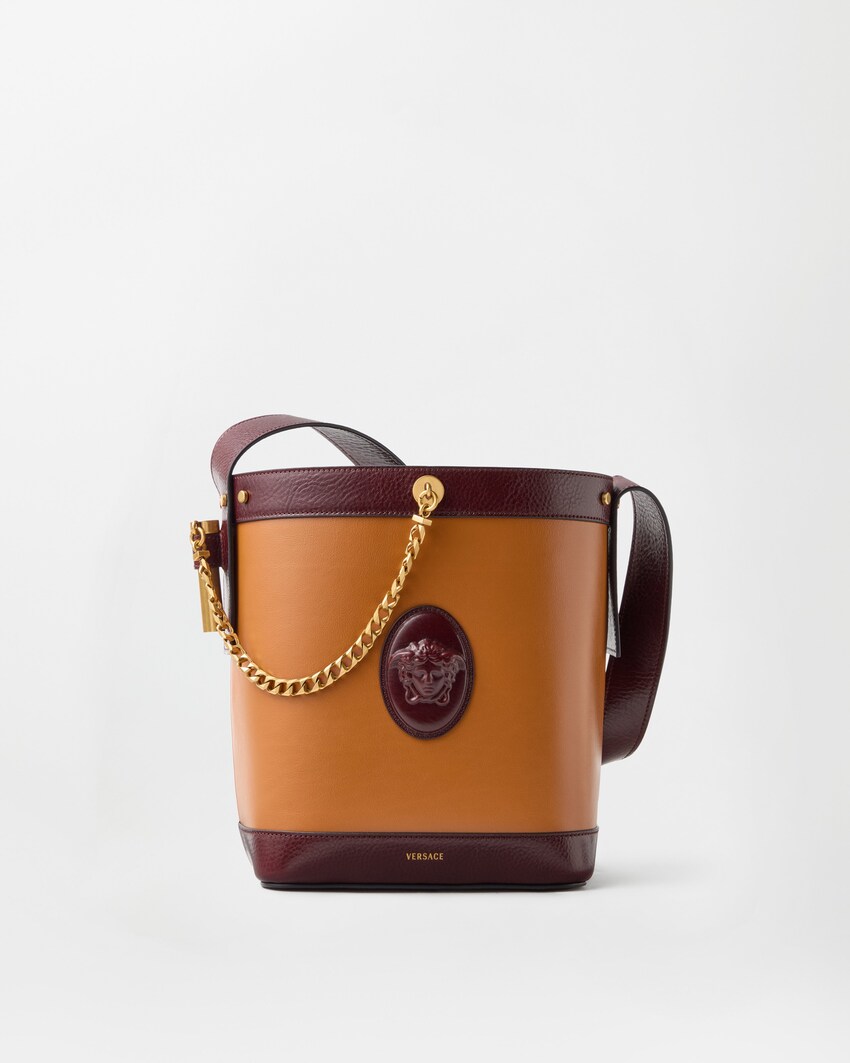
By the mid-eighties, that noise had become a roar. The Medusa head — lifted from the ruins of Magna Graecia, a nod to his Calabrian roots — appeared on everything. The safety-pin dress, shown in 1994 and worn by Elizabeth Hurley to a film premiere, became shorthand for the brand's entire ethos: engineering and exhibitionism in equal measure. Versace dressed rock stars and supermodels, often at the same time, often at his Lake Como villa. The runway shows were events, not presentations. Naomi, Cindy, Linda, Christy — the supers walked in formation, soundtracked by Prince or George Michael, and the message was clear. This was fashion as spectacle, as unapologetic pleasure.
But the engine behind that spectacle was Santo's financial discipline and Donatella's growing influence. She had started as a muse, the blonde foil to Gianni's dark intensity, but by the nineties she was his closest collaborator. She pushed him toward younger, brasher references — Miami bass, hip-hop, the aesthetics of American celebrity. The result was Versus, the diffusion line launched in 1989, which leaned harder into provocation and played to a younger audience. It worked. Versace became a global brand, not just an Italian one.
Then, in July 1997, Gianni was shot on the steps of his Miami Beach mansion. The killer, Andrew Cunanan, was on a spree that ended with his own suicide. Gianni was fifty. The brand lost its center.
What Donatella Inherited
Donatella became creative director by necessity, not ambition. She was forty-two, grieving, and facing a house that had been built entirely around her brother's vision. The early collections under her name were uncertain — too close to Gianni's codes, or too far from them, depending on whom you asked. Critics were not kind. The business, however, held. Santo remained at the helm financially, and the brand's commercial lines — the fragrances, the accessories, the licensed homeware — continued to generate revenue.
It took Donatella nearly a decade to find her own voice. By the mid-2000s, she had sharpened Versace's vocabulary: more black, more hardware, a harder, more angular silhouette. The overt sexuality remained, but it was colder now, more controlled. She leaned into collaborations — with H&M in 2011, with younger designers who brought fresh energy to the atelier. She also leaned into her own image, the platinum hair and year-round tan becoming as recognizable as the Medusa itself.
The question, always, was whether this was evolution or preservation. Donatella was not trying to escape Gianni's shadow — she invoked it constantly, in interviews and in the design language itself. The Spring 2018 collection, her last before the sale to Capri Holdings, was an explicit homage: the supers returned, now in their fifties, walking to the same George Michael track. It was moving, and it was also a form of embalming.
The Capri Chapter
In 2018, Michael Kors Holdings (later rebranded as Capri Holdings) acquired Versace for $2.1 billion. Santo and Donatella retained minority stakes, and Donatella remained as creative director, but the family triangle was effectively dissolved. The logic was clear: Capri wanted a European luxury asset to sit alongside Michael Kors and Jimmy Choo, and Versace needed capital to expand its retail footprint and compete with the LVMH and Kering machines.
The results have been mixed. Revenue grew initially, but the brand's identity became harder to parse. Donatella continued to produce collections that referenced the house codes — the baroque prints, the gold hardware, the high-slit gowns — but the context had shifted. Versace was now part of a portfolio, subject to quarterly earnings calls and market expectations. The wildness that defined Gianni's era, and even the disciplined provocation of Donatella's first decade, was harder to locate.
There is also the matter of what happens when Donatella steps down. She is sixty-nine, and there is no clear successor within the family. Allegra Versace, Donatella's daughter and the largest individual shareholder, has stayed out of the business. The atelier remains in Milan, the craftsmanship is still there — the pleating, the chain-mail work, the ability to cut a dress that looks like it was painted on — but the question is whether those skills can carry a vision forward, or whether they will become a form of heritage craft, admired but static.
What Remains
Walk through the Versace archives, and you see a house that was never interested in discretion. The prints are loud, the cuts are unforgiving, the embellishments are applied with a heavy hand. This is not a criticism. It is a description of intent. Gianni Versace believed that fashion should announce itself, that beauty and excess were not opposites but partners. Donatella has carried that belief forward, even as the industry around her has moved toward minimalism and quiet branding.
Whether that belief can survive in a corporate structure designed for consistency rather than risk is the open question. Versace is no longer a family business. It is a brand within a holding company, and the logic of that structure tends toward the predictable. The Medusa is still there, stamped on bags and belts and ready-to-wear. But the wildness — the sense that anything could happen on that runway — is harder to find. One suspects Gianni would have had something to say about that.