Portrait : le directeur artistique de Gucci
The fitting room at Gucci's Via delle Caldaie headquarters runs long and narrow, lined floor to ceiling with bolts of silk faille and wool crêpe in graduated shades of grey. Sabato De Sarno stands at the far end, hands in the pockets of navy trousers, watching a model turn in a double-breasted coat cut from camel hair so fine it moves like liquid. He says nothing for ten seconds. Then: "The shoulder, again."
This is the rhythm now. De Sarno arrived at Gucci in January 2023, appointed creative director after a sixteen-month interregnum that followed Alessandro Michele's departure. He was forty years old. He had never held the top chair. And he inherited a house whose revenues had grown fivefold under Michele's magpie maximalism — a house now expected to pivot, recalibrate, and keep growing.
The brief, one imagines, was clear enough: make Gucci desirable again without erasing what made it profitable.
The Apulian route
De Sarno was born in 1982 in Gallipoli, a fishing town on the Salento coast where his father sold furniture and his mother worked in local government. He studied at the Istituto Europeo di Design in Rome, then moved to London for a stint at Central Saint Martins — a trajectory common enough among Italian designers of his generation. What set him apart, according to former colleagues, was his fixation on construction. Not styling. Not mood boards. The way a sleeve meets an armhole.
He joined Prada in 2005, working under Miuccia Prada and Raf Simons in the womenswear atelier. He stayed twelve years. By the time he left for Valentino in 2017, he had absorbed the house codes — the deliberate austerity, the refusal to seduce too easily — that would later define his own vocabulary. At Valentino, under Pierpaolo Piccioli, he led the ready-to-wear studio. The work was less visible than the couture, but it paid the bills. And it taught him how to scale craft.
When Kering came calling in late 2022, De Sarno had spent half his career inside two of the most technically rigorous houses in Milan and Rome. He had never courted press. He had never staged his own runway show. He was, in the language of the industry, a studio animal.
The first collection
His debut for Gucci arrived in September 2023 during Milan Fashion Week. The show took place not in the brand's usual venue but in a raw concrete space near the Fondazione Prada, stripped of ornament. Models walked in fluid jersey dresses, boxy leather jackets, and trousers cut with a high waist and a relaxed leg. The palette ran to rust, camel, ink blue, and a particular shade of rosso ancora — a deep, oxidised red that De Sarno would return to again and again.
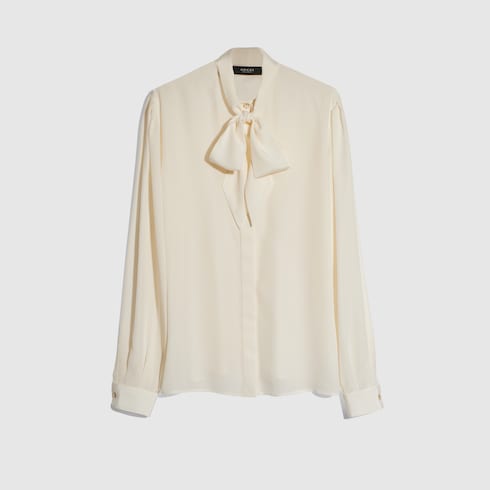
The collection was titled Ancora, Italian for "still" or "yet" or "anchor," depending on how one translates. The ambiguity, one suspects, was intentional. This was Gucci ancora Gucci — still itself, yet different. The pieces felt considered rather than exuberant. Tactile rather than ironic. There were no pussy-bow blouses, no Dionysus bags festooned with tiger heads, no knowing winks at the archive.
The reaction split cleanly. Retailers applauded the wearability. Certain critics mourned the loss of Michele's fantasy. Social media, predictably, debated whether a brand could survive without spectacle.
De Sarno's answer, delivered in a backstage scrum, was characteristically measured: he wanted to make clothes that women would keep. Not collect. Keep.
Signature and tension
Eighteen months in, a De Sarno silhouette has begun to emerge. The shoulder sits natural, never exaggerated. The waist is defined but not constricted. Trousers pool slightly at the ankle. Leather — calf, suede, nappa — appears in nearly every look, often in shades that read as neutrals until the light shifts. Bags have become smaller, more architectural. The Jackie 1961, a style introduced under Tom Ford and revived under Michele, has been reworked with a slimmer profile and a softer handle. Sales, according to Kering's Q4 2024 earnings, have stabilised after two quarters of decline.
But stabilisation is not growth. And growth is what the parent company needs. Gucci still represents more than half of Kering's operating income. When the brand stumbles, the conglomerate's share price follows. De Sarno's mandate, then, is not simply to design. It is to design in a way that moves product at scale while protecting the perception of exclusivity — a tension that has broken more than one creative director.
He has made adjustments. The spring 2025 collection, shown last September, introduced more colour: acid yellow, electric blue, a lipstick red that felt less oxidised and more immediate. Hemlines shortened. Silhouettes tightened. The accessories grew more overt — a top-handle bag in crocodile-embossed leather, a loafer with an oversized horsebit. These are concessions, perhaps, to the commercial realities of running a ten-billion-euro brand. But they are also signs of a designer learning to modulate his own instincts.
What remains open
The question now is whether De Sarno's Gucci can generate the kind of cultural traction that Michele's version commanded. Michele understood that fashion, at this level, is as much about narrative as it is about cut. His shows were events. His campaigns were memes. His clothes appeared on Harry Styles, Jared Leto, and a rotating cast of musicians and actors who treated the brand as a form of self-expression.
De Sarno's Gucci, by contrast, speaks more quietly. It does not court virality. It does not dress rock stars in sequined jumpsuits. It makes a very good camel coat and expects that to be enough.
Whether it is enough remains to be seen. The next earnings call will offer one answer. The secondary market — where Michele-era pieces still command premiums — will offer another. But the more interesting measure, arguably, is whether De Sarno can shift the terms of the conversation. Whether he can make quietness feel radical.
He is not the first designer to attempt this. Phoebe Philo did it at Celine. Lemaire and Christophe Lemaire have done it at their own label. But both operated at a different scale, with different expectations. Gucci is a machine. It requires fuel.
In the Via delle Caldaie fitting room, the model turns once more in the camel coat. De Sarno nods. The shoulder, finally, is right. The coat will go into production. It will appear in stores in four months. It will sell, or it won't. And the work will continue.