Portrait : le directeur artistique de Jacquemus
The fitting room in the Jacquemus atelier, tucked into a converted warehouse in the 10th arrondissement, is smaller than one might expect. Simon Porte Jacquemus stands barefoot on a trestle table, pinning a linen shirt on a house model who looks faintly amused. The shirt is enormous — sleeves that pool past the wrists, a hem that grazes mid-thigh — and he is frowning at the way it catches light. "Plus large," he mutters, tugging at the shoulder seam. Wider still.
This is the designer who turned a sun hat the size of a cartwheel into a cultural event. Who made the French Riviera, long considered too obvious for serious fashion, feel urgent again. Who built a house valued north of half a billion euros without a single season at Central Saint Martins or the Chambre Syndicale. At thirty-three, Jacquemus has become shorthand for a certain strain of accessible luxury — approachable in image, less so in price — and the industry is still trying to parse whether that constitutes genius or very good timing.
Salon, not school
Simon Porte was raised in Mallemort, a commune of fewer than six thousand souls in the Bouches-du-Rhône. His mother ran a farm; his father worked in construction. There was no atelier, no family trade. What there was: fabric, colour, a mother who sewed and a son who watched. He has spoken often, in interviews with System and Vogue Business, of her death when he was nineteen — the rupture that sent him to Paris with little more than a sewing machine and a surname he would later adopt as his label's first name.
He enrolled at ESMOD for a term, maybe two, before dropping out. The reasons vary depending on the telling: impatience, poverty, a belief that the curriculum had nothing to teach him. What followed was an education of a different sort. He worked at Comme des Garçons' Paris showroom, absorbing the house's approach to volume and negative space. He apprenticed, briefly, under Marc Jacobs. Mostly, though, he taught himself — draping on a dress form in a chambre de bonne, showing his first collection in 2009 to an audience of twelve.
The early work was raw in every sense. Proportions lurched. Seams puckered. But the silhouette was already there: long, lean, faintly agricultural. A linen smock that could have been lifted from a Provençal laundress. A straw hat brim so exaggerated it read as sculpture. He called the label Jacquemus, after his mother's maiden name, and the gesture felt less like branding than like an inheritance claimed.
Le Coup de Soleil
The breakthrough came in 2015, though one could argue the seeds were planted a season earlier. Jacquemus staged his spring 2015 show in a wheat field outside Paris, models walking a dirt path in broderie anglaise and raffia slides. It was unabashedly pastoral, almost naïve, and the fashion press did not quite know what to make of it. Then came Le Chiquito, the micro-bag so small it could barely hold a lipstick, and the discourse shifted.
Suddenly, Jacquemus was everywhere. Not in the traditional sense — the distribution remained tight, the runway shows intimate — but in the algorithmic sense. Instagram, still relatively new as a fashion tool, turned his sun hats and tiny bags into visual shorthand for a certain Mediterranean fantasy. The house's aesthetic, which had always leaned into colour and landscape, became indistinguishable from its digital presence. A lavender field in Valensole. A pink salt flat in Aigues-Mortes. The Riviera, shot in the golden hour, every time.
Critics have noted, not unfairly, that Jacquemus traffics in cliché. The straw hat. The linen dress. The woven basket bag that conjures a Jane Birkin photograph from 1971. But the designer's skill lies in isolating these tropes and blowing them up — sometimes literally — until they feel new again. A shirt so oversized it becomes a dress. A bag so small it becomes a joke, then a status object. The line between homage and pastiche is thin, and he walks it with a kind of guileless confidence that disarms.
Facture and fantasy
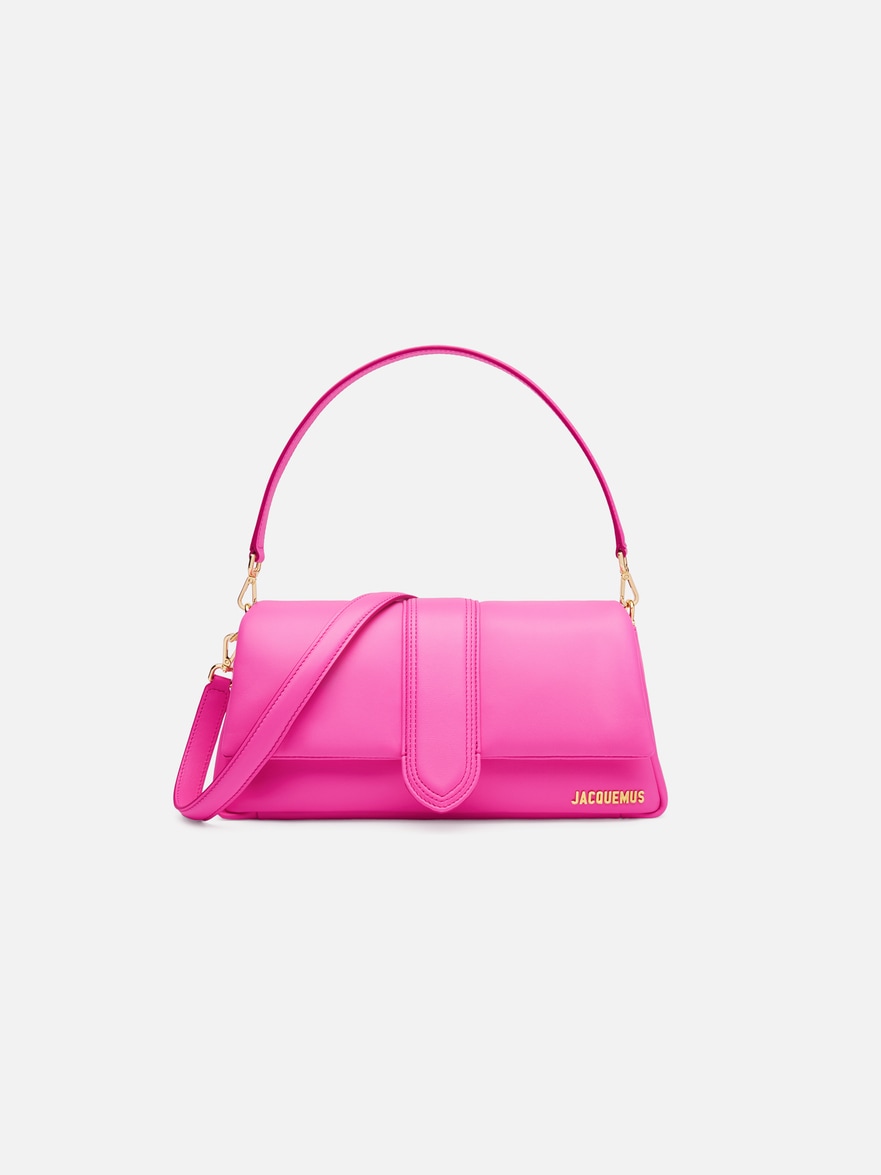
What gets less attention, perhaps because it is less photogenic, is the garment itself. Jacquemus has built a reputation on image, but the atelier has quietly developed a level of facture that bears scrutiny. The house works primarily in natural fibres — linen, cotton, wool — and the construction, while not couture, is considered. Seams are topstitched for durability. Hems are left raw where appropriate, finished where not. The leather goods, produced in partnership with Italian ateliers, have improved markedly since the early Chiquito days; a current Bambino bag, at €590, is still expensive for its size, but the stitching is tight and the hardware sits flush.
The ready-to-wear operates in a similar register: not precious, but not careless. A linen blazer from the spring 2024 collection, shown in a villa in Capri, retails at €890 and features a half-canvas construction and horn buttons. This is not transformative tailoring, but it is competent, and competence at this price point is rarer than one might think.
Where the house falters, occasionally, is in its reach. The collaboration with Nike, announced in 2023, produced a Humara sneaker in beige and cream that looked handsome in campaign images and somewhat lost in person. The menswear, launched in 2018, has yet to find a distinct identity beyond "womenswear, but for men." These are not failures, exactly, but they suggest a designer still testing the edges of his vocabulary.
What comes next
Jacquemus has spoken, in recent interviews, of wanting to slow down. The house currently shows twice a year, produces four collections, and stages at least one major spectacle per season — the kind of output that would exhaust a team twice its size. Whether this deceleration will actually occur is another question. The brand is now partially owned by Bastille Capital, a private equity firm that acquired a minority stake in 2022, and private equity firms are not typically in the business of slowing down.
What seems more likely is a continued expansion into categories the house has not yet dominated. Fragrance is an obvious next step; so is homeware, given the designer's well-documented interest in interiors. There is talk, unconfirmed, of a permanent Paris flagship, something larger and more central than the current Rue de Turenne boutique.
The risk, as with any house that has grown this quickly, is dilution. Jacquemus has succeeded in large part because it feels specific — to a place, to a sensibility, to a particular fantasy of French leisure. Scale that fantasy too broadly, and it becomes generic. But Porte Jacquemus has so far proven more nimble than his critics expected. The boy from Mallemort who taught himself to sew has built something that looks, at least from the outside, like a maison. Whether it endures will depend less on the hats and bags, which are subject to the whims of trend, and more on whether the garments underneath can bear the weight of all that sun.