Stockholm, 1996
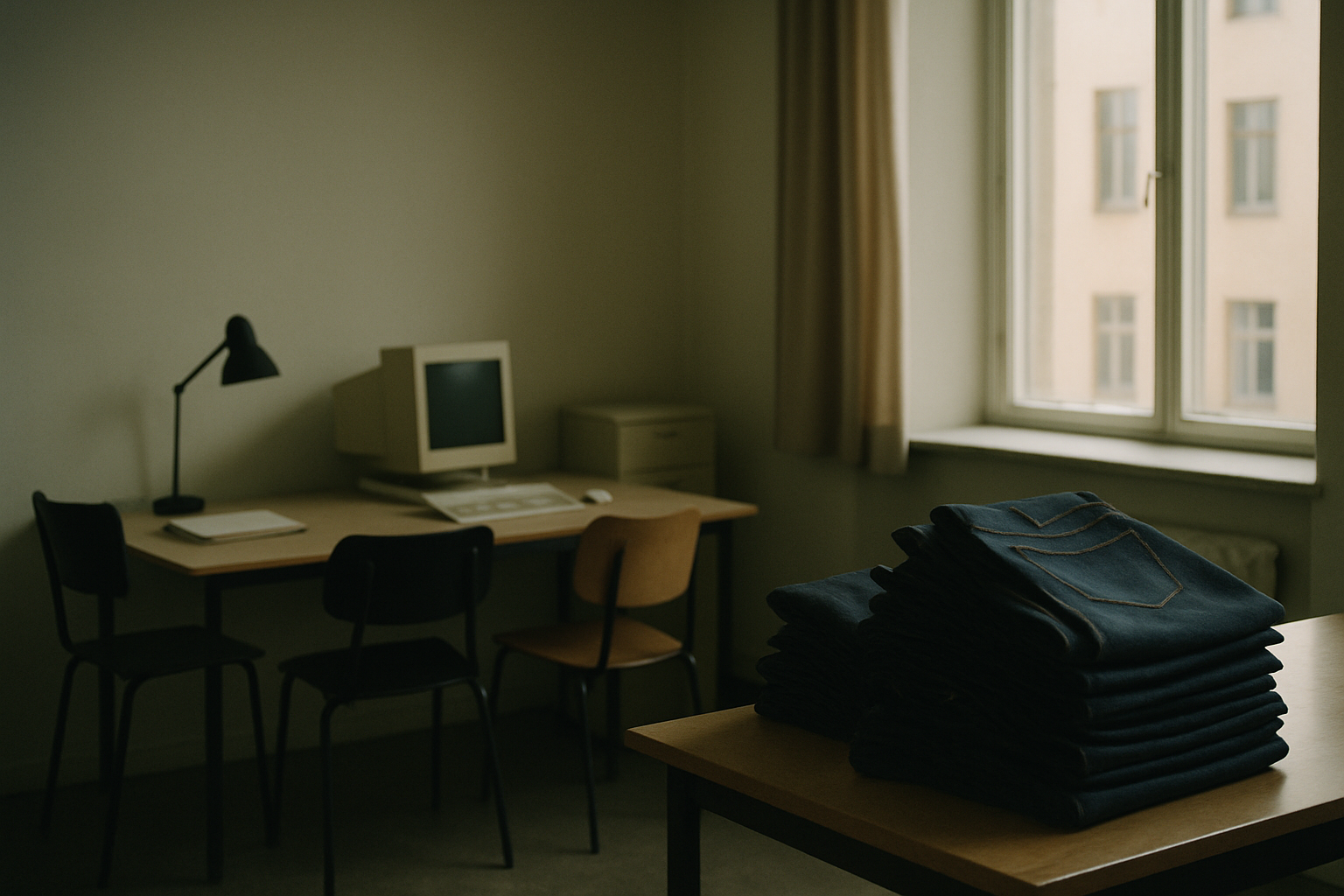
Stockholm, 1996. Four men in a shared office above a production studio decide to make a hundred pairs of jeans with red stitching. They give them away to friends. The friends wear them. Other people notice. By the following spring, the jeans are being stocked in six European cities, and the four men — Jonny Johansson, Mikael Schiller, Tor Stenström, and Patrik Ervell — realize they have stumbled into something they hadn't quite intended: a fashion label.
Acne Studios began as an acronym: Ambition to Create Novel Expressions. The name was chosen for a creative collective that worked across advertising, film, and graphic design. The jeans were meant as a side project, a giveaway to generate goodwill. Instead, they became the foundation. Johansson, who had studied at Stockholm's Beckmans College of Design, took the lead on the clothing. The others eventually peeled away — Ervell to New York, where he launched his own menswear line; Schiller and Stenström to other ventures. By the early 2000s, Acne Studios was Johansson's concern, and it had moved well beyond denim.
What set the house apart, in those early years, was a studied refusal of Scandinavian cliché. Swedish design, particularly in fashion, had long been associated with clean lines, pale palettes, and a kind of moral simplicity. Acne Studios offered something else: asymmetry, bold color, a willingness to reference disparate sources without declaring allegiance to any single tradition. A men's coat might borrow from a French workwear silhouette but rendered in an exaggerated proportion that felt closer to Japanese avant-garde. A women's sweater could be oversized, cropped, and finished with an unexpected contrast stitch. The effect was neither minimal nor maximal. It was, instead, deliberately unresolved.
Johansson has described his process, in various interviews over the years, as intuitive rather than conceptual. He does not begin with a mood board or a manifesto. He begins with fabric, with a shape that interests him, with a garment he saw on the street and wants to reinterpret. This approach has its risks. Without a clear thesis, a collection can feel scattered. But it also allows for a kind of openness — a sense that the clothes are in conversation with the world as it is, rather than with an idealized version of it.
The breakthrough, if one can identify a single moment, came in the mid-2000s. Acne Studios began showing in Paris, and the international press took notice. The house was praised for its ability to balance wearability with a distinct point of view. A leather jacket from the Spring/Summer 2008 collection — boxy, butter-soft, with an off-center zip — became a reference point. It was not revolutionary. But it was specific, and it was well made, and it appeared at a moment when much of contemporary fashion felt either too referential or too austere. Acne Studios occupied a middle ground: clothes that acknowledged fashion history without being beholden to it.
By 2010, the house had expanded into accessories, footweps, and denim lines that went well beyond those original red-stitched pairs. The Jensen boot — a Chelsea silhouette with an exaggerated toe — became a signature. So did the Velocite jacket, a slim-cut moto style that appeared in multiple iterations each season. These were not quite wardrobe staples in the traditional sense. They were recognizable, but they carried enough detail to feel considered rather than generic.
In 2019, Acne Studios sold a majority stake to IDG, a London-based investment group. The deal was reported to value the company at roughly five hundred million euros. Johansson remained as creative director, and the house stated publicly that the sale would allow for further expansion without compromising its design ethos. Whether that proves true is, as yet, an open question. Majority investment often brings pressure to scale, and scaling in fashion tends to mean simplification. The house that once made a hundred pairs of jeans and gave them away now operates over fifty stores worldwide. The red stitching is still there, but so is a handbag line, a childrenswear collection, and a growing presence in Asia.
What remains of the original impulse? Walk into an Acne Studios store today and the palette is still broader than one expects from a Scandinavian label. The cuts are still slightly off — a sleeve too long, a hem that doesn't quite sit where convention would place it. But there is also a sense of consolidation. The house has settled into a recognizable language: oversized outerwear, relaxed tailoring, denim in multiple weights and washes, leather goods that lean toward the understated. It is a coherent offer, and a commercially successful one. Whether it remains novel is another matter.
Johansson, now in his early fifties, continues to work from Stockholm. He has not cultivated the persona of the fashion auteur. He does not give lengthy interviews about his vision or his influences. He shows up, he makes clothes, he moves on to the next season. This reticence has served him well. In an industry that often rewards spectacle over substance, Acne Studios has built its reputation on a quieter proposition: clothes that feel current without chasing trends, that reference without replicating, that are made with care and sold at a price that reflects that care.
The question now is whether the house can maintain that balance as it grows. Expansion brings visibility, and visibility brings expectation. The fashion press, which once celebrated Acne Studios for its idiosyncrasy, now evaluates each collection against a set of established markers. The house is no longer the underdog. It is an established player, with the pressures that accompany that status.
One suspects Johansson is aware of this. In a 2021 interview with System, he acknowledged that the creative process has become more complex as the company has grown. There are more stakeholders, more markets to consider, more voices in the room. But he also insisted that the core approach — starting with the garment, with the material, with the detail — has not changed. Whether that remains sufficient, as Acne Studios moves into its third decade, will depend on how much room the house allows itself to continue experimenting. The red stitching was never the point. It was the willingness to try something without knowing where it would lead. That impulse, more than any single design, is what the house needs to preserve.