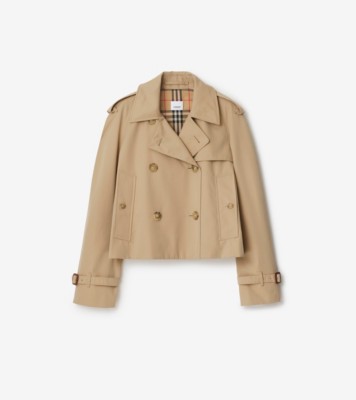
The atelier at Burberry's Horseferry Road headquarters smells faintly of steam and wool
The atelier at Burberry's Horseferry Road headquarters smells faintly of steam and wool. In one corner, a woman named Susan Pattison is pressing a trench coat collar by hand, easing the cotton gabardine around a curved wooden former with movements so practised they look automatic. They are not. She has been doing this for thirty-two years, and every coat still requires her full attention. The collar must sit flat against the shoulder without gapping at the nape. If it doesn't, the coat fails.
Pattison is one of seventeen pattern cutters and machinists who work exclusively on Burberry's heritage trench coats. She does not design them. She does not appear in campaigns. Her name does not appear on the label. But without her, and the others in her team, the trench coat as you know it would not exist.
This is the work that happens after the runway. After the creative director signs off on the sketch. After the fabric is chosen and the sample approved. Someone has to make the thing, and make it well enough that it justifies the price and the reputation. At Burberry, that someone is rarely one person. It is a sequence of hands, each responsible for a single operation, repeated thousands of times until it becomes invisible.
The line between craft and production
Burberry has manufactured outerwear in Castleford, Yorkshire, since 1997. The facility employs just over 200 people, most of them machinists. Some have been there since the factory opened. Others joined straight from school, trained on-site, and never left. The work is not romantic. It is repetitive, physically demanding, and requires a level of precision that most people assume machines now handle.
They do not. A trench coat has 87 individual components. The storm shield alone involves fourteen steps, including hand-stitching the edge tape and setting the eyelets without puckering the cloth. The belt loops must be folded, topstitched, and bar-tacked at an exact angle so they align with the D-rings when the coat is worn. The undercollar is cut on the bias to allow it to curve naturally around the neck. If you cut it on the straight grain, it will ripple. If you stretch it while sewing, it will pull. Both mistakes are irreversible.
The people who do this work are not called artisans at Burberry. They are machinists, cutters, pressers. The distinction matters. Artisan implies autonomy, a single maker responsible for the whole. This is assembly, refined to the point where each person becomes expert in one small part of a larger system. It is closer to watchmaking than to bespoke tailoring, and it works because the system is stable. The trench coat has not changed meaningfully in sixty years. The people making it have had time to get very, very good.
What training looks like now
Burberry runs an apprenticeship programme out of Castleford. It lasts eighteen months. Candidates are taught to operate industrial sewing machines, handle different weights of cloth, and read technical patterns. They are also taught to spot defects that a machine cannot catch: a thread tension slightly off, a seam allowance that will fray under stress, a topstitch that looks straight but is not parallel to the edge.
The programme is not romantic. It does not involve draping muslin or sketching silhouettes. It involves sewing the same seam 400 times until your hands stop thinking about it. Then sewing it another 400 times on a different fabric weight. Then learning to do it 15 per cent faster without losing accuracy.
One graduate, a woman named Chloe Brennan, now works on sleeve setting. She attaches roughly sixty sleeves per day, five days a week. Each sleeve must be eased into the armhole without creating pleats, and the seam must be pressed open from the inside so it lies flat under the lining. She has been doing this for four years. She can feel when a sleeve is wrong before she sees it.
This is what Burberry means when it talks about craft. Not the romance of a lone maker, but the accumulated skill of people who have done one thing long enough to make it look easy.
The tension between heritage and speed
Burberry produces approximately 40,000 trench coats per year. That figure includes the heritage line, which is still made in Castleford, and the mainline trenches, which are manufactured in Portugal and Romania under licence. The heritage coats cost nearly twice as much. They take longer to make, involve more hand-finishing, and are marketed as the authentic version of the style.
The people in Castleford are aware of this distinction. They are also aware that the mainline coats sell better. The licensed factories are faster, cheaper, and produce a coat that most customers cannot distinguish from the Castleford version without examining the label. This creates a problem. If the heritage line is only heritage because it is slower and more expensive, what happens when that stops being commercially viable?
Burberry has not answered this question publicly. What it has done is invest in automation at Castleford. Cutting tables are now digital. Fabric is pre-shrunk and inspected by machine. Seam allowances are marked by laser rather than chalk. The machinists still sew by hand, but everything upstream of them has been optimised to reduce waste and speed throughput.
The result is a factory that produces a hand-finished coat faster than it did ten years ago, but not fast enough to compete with full automation. It exists in a strange middle ground: too expensive to scale, too efficient to justify as pure craft.
Who gets remembered
When Burberry talks about its history, it names Thomas Burberry, the founder. It names the pilots and explorers who wore the trench in the field. It names the creative directors who have reinterpreted the house codes. It does not, as a rule, name the people who actually make the coats.
This is not unusual. Fashion has always foregrounded designers and erased makers. But it creates a distortion. The trench coat is not famous because Thomas Burberry invented gabardine. It is famous because someone figured out how to manufacture it at scale without losing the details that make it work. That someone was not one person. It was a sequence of pattern cutters, machinists, and production managers who solved problems that never made it into the archive.
Susan Pattison, the woman pressing collars at Horseferry Road, is one of them. So is Chloe Brennan, setting sleeves in Castleford. So are the cutters in Portugal and the quality controllers in Romania. They are not artisans in the romantic sense. They are skilled workers in an industrial system, and the system works because they are good at their jobs.
Burberry has recently started naming some of them in internal communications and factory tours. It is a small gesture, and it does not change the fact that the brand's value is built on their labour. But it is a start. The trench coat is not an idea. It is a physical object, made by specific people, using skills that take years to develop. If you are going to charge £1,800 for it, the least you can do is say who made it.