The fitting room at Acne Studios' Stockholm headquarters is not, by design, particularly comfortable
The fitting room at Acne Studios' Stockholm headquarters is not, by design, particularly comfortable. Concrete floors. Industrial track lighting. A wall of mirrors that catch every seam, every drape, every miscalculation. Jonny Johansson stands at the centre of it, arms crossed, watching a model pivot in a denim jacket that is, by his own assessment, not quite right. The collar sits a centimetre too high. He gestures. An assistant pins. The room is silent except for the hiss of fabric against fabric.
This is how it has been for nearly three decades. Acne Studios began in 1996 as a creative collective — Ambition to Create Novel Expression, the acronym spelled out with the earnestness of the era — and its first product was not a garment but a piece of furniture. Then came the jeans. One hundred pairs, raw denim, given to friends in the Stockholm art and music scene. The fit was intentional: low-slung, straight through the leg, with a red stitched label at the back pocket. Within months, the jeans were appearing in magazines. Within a year, Acne was no longer a collective but a fashion house.
Johansson, who had studied graphic design and worked in advertising, was not trained as a tailor. Neither were his three co-founders: Mikael Schiller, Patrik Ervell, and Tomas Skoging. They were, in the language of the time, multidisciplinary. They made films, designed interiors, threw parties. The jeans were an extension of that ethos — functional, unadorned, made for people who did not think of themselves as fashion consumers. It was, in hindsight, a distinctly Swedish proposition: democratic without being populist, minimal without being austere.
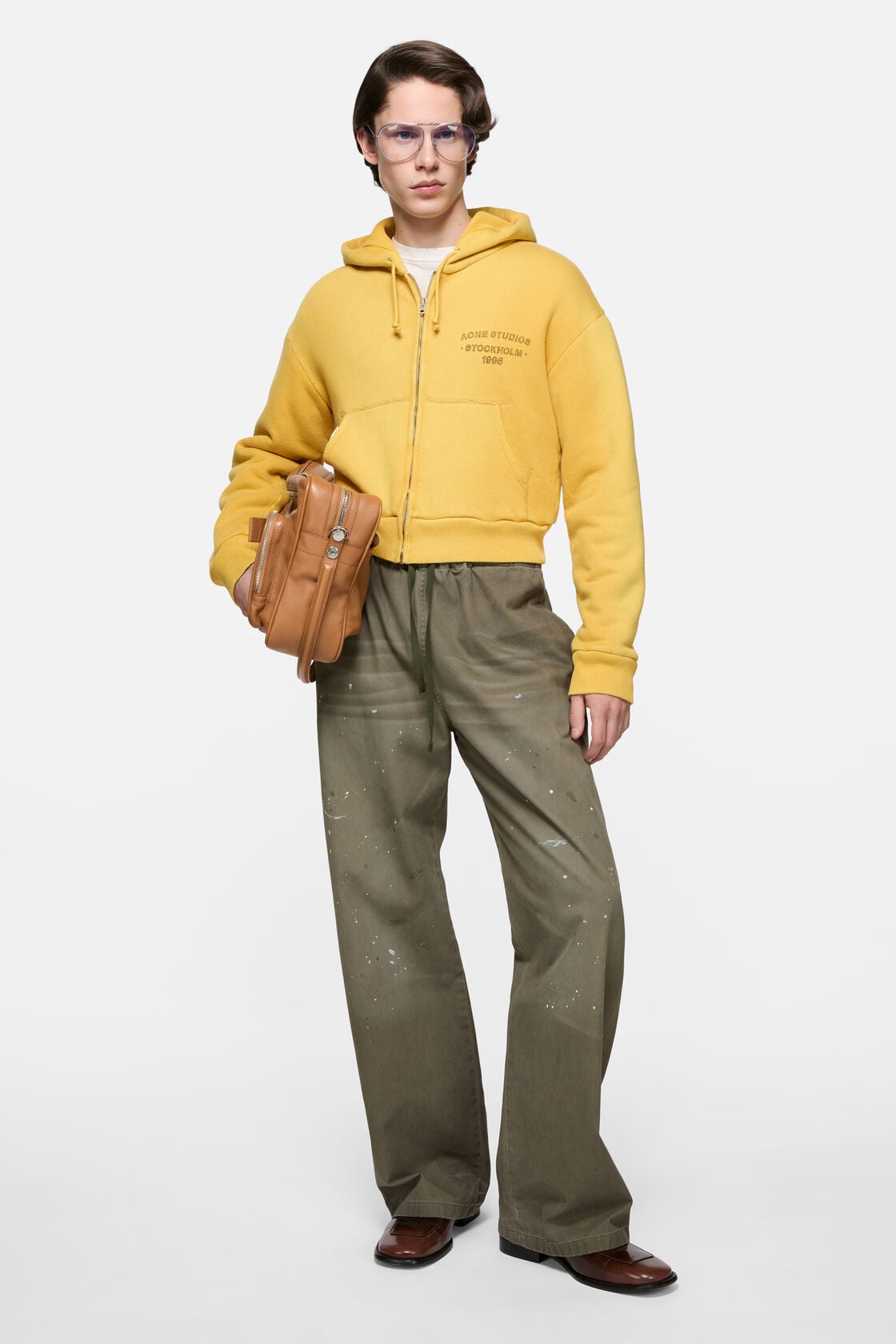
By the early 2000s, Acne had expanded into ready-to-wear. The collections were shown in Paris, though the atelier remained in Stockholm. Johansson's aesthetic was, and remains, difficult to summarise in a single phrase. There is an affection for tailoring, but the cuts are often slouched or exaggerated. There is a Nordic restraint, but also a willingness to deploy colour — acid yellow, electric pink — in ways that feel less like provocation than like punctuation. The fabrics are good. The construction is sound. The silhouettes shift season to season, but never so radically that one loses the thread.
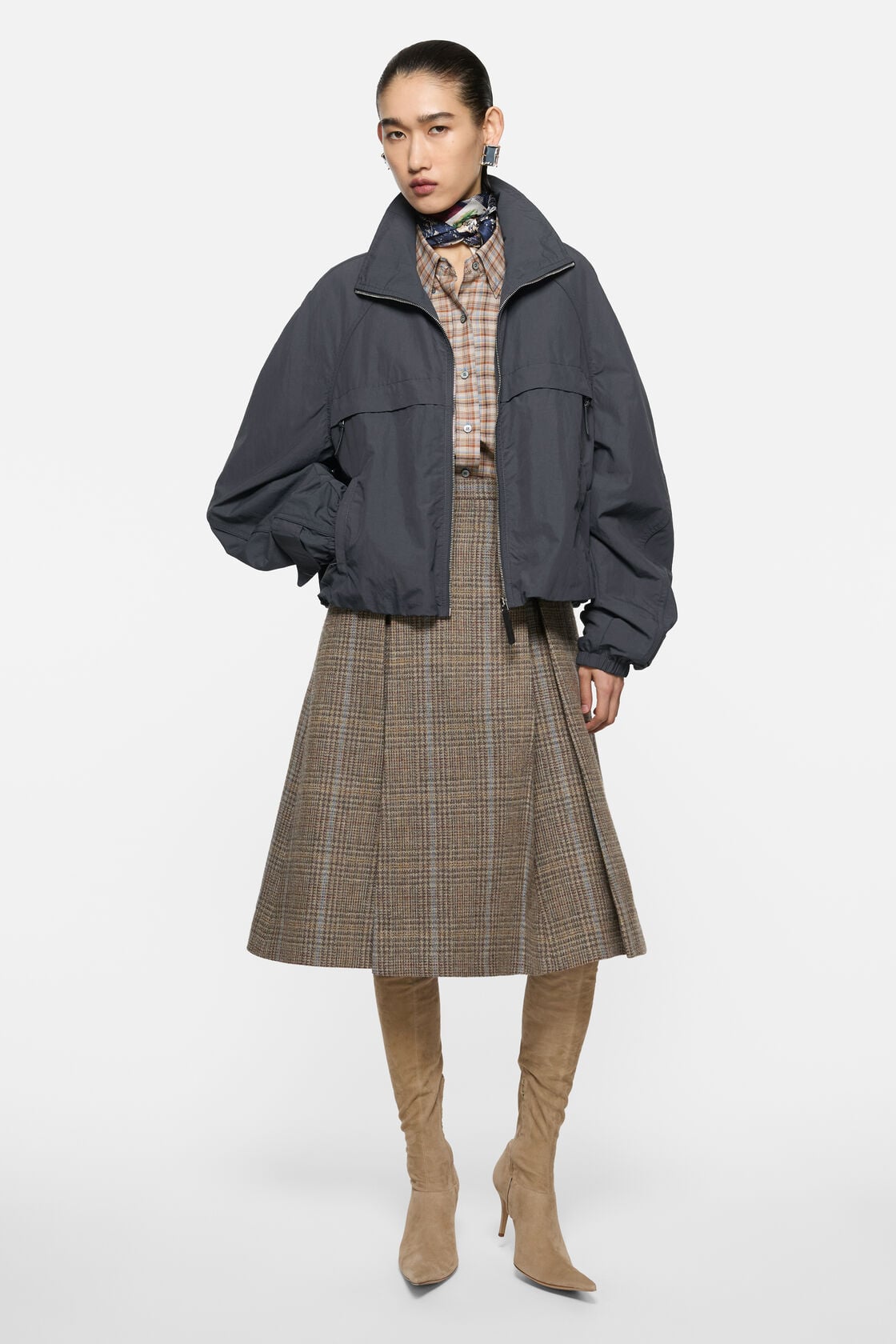
What distinguishes Acne from its Scandinavian peers — COS, Filippa K, even the early work of Margiela-adjacent minimalists — is a certain refusal to be legible. The house does not trade in wardrobe staples. It does not position itself as anti-fashion, nor does it court the avant-garde. Johansson's references are eclectic: American workwear, Japanese street style, the tailoring traditions of Savile Row, the louche glamour of 1970s Los Angeles. He mixes them without hierarchy. A trench coat might be cut from technical nylon and paired with wide-leg trousers in Prince of Wales check. A leather jacket might have the proportions of a blazer. The effect is less collage than translation.
The business expanded aggressively through the 2010s. Retail flagships opened in New York, London, Tokyo, Seoul. The accessories line — particularly the Jensen boot, a Chelsea silhouette with an exaggerated toe, and the Musubi bag, named for the Japanese knot that forms its closure — became commercial anchors. In 2014, the house launched Acne Paper, a biannual arts journal that functioned as both portfolio and manifesto. The magazine folded after six issues, but its existence signalled something about the house's ambitions. Acne wanted to be more than a brand. It wanted to be a reference point.
Then came the sale. In 2019, Acne Studios was acquired by a majority stake by the London-based investment firm Puig, which also owns Carolina Herrera, Nina Ricci, and a portfolio of fragrance licences. Johansson remained as creative director. The press release emphasised continuity. The Stockholm atelier stayed intact. The design process, we were told, would not change.
One suspects it did, in ways both subtle and structural. The collections post-acquisition have been, on balance, more commercial. The tailoring is sharper. The colour palette skews neutral. The runway presentations still carry Johansson's signature — models cast for character rather than uniformity, styling that feels lived-in rather than styled — but there is a new polish, a new legibility. The house is speaking to a broader audience now. Whether that audience was waiting, or whether it had to be created, is an open question.
The flagship on Dover Street in London, which opened in 2021, offers a useful case study. The interiors are warm, almost domestic: oak floors, velvet seating, a staircase that curves like a sculpture. The merchandise is displayed sparingly, as if in a private apartment. One can buy a Jensen boot, a cashmere sweater, a leather tote. One can also buy a scented candle, a book of photography, a piece of ceramic tableware. The store is, in the language of retail strategy, experiential. It is also, one notes, expensive to operate.
Johansson has said, in various interviews over the years, that he does not think of Acne as a Swedish house. He thinks of it as a house that happens to be based in Sweden. The distinction matters. The maison's identity is not rooted in a national tradition — there is no equivalent to the Parisian atelier system, no centuries-old craft guilds to reference. Instead, Acne has built its identity around a kind of cultivated restlessness. The collections change. The references shift. The only constant is Johansson himself, still standing in that fitting room, still adjusting the collar on a jacket that is not quite right.
What remains, three decades in, is harder to quantify. The jeans are still in production, though they are no longer the entry point they once were. The house still shows in Paris, though the runway has become less central to how fashion is consumed and understood. The Stockholm atelier is still there, though one imagines the pressure to deliver — to justify the investment, to meet the quarterly targets — has intensified.
There is a tendency, in writing about designers who have sold their houses, to frame the transaction as a loss. The implication is that creative control and financial backing are incompatible, that the work produced under corporate oversight is somehow less authentic. This is, in most cases, reductive. Johansson is not a martyr. He is a designer who made a calculation. The question is not whether Acne has changed — of course it has — but whether the change has been generative or merely adaptive.
The answer, for now, is provisional. The recent collections suggest a house in negotiation with itself. There are moments of real invention — a leather coat with an origami-like fold at the shoulder, a pair of trousers cut so wide they read almost as a skirt — and there are moments that feel more dutiful, as if the collection were designed to satisfy a checklist rather than an impulse. The tension is not necessarily a flaw. It may, in fact, be the most honest thing about the house at this moment. Acne Studios is no longer a scrappy collective making jeans for friends. It is a business, with all the compromises and possibilities that entails.
Johansson is fifty-three now. He has been at this longer than most of his peers. The next chapter, whatever it looks like, will be written against the backdrop of an industry that has become faster, louder, more consolidated. Whether Acne can retain its particularity in that environment — whether it can remain a house that refuses easy categorisation — is not a question of talent. It is a question of will.