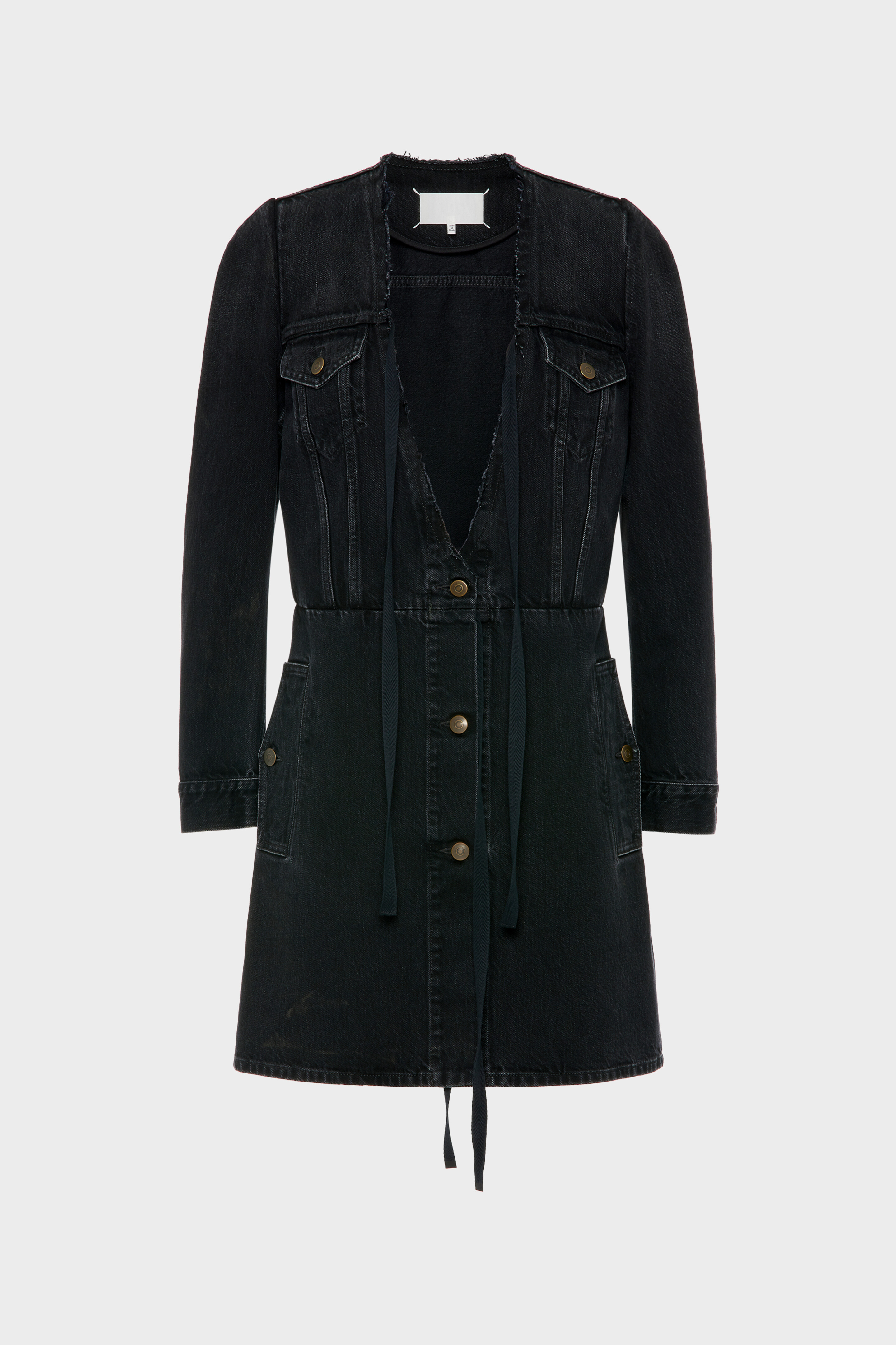
The fitting room at Maison Margiela's Paris atelier is white
The fitting room at Maison Margiela's Paris atelier is white. Not cream, not off-white — white in the way a plaster cast is white before it absorbs the first hour of wear. The house has always preferred this kind of absence. No colour, no distraction, nothing that might suggest the garment is anything other than what it claims to be. And for three decades, three women have stood in rooms like this one, wearing clothes that asked them to disappear so the work could speak.
They were not models in the usual sense. They were collaborators. Jenny Meirens, the house's first muse, wore the deconstructed blazers and inside-out seams before anyone understood what they meant. Inge Grognard painted faces into masks, turning beauty into something closer to architecture. And later, when Martin Margiela had left and John Galliano had arrived, Pat Cleveland returned to the runway at seventy-four, proving that the house's relationship with women was never about youth. It was about presence.
Jenny Meirens and the Art of Not Being Seen
Meirens came to Margiela through the Belgian art world. She was a gallerist, not a mannequin, and that mattered. When the house staged its first show in 1989, it did so in a Salvation Army hall in the 20th arrondissement. The clothes were shown on women who looked like they had walked in off the street. Some had. Meirens was among them, wearing a coat whose lining had been turned out and whose seams were visible in a way that suggested the garment was still under construction.
She understood what Margiela was doing because she had spent years around artists who worked the same way. The house was not interested in finished objects. It was interested in process. A jacket was not complete when it left the atelier; it was complete when it had been worn, altered, and worn again. Meirens wore those early pieces as if they were still being made on her body. She moved carefully. She did not smile. She allowed the clothes to remain strange.
This was not the fashion of the late eighties. Thierry Mugler was building shoulders that could support a small aircraft. Claude Montana was cutting power suits in leather. Margiela was unpicking the seams of a dinner jacket and showing you the canvas underneath. Meirens wore it all without explanation. She was not there to sell you anything. She was there to show you what the house had found.
The collaboration lasted through the early nineties. Meirens appeared in lookbooks, fittings, and the occasional runway show, always in white or grey, always with her hair pulled back, always with the same expression of mild detachment. She was not a muse in the way Bettina Graziani had been a muse to Hubert de Givenchy. She was a muse in the way a wall is a muse to a painter. She held the work without interfering with it.
Inge Grognard and the Face as Surface
Grognard arrived at Margiela through makeup, though calling it makeup undersells what she did. She was a painter who worked on skin. Her early work with the house involved covering models' faces entirely — sometimes in nude stockings, sometimes in white fabric, sometimes in nothing but a thick coat of foundation that erased every feature except the eyes. The effect was unsettling. You could see the shape of a face, but not the face itself.
This was the house's logic taken to its conclusion. If a garment could be turned inside out, why not a face? If a seam could be left raw, why not skin? Grognard's work was not about beauty. It was about surface. She treated the face the way Margiela treated a coat: as a thing that could be deconstructed, flattened, and rebuilt.
The most famous example came in the autumn 1997 show, when models walked with their faces entirely obscured by fabric hoods. You could see their mouths moving beneath the cloth, but nothing else. Grognard had not erased their faces. She had asked you to imagine them. It was a trick the house used often: showing you less so you would see more.
She worked with Margiela until he left in 2009, and her influence remains. The house still casts models whose faces are interesting rather than perfect. It still uses makeup to obscure rather than enhance. Grognard proved that you could build a beauty language around refusal. You could say no to the face, no to the smile, no to the idea that a woman on a runway owed you anything other than her presence.
Pat Cleveland and the Return
When Galliano took over Margiela's haute couture line in 2015, he did something the house had never done before. He brought back the past. Not through archive pieces, though those appeared, but through the women who had worn them. Pat Cleveland, who had walked for Halston and Yves Saint Laurent in the seventies, returned to the runway at an age when most models are no longer invited.
She wore a coat whose sleeves had been removed and reattached at odd angles. She wore a dress that looked like it had been assembled from four other dresses. She moved the way she had always moved: loose, improvisational, as if the runway were a stage and she had just decided what to do next. Galliano understood what Margiela had understood thirty years earlier. The woman wearing the clothes mattered as much as the clothes themselves.
Cleveland has appeared in nearly every Galliano-era Margiela show since. She is not there for nostalgia. She is there because the house has always preferred women who carry their own history. Meirens carried the history of Belgian conceptual art. Grognard carried the history of painting. Cleveland carries the history of fashion itself, and she wears it the way Margiela wears a deconstructed blazer: with full knowledge of what it used to be, and no interest in going back.
What Remains
The house no longer operates the way it did in 1989. It is owned by a conglomerate. It produces ready-to-wear, accessories, and fragrance. It has boutiques in cities where Martin Margiela would never have shown. But the women who define it still move through those white rooms, still wear clothes that ask them to be something other than decorative.
Galliano has said, in various interviews, that he is interested in women who have lived. Not girls, not ingénues, not faces that have never seen weather. Women. The house has always been interested in the same thing. It has never asked its muses to be young, or thin, or beautiful in any conventional sense. It has asked them to be present. To stand still. To let the work speak.
That is what Meirens did in 1989. That is what Grognard did in 1997. That is what Cleveland does now, at seventy-eight, walking a runway in a coat that has been taken apart and put back together in a way that makes no sense until you see it move. The house has always been about that movement. The moment when the strange thing becomes the only thing that makes sense.