The fitting room at Palazzo Fendi smells of espresso and pressed wool
The fitting room at Palazzo Fendi smells of espresso and pressed wool. A model stands centre, draped in a coat whose sleeves puddle at the wrist. Silvia Venturini Fendi circles once, tugs the shoulder seam forward two centimetres, steps back. She does not speak. The atelier head nods. The coat comes off. Fendi has always worked this way — quietly, with gesture more than decree — and it has always been a house shaped by women who preferred the work to the myth.
Three figures anchor that lineage, each arriving at a different inflection point in the maison's century-long arc. They are not muses in the decorative sense. They are architects.
Silvia Venturini Fendi: la continuità
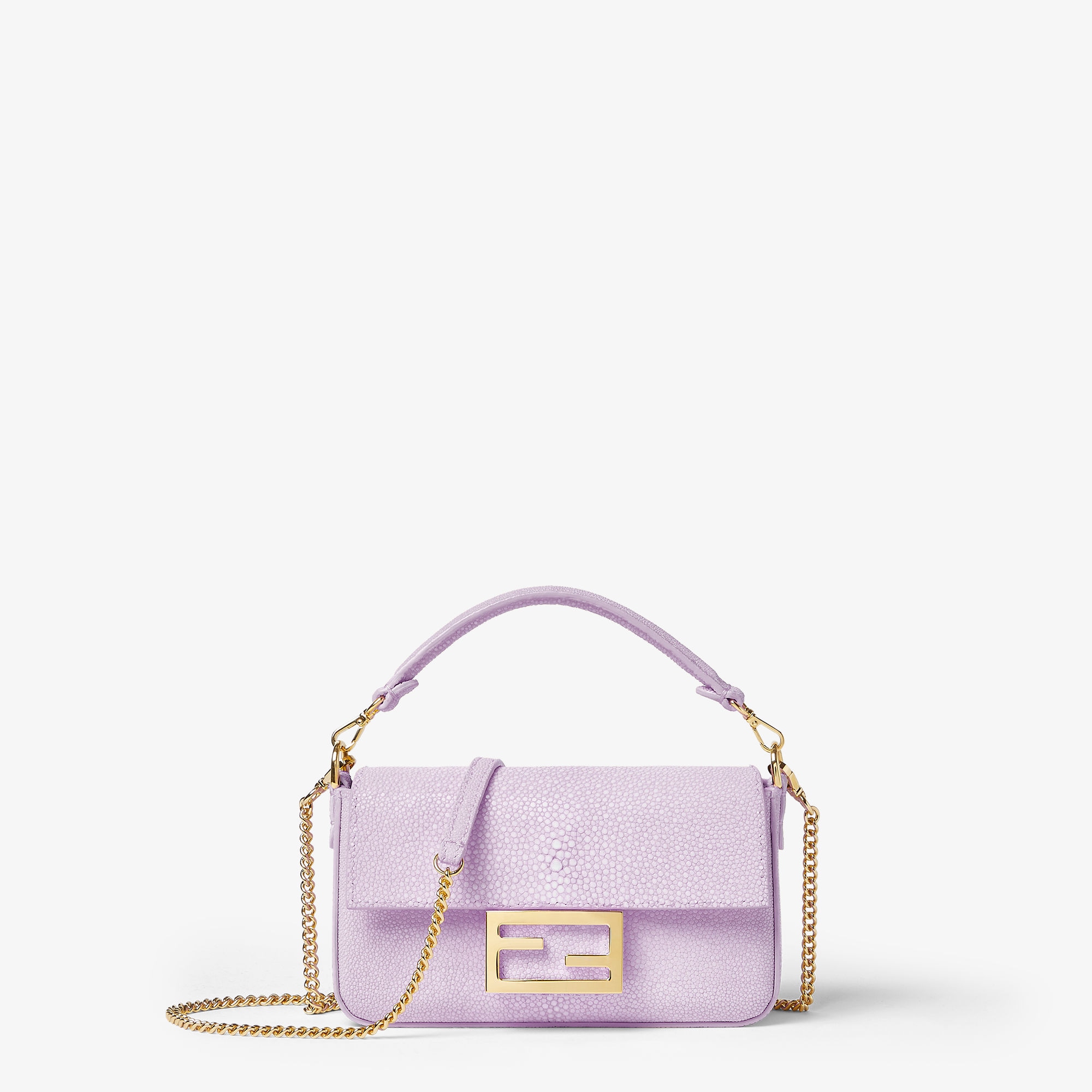
Silvia was born into the house in 1960, third generation, and has never worked anywhere else. That fact alone makes her an anomaly in contemporary fashion, where lateral moves and headline departures are currency. She began in accessories in 1994, taking over what was then a supporting category. Under her direction, the Baguette launched in 1997 — a compact, underarm bag that predated the It-bag economy and arguably set its terms. The style sold in the hundreds of thousands, spawned two decades of reissues, and became shorthand for a certain late-nineties optimism about luxury: playful, tactile, still rooted in craft.
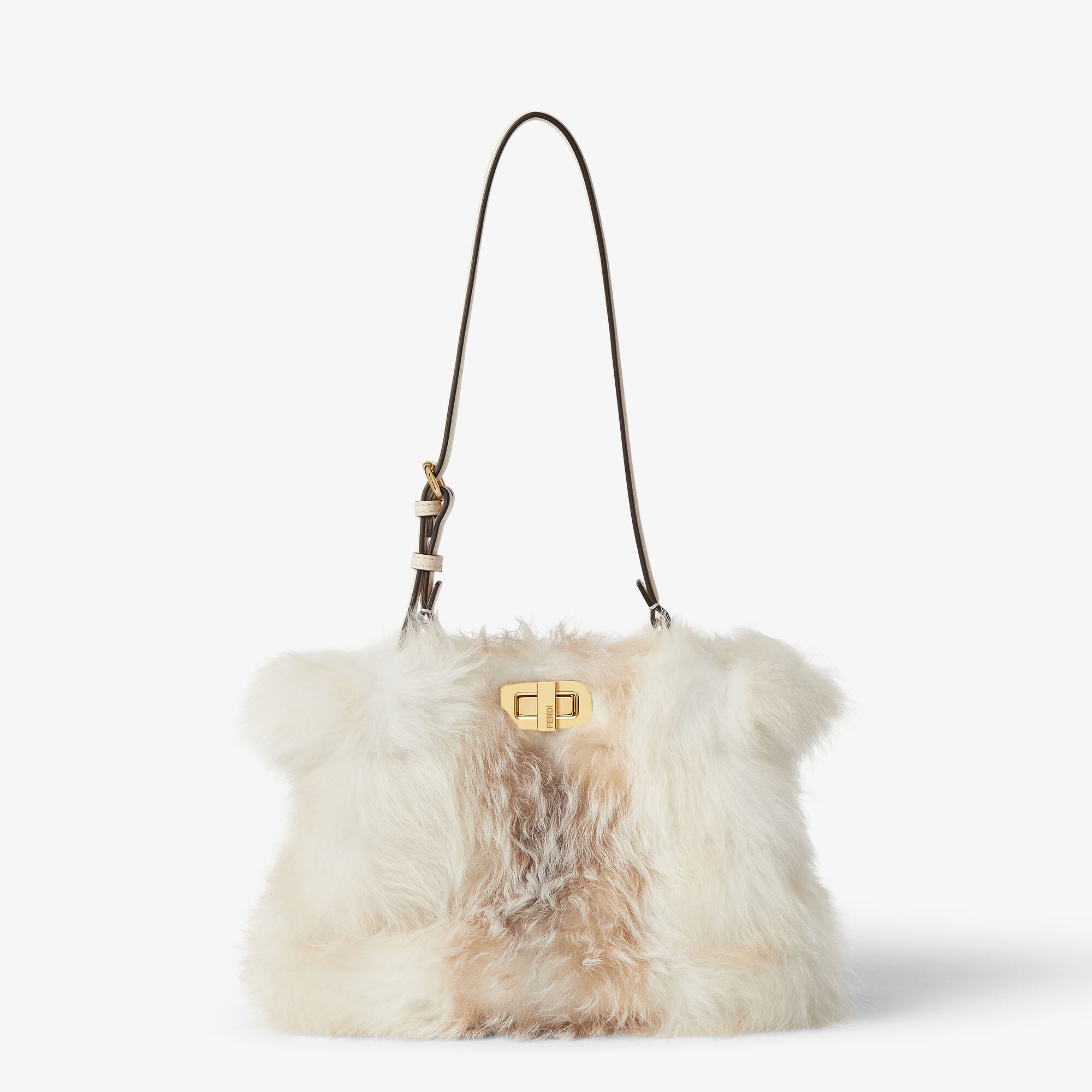
Venturini Fendi's work is notable for what it does not do. She has never chased the streetwear crossover, never leaned into logo maximalism beyond the double-F that was already there. Her bags tend toward structure and wit — the Peekaboo, introduced in 2008, opens to reveal contrast linings and internal compartments, a kind of architectural joke. The Mon Trésor bucket, the First, the Fendigraphy: each arrives with a mechanism, a clasp or closure that asks the wearer to pause. This is not fashion as signal. It is fashion as object.
She also helms Fendi's menswear, a role she assumed in 1990. The line is precise, often minimal, occasionally punctuated by fur — shearling bombers, mink-lined parkas — that nod to the house's origins in pelts and skins. Her men's shows are less spectacle than demonstration: cloth, cut, a certain restraint. One suspects she prefers it that way.
Silvia is, in many ways, the house's institutional memory. She knew the five founding sisters, worked alongside Karl Lagerfeld for two decades, and remains after his death in 2019 the figure who can say, with authority, what Fendi is. That continuity is rare. It is also a kind of discipline.
Anna Piaggi: l'imaginaire
Anna Piaggi never worked for Fendi in any official capacity, yet her influence on the maison's visual language is undeniable. A journalist, editor, and self-styled eccentric, Piaggi spent five decades at the helm of Italian Vogue's opinion pages and became, in the process, one of fashion's great collectors and collaborators. She wore Fendi often — coats, furs, bags layered into her maximalist assemblages — and her patronage conferred a kind of intellectual credibility.
Piaggi's approach to dress was archival and referential. She mixed centuries, genres, designers, treating her body as a moving exhibition. Fendi, with its history in fur and its willingness to experiment with texture, fit neatly into that vocabulary. She appeared in campaigns, sat front row, and maintained a decades-long dialogue with the house that was equal parts muse and critic. Lagerfeld, who designed for Fendi from 1965 until his death, cited her repeatedly as a source. He sketched her, photographed her, and used her as a sounding board for ideas that were, by his own admission, too strange for the runway.
What Piaggi gave Fendi was permission. Permission to be odd, to layer, to treat fur not as status symbol but as medium. Her influence is less visible in specific garments than in the house's willingness to entertain contradiction — classical and avant-garde, Roman and global, precious and irreverent. She died in 2012. The house mourned publicly, which is rare. More telling: they continue to reference her in mood boards and casting notes, a decade on.
Adele Fendi: la fondation
Adele Casagrande married Edoardo Fendi in 1925 and took over the fur and leather workshop they had opened together on Via del Plebiscito. She was twenty-six. Edoardo died in 1954, leaving her with five daughters and a business that was profitable but not yet prominent. Adele expanded. She hired artisans, opened a larger atelier, and began producing handbags alongside furs. By the time she brought Lagerfeld on board in 1965, Fendi was a Roman maison with an international client list and a reputation for facture.
Adele's contribution is often reduced to matriarch, but the record suggests something sharper. She ran the business through two wars, the collapse of the Italian monarchy, and the postwar economic boom. She trained her daughters — Anna, Paola, Franca, Carla, Alda — in different facets of the trade and installed them in roles that played to their strengths. This was not sentiment. It was strategy. The sisters took the house public in the 1980s, sold to LVMH and Prada in phases, and eventually ceded control to Bernard Arnault in 2001. But the structure Adele built — a family business rooted in craft and managed with unsentimental precision — held for seventy-five years.
She died in 1978, before Fendi became the global brand it is now. One imagines she would find the scale bewildering and the savoir-faire familiar. The house still operates an atelier in Rome. The fur workshop, now a fraction of its former size, still employs the intarsia and inlay techniques Adele commissioned in the 1940s. That continuity is her legacy, more than any single garment.
Ce qui reste
Fendi is now owned by LVMH, shows in Milan and Paris, generates revenue in the billions. The Baguette is back in production, reissued in python and sequins and logo jacquard, sold to a generation that was not yet born when it first appeared. Silvia Venturini Fendi remains, the last family member in a creative role. Kim Jones, installed as artistic director of womenswear in 2020, brings his own references — sportswear, streetwear, a certain British pragmatism — but defers, in interviews, to the house codes.
What those three women established was not a style, exactly. It was a posture: serious about craft, sceptical of hype, willing to let the work speak. Fendi has stumbled — the logo mania of the early aughts, the awkward pivot to youth marketing — but it has not, on balance, betrayed that posture. The bags are still constructed by hand. The furs, now controversial and increasingly rare, are still cut in-house. The atelier still operates on the assumption that someone, somewhere, will notice the difference between adequate and exact.
Whether that assumption holds in an era of algorithmic trend cycles and quarterly earnings calls is an open question. But the house has survived longer bets.