## The Fitting Room
The Fitting Room
John Galliano stands at the centre of a white-walled studio in Paris, one hand lifting the hem of a deconstructed coat, the other tracing the line where sleeve meets body. The garment is inside-out. So, in a sense, is he.
This is Maison Margiela, where seams show and linings become exteriors, where a coat's construction is as important as its silhouette. Galliano has been creative director here since 2014, long enough that the appointment no longer reads as provocation. Long enough, too, that the work has stopped being about redemption and started being about cloth.
Gibraltar to Givenchy
He was born Juan Carlos Antonio Galliano-Guillén in 1960, raised in South London after his family left Gibraltar. Central Saint Martins came next, then a graduate collection titled Les Incroyables that landed him a contract before he'd cleared his studio. The references were French Revolution, the cut was bias, the reception was immediate.
By the mid-nineties he was at Givenchy, then Dior, where he stayed for fifteen years. The shows were theatre: models in corsets and crinolines, soundtracks that swung from opera to punk, collections that turned the Grand Palais into a salon or a circus depending on the season. He worked fast, designed faster, and built a reputation for historical pastiche executed with technical precision.
The work was spectacular. It was also, by his own later admission, exhausting.
The Gap
What happened in 2011 is public record. A video, a dismissal, a trial. Galliano left Dior and disappeared from the industry for three years. He has since described that period as necessary, a forced pause that let him strip back not just his process but his relationship to design itself.
When he resurfaced, it was not at a house that trafficked in spectacle. Maison Margiela, founded in 1988 by the Belgian designer Martin Margiela, had spent two decades building a reputation for anonymity and deconstruction. Margiela himself had left in 2009. The house was owned by Diesel's parent company, OTB, and it needed a designer who could respect the codes without imitating the founder.
Galliano's appointment in October 2014 read, at first, like a mismatch. His previous work had been maximalist, historically referential, designed for the front row. Margiela's aesthetic was conceptual, anti-fashion, built on the idea that the garment's construction mattered more than its wearer's identity.
The First Collection
His debut for the house came in January 2015, shown during Couture Week. It was called Artisanal, Margiela's term for its highest-tier work, and it opened with a model in a deconstructed trench, sleeves removed and reattached at odd angles, the lining pulled outside and stitched flat.
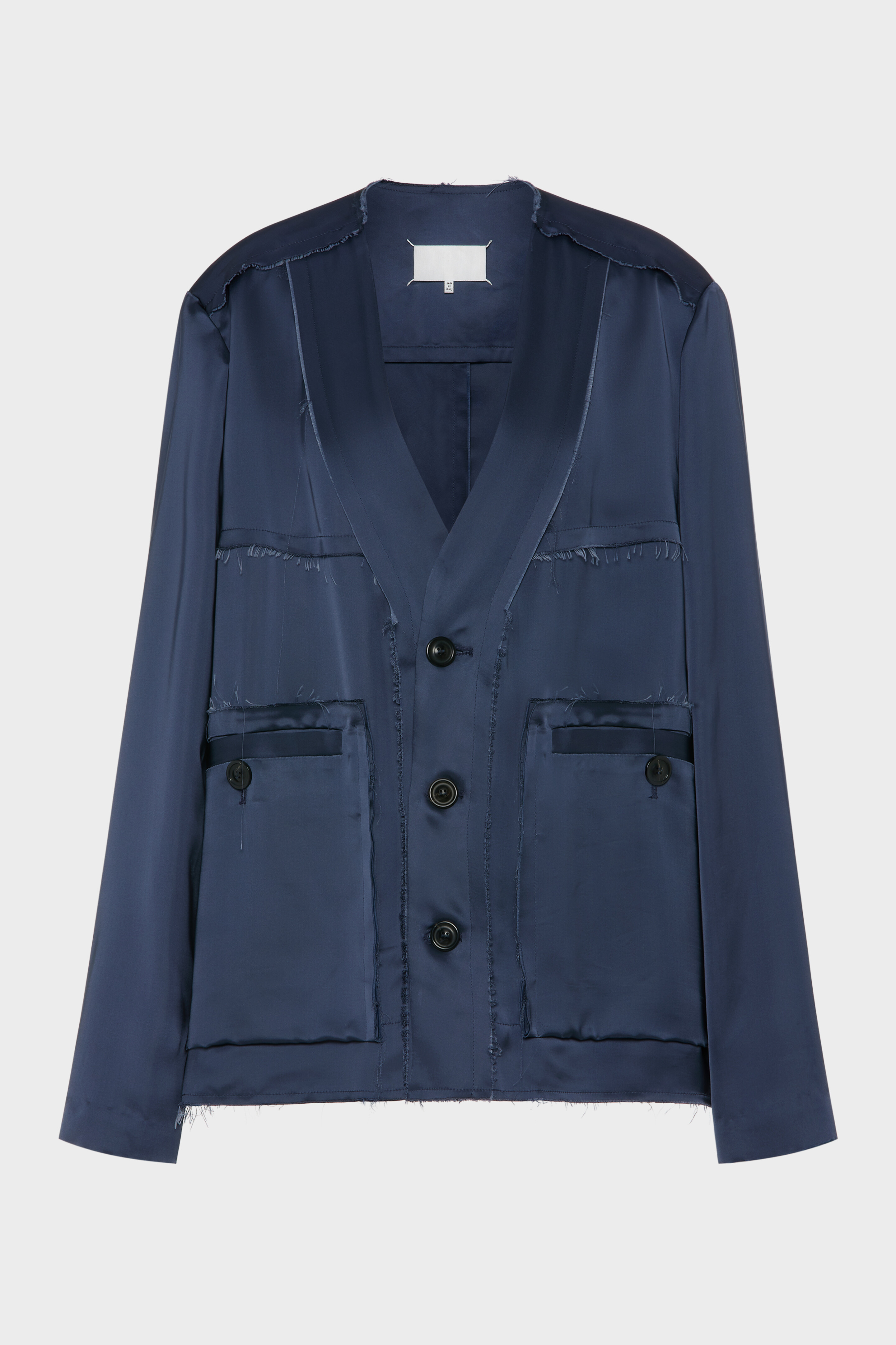
The silhouette was Galliano's—bias-cut, draped, technically complex—but the language was Margiela's. Seams were exposed. Hems were unfinished. Garments looked as though they'd been taken apart and reassembled by someone more interested in structure than polish.
The collection also included the house's signature Tabi boot, the split-toe design that Margiela had introduced in his first collection in 1989. Galliano kept it, just as he kept the blank label, the four white stitches that Margiela used in place of a logo. The message was clear: this was not a reboot. It was a continuation.
The Signature
What has emerged over the past decade is a body of work that borrows Margiela's conceptual framework and fills it with Galliano's technical skill. The Artisanal collections, shown twice a year, remain the clearest expression of this. They are built on deconstruction—garments taken apart, reconstructed, turned inside-out—but the execution is precise. A dress might be made from vintage scarves, but the seams are perfect. A coat might have its lining on the outside, but the balance is exact.
The ready-to-wear collections, shown during Paris Fashion Week, are more commercial but no less rigorous. Galliano has introduced new silhouettes—oversized blazers with exaggerated shoulders, trousers with asymmetric waistbands, dresses that drape and collapse in unexpected places—while maintaining the house's commitment to anonymity. Models' faces are often obscured. The clothes are the subject.
He has also leaned into the house's archival vocabulary. The Tabi boot, once a niche reference, is now a bestseller. The Glam Slam bag, a quilted design introduced in 2018, has become one of the house's most recognisable pieces. The Replica sneaker, a recreation of a generic German Army trainer, sells in multiple colourways each season.
This is not the Galliano of the Dior years. There are no crinolines, no corsets, no models dressed as geishas or flappers. The references are still there—he has cited everyone from Madame Grès to Leigh Bowery—but they are filtered through Margiela's aesthetic of reduction and exposure.
The Process
Galliano has described his work at Maison Margiela as collaborative, a departure from the auteur model that defined his earlier career. He works closely with the in-house ateliers, many of whom have been with the house since Margiela's tenure. The process is iterative: a garment is constructed, deconstructed, reconstructed. Seams are exposed, then hidden, then exposed again.
In a 2019 interview with System, he described the work as "a conversation with the house." He is not trying to impose his vision on Margiela's codes; he is trying to extend them. The result is a body of work that feels both familiar and new, rooted in the house's history but not trapped by it.
The Next Chapter
Maison Margiela is now a commercial success. Revenue has grown steadily since Galliano's arrival, driven by accessories, footwear, and ready-to-wear. The Artisanal collections remain the creative engine, but they are no longer the only story.
Galliano, now in his sixties, shows no signs of slowing. The collections continue to arrive twice a year, each one building on the last. The language is consistent: deconstruction, reconstruction, exposure. The execution is exact.
What comes next is unclear. Galliano has said he has no plans to leave, and OTB has given no indication that it wants him to. The house is stable, profitable, creatively coherent. It is, in other words, exactly what it was designed to be: a place where the work matters more than the name on the label.
The fitting continues. Galliano adjusts the hem, steps back, considers the line. The coat is still inside-out. It will stay that way.