## The Fitting Room on Via Condotti
The Fitting Room on Via Condotti
Valentino Garavani was twenty-eight when he opened his atelier on Via Condotti in 1959, and the first thing he did was paint the walls white. Not cream, not ivory — white. He wanted the cloth to speak without interference, and in those early fittings, standing behind a model in a half-finished gown, he would pin and repin the same seam until the fabric moved as he intended. His business partner, Giancarlo Giammetti, handled the ledgers and the clients. Valentino handled the scissors.
The partnership was unusual for its time, though neither man made much of it publicly. Giammetti had met Valentino at a café on Via Veneto in 1960, a year after the maison opened, and within months he had left architecture school to manage the business full-time. He was nineteen. The division of labour was clean: Valentino designed, Giammetti sold, and between them they built a house that dressed Elizabeth Taylor, Jacqueline Kennedy, and later, nearly every European aristocrat who could afford the fittings.
Valentino had trained under Jean Dessès in Paris, then briefly at Guy Laroche, and the influence shows in the early work. The silhouettes were precise, the embroidery restrained. He was not interested in shock. His first collection, shown in the Pitti Palace in Florence, included day dresses in duchesse satin and evening gowns with covered shoulders. Italian Vogue called it elegant. Others called it safe. It sold.
Red, But Not Immediately
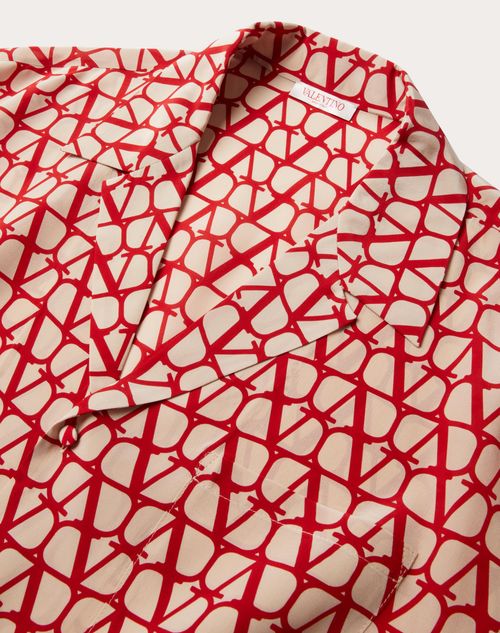
The colour most associated with Valentino — that particular shade of red, somewhere between vermillion and carmine — did not appear until 1959, though it would not dominate the house's identity until the late sixties. The story varies depending on who tells it. Valentino himself claimed he was inspired by a performance at the Barcelona Opera, where the velvet curtains and the gowns of the audience seemed to glow under the house lights. Giammetti, in a later interview with WWD, suggested it was simply a question of what worked on the runway under tungsten.
Either way, the red became a signature. By 1968, when Valentino dressed Jacqueline Kennedy for her wedding to Aristotle Onassis, the gown was ivory — but the house had already made its name in scarlet. The press called it Valentino Red. The Pantone reference is 18-1662 TCX, though the house has never confirmed this.
The Seventies, and What Followed
Valentino's work in the seventies was less about innovation than refinement. He was not Yves Saint Laurent, reimagining the blazer, nor was he Halston, stripping everything down to a single seam. He made gowns. Long gowns, short gowns, gowns with trains that required three assistants to carry. The construction was impeccable. The embroidery, often executed by Lesage in Paris, could take six hundred hours per piece. The clients were loyal, the press was kind, and the business grew.
In 1998, HdP — Holding di Partecipazioni, an Italian conglomerate — acquired the house for approximately $300 million. Valentino and Giammetti retained creative and operational control, but the structure had shifted. The maison was no longer theirs in the way it had been when they were pinning hems on Via Condotti. Valentino continued to design. The collections were still beautiful. But the question of succession had begun to hover.
The Exit
Valentino retired in 2008, after a final haute couture show at the Musée Rodin in Paris. The collection included forty-two gowns, most of them red, and the front row included Valentino's usual clients: European royalty, American actresses, the occasional oligarch. The finale was a white gown embroidered with gold thread, and when Valentino took his bow, the applause lasted four minutes.
Giammetti did not retire. He remains, as of this writing, honorary president of the house, though his role is largely ceremonial. The business has changed hands twice since 2008 — first to Permira, then to Mayhoola for Investments, a Qatari private equity fund, in 2012. The price was rumoured to be €700 million, though neither party confirmed.
What Remains
The question of what survives a founder is always the same: does the work stand without the hand that made it? Valentino's successors — first Maria Grazia Chiuri and Pierpaolo Piccioli, then Piccioli alone after Chiuri left for Dior in 2016 — have attempted to answer this by treating the archive as a starting point rather than a constraint. Piccioli, in particular, has pushed the house toward colour and volume in ways Valentino himself rarely did. His autumn 2022 collection included fuchsia taffeta coats and oversized bows, and while the craftsmanship remained extraordinary, the aesthetic had shifted.
Piccioli left Valentino in March 2024, and the house appointed Alessandro Michele — formerly of Gucci — as creative director two months later. Michele's first collection, shown in September 2024, was a sharp departure. The silhouettes were narrower, the references more archival. He pulled from Valentino's sixties work, not the eighties excess, and the result felt less like a reinvention than a correction. The press was divided. The clients, as always, will decide.
The Atelier Today
The Valentino atelier still operates in Rome, though it has moved from Via Condotti to a larger facility in Palazzo Mignanelli. The petites mains — the seamstresses and embroiderers who execute the haute couture — number around sixty, and many of them trained under the same master craftsmen who worked for Valentino in the seventies. The techniques have not changed. A gown still takes three fittings, minimum. The embroidery is still done by hand.
Giammetti visits occasionally, though he no longer keeps an office there. In a 2018 interview with Vanity Fair Italia, he said the hardest part of stepping back was not the loss of control but the loss of routine. He had spent fifty years arriving at the atelier each morning, reviewing the samples, approving the invoices. Without that rhythm, he said, the days felt unmoored.
Valentino himself lives between London, New York, and a château in Wideville, outside Paris. He collects art, hosts dinners, and has not, as far as anyone knows, attended a fashion show since his retirement. The house continues without him. Whether it continues as him is another question, and one that will take longer than a decade to answer.