The fitting room on via delle Caldaie smells faintly of steam and bergamot
The fitting room on via delle Caldaie smells faintly of steam and bergamot. Sabato De Sarno stands before a dress form draped in burnt sienna silk, one hand adjusting the fall of a sleeve, the other holding a pair of fabric shears he hasn't yet used. He steps back. Tilts his head. Steps forward again. The sleeve stays where it is.
This is the work: not the runway, not the campaign, but the hour spent convincing a seam to behave as though it were never sewn at all.
De Sarno took the creative helm at Gucci in January 2023, succeeding Alessandro Michele after a seven-year tenure that had turned the Florentine house into a maximalist fever dream of logos, appliqués, and references stacked three deep. The new director arrived with a different proposition. He used the word essenziale in his first press briefing — essential, stripped, foundational — and the atelier took note. So did the analysts.
The Valentino years
De Sarno spent sixteen years at Valentino, the last stretch as design director of ready-to-wear under Pierpaolo Piccioli. That is where he learned to cut a sleeve so it moves like water, where he absorbed the grammar of Roman couture: proportion over decoration, gesture over statement. Piccioli has said, in interviews with WWD and The Business of Fashion, that De Sarno possessed an unusual sensitivity to fabric behaviour — the way a bias-cut panel wants to spiral, the way jersey forgives and gabardine does not.
One does not leave Valentino untouched. The house prizes a particular kind of rigour, a belief that beauty is achieved through reduction rather than addition. De Sarno carried that belief across the Apennines when Kering came calling in late 2022, and it shows in his first collections for Gucci: clean shoulder lines, fluid trousers, colour deployed like punctuation rather than prose.
The reset
His debut collection, shown in September 2023 during Milan Fashion Week, opened with a cream wool coat worn over a silk slip dress in the same shade. No monogram. No hardware louder than a discreet belt buckle. The front row sat in near silence for the first twelve exits, a silence that felt less like approval than recalibration. Gucci had been, for nearly a decade, a house of more — more embroidery, more clashing prints, more ironic appropriation of its own archive. De Sarno proposed less.
The critical response split cleanly. Vogue Italia praised the "return to craft". The Cut wondered aloud whether the collection was too quiet, whether it risked invisibility in a market still drunk on Michele's ornamental excess. De Sarno, for his part, told Financial Times that he was not interested in making noise for its own sake. He wanted, he said, to build a wardrobe.
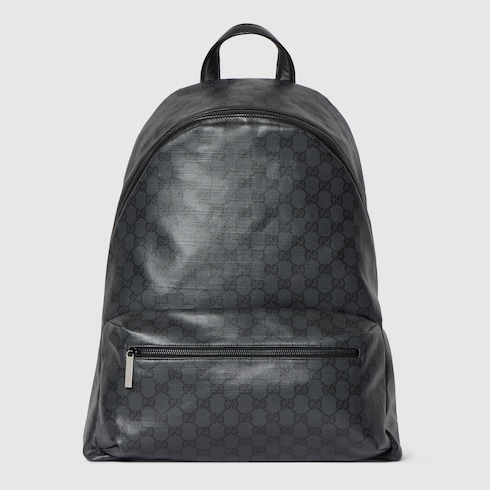
The business responded more warmly than the critics. Kering reported in its Q4 2023 earnings call that Gucci's leather goods — particularly the new Ancora line of soft, unstructured handbags — had begun to gain traction with younger clients who had aged out of the logo-forward aesthetic but were not yet ready for the severity of Bottega Veneta or The Row. The Ancora tote, a slouchy rectangle of vegetable-tanned calfskin with a single gold ring closure, became a quiet bestseller. One suspects this pleased the finance team more than it pleased the stylists.
Signature in formation
What, then, is a De Sarno piece? It is harder to say than it was with his predecessor. Michele's Gucci was instantly legible: if it had a snake, a tiger, or a severed head embroidered on it, it was his. De Sarno's vocabulary is more subdued, which makes it more difficult to parse. But patterns emerge.
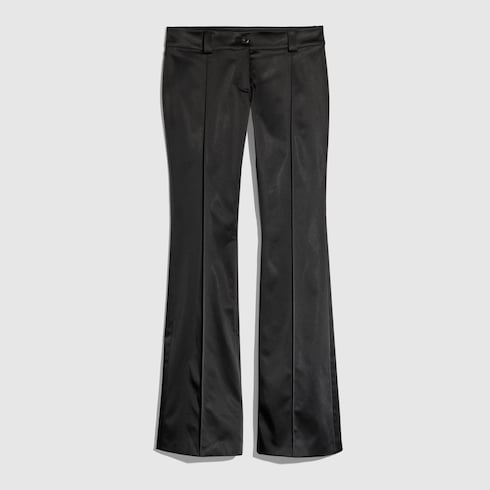
He favours a high, soft shoulder that does not announce itself. He returns obsessively to a particular shade of rosso ancora — a deep, earthy red that sits somewhere between terracotta and dried blood — which now appears in every collection as a kind of house colour. He likes jersey that drapes without clinging, trousers that pool slightly at the ankle, outerwear constructed with a couture hand but worn as though it were denim.
The accessories tell a clearer story. The Blondie bag, introduced in his second season, takes the interlocking-G hardware — Gucci's most recognisable motif after the web stripe — and blows it up to the size of a fist, centring it on a small, boxy shoulder bag in grained leather. It is logo-driven, yes, but in a way that feels considered rather than desperate. The hardware is tactile, weighty, engineered to age into a soft patina rather than chip and flake.
His shoe collaborations with the house's leather atelier have leaned into loafers and ballet flats, both styles rendered in supple calfskin with a slight, deliberate slouch. These are not the Princetowns — Michele's backless loafer with the metal horsebit — but something quieter, less declarative. They sell steadily, if not spectacularly.
The inheritance problem
De Sarno has inherited a house with a deep archive and a shallow memory. Gucci's most iconic codes — the bamboo handle, the horsebit, the green-red-green web — date to the Forties and Fifties, the era of Guccio Gucci's sons and the post-war boom in Italian luxury. Tom Ford revived the house in the Nineties with overt sex appeal and a ruthless edit. Michele, in turn, revived it again in the twenty-tens with archival pastiche and gender-fluid camp.
What De Sarno offers is neither revival nor pastiche. It is, instead, a kind of re-centering. He has said, in interviews with Sistema Moda Italia, that he is less interested in what Gucci was than in what it could be — a house that makes clothes and bags for people who live in cities, who move through their days without costume changes, who want quality they can feel in their hands.
This is a commercial proposition as much as a creative one. Kering needs Gucci to stabilise after years of volatility. De Sarno's mandate is not to provoke but to produce: to build a business around repeatable, wearable pieces that clients return to season after season. Whether that is enough to satisfy an industry addicted to disruption remains an open question.
What comes next
De Sarno's third collection, shown in February 2024, introduced more colour — saffron yellow, cobalt blue, a particular shade of pistachio green that felt almost edible — and more texture. He sent out shearling-lined bombers, chunky-knit cardigans worn open over silk slips, trousers in brushed cotton that moved like flannel but looked sharper. The palette was warmer, the silhouettes slightly looser. One could see him relaxing into the role.
The challenge now is differentiation. Quiet luxury, so-called, has become a crowded field. Loro Piana, Brunello Cucinelli, The Row, Khaite, even Hermès in its ready-to-wear — all occupy the same territory of understated, expensive simplicity. De Sarno must find a way to make Gucci's version of that simplicity feel distinct, necessary, worth the premium.
He has time. Kering has signalled patience, and the market has not yet turned against him. But patience in fashion is a relative term, and the clock is always running.
Back in the fitting room, De Sarno finally uses the shears. A single snip, just above the elbow, and the sleeve falls differently. He nods. The fitter pins the adjustment. Outside, the Florentine afternoon is fading into blue hour, and somewhere in Paris or New York or Shanghai, someone is deciding whether to buy the bag or wait another season.
The work continues.