The leather-goods workshop on Via della Vigna Nuova had seven employees in 1921, and Guccio Gucci was not yet forty
The leather-goods workshop on Via della Vigna Nuova had seven employees in 1921, and Guccio Gucci was not yet forty. He had spent a decade working the front desk at the Savoy in London, watching luggage arrive and depart, noting what held up and what did not. When he returned to Florence, he opened a shop that sold imported trunks and equestrian fittings. The saddle stitch came later, as did the bamboo handle, the horsebit, and the rest of the visual grammar we now recognise as Gucci. But in the beginning, it was just a man who had studied how the wealthy travelled, attempting to supply what they needed.
That origin story — modest, practical, rooted in craft rather than couture — has been sanded down over the decades into something shinier. The maison now trades on a version of itself that privileges spectacle over utility, and one can hardly blame it. The market rewards that choice. But it is worth pausing to ask what remains of the original impulse, and whether the house that bears Guccio's name still resembles the business he built.
The workshop years
Guccio's early catalogue leaned heavily on luggage: hat boxes, suitcases, steamer trunks reinforced with brass corners. The leather came from Tuscan tanneries, the hardware from local metalworkers. Florence in the 1920s was not yet a tourist destination in the modern sense, but it had a client base — minor aristocracy, visiting English families, Florentine merchants with country estates — that required durable goods for regular travel. Gucci positioned himself as a supplier to that class, not a creator of fashion objects.
The saddle stitch, which would become a signature, was borrowed directly from equestrian tradition. It is a hand technique: two needles, one thread, each stitch locked by the opposing pull. Machines can approximate it, but the result lacks the slight irregularity that signals human labour. Guccio insisted on it because it held, not because it looked a certain way. The aesthetic value came later, once clients began to associate that particular seam with a certain standard of facture.
His sons — Aldo, Vasco, Ugo, and eventually Rodolfo — entered the business in the 1930s and 40s. Aldo, the eldest, had the sharpest commercial instincts. He opened the first店 outside Florence, in Rome, in 1938, and understood early that Gucci could be more than a regional supplier. After the war, he pushed the company toward New York, opening a Madison Avenue location in 1953. That move — exporting Florentine leather craft to the American market — shifted the brand's centre of gravity. It was no longer a workshop serving local gentry. It was, increasingly, a name.
The horsebit and after
The loafer with the metal horsebit across the vamp appeared in 1953, the same year as the New York opening. It is difficult now to separate the shoe from its context — countless imitations, decades of styling, the specific semiotics it acquired in certain American subcultures — but at the time it was a fairly straightforward piece of design. A slip-on moccasin, Tuscan calfskin, a brass ornament borrowed from equestrian tack. Comfortable, durable, legible as luxury without announcing itself.
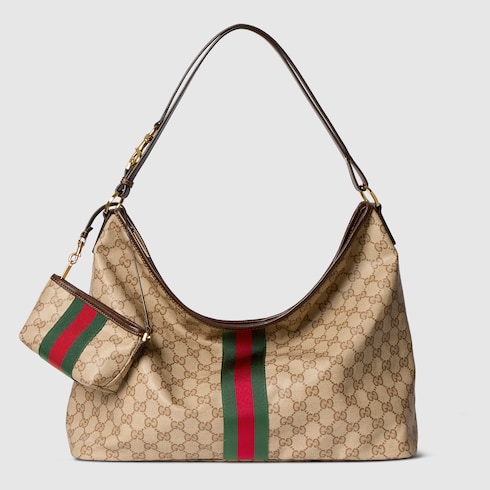
It sold. Consistently, across decades, in volumes that allowed Gucci to expand without diluting its material standards. The bag with the bamboo handle, introduced in 1947, followed a similar trajectory: a practical solution — metal was scarce postwar, bamboo was not — that became a signature because it worked, and because clients returned to it.
By the 1960s, the house had moved decisively into ready-to-wear, fragrance, and eventually a diffuse range of licensed products that bore the interlocking-G logo but had little to do with Florentine leather craft. Aldo drove much of that expansion, and it made the family wealthy. It also diluted the brand in ways that would take decades to correct. By the 1980s, Gucci was everywhere and nowhere: the logo appeared on keychains and lighters and airport-boutique scarves, but the atelier discipline that Guccio had insisted on was no longer central to the business.
What collapsed, and what didn't
The family fractured publicly in the 1980s. Aldo and his nephew Maurizio fought for control; lawsuits proliferated; Maurizio eventually sold his shares to Investcorp in 1993, two years before he was murdered outside his Milan office. The crime remains one of the more sordid episodes in fashion-industry history, and it has been dramatised enough that the details need not be repeated here. What matters, for our purposes, is that by the mid-1990s the Gucci family no longer controlled Gucci.
Tom Ford arrived in 1994 as creative director, under the Investcorp-installed CEO Domenico De Sole, and spent the next decade rebuilding the brand's image around sex appeal and a kind of louche, 70s-inflected glamour that had almost nothing to do with Florentine saddle stitching. It worked — sales quadrupled — but it also completed the transformation that Aldo had begun. Gucci was now a fashion house in the contemporary sense: trend-responsive, celebrity-adjacent, driven by runway spectacle rather than atelier process.
Ford left in 2004. Frida Giannini followed, then Alessandro Michele, whose magpie maximalism dominated the house from 2015 to 2022. Michele's Gucci — eclectic, ironic, dense with historical reference — was commercially successful and critically divisive. It leaned into the idea of Gucci as a canvas for postmodern bricolage, a brand with enough history that one could sample freely from its archive without worrying about coherence.
Sabato De Sarno, who took over in 2023, has signalled a return to something quieter. His debut collection emphasised clean lines, quality fabrication, a certain restraint. Whether that represents a return to the house's craft-based origins, or simply a market correction after years of maximalist excess, remains to be seen.
What persists
The saddle stitch is still there, on certain bags, if you know where to look. The horsebit loafer remains in the catalogue, largely unchanged. The bamboo-handle bag has been reissued multiple times, most recently in 2023. These are not the products that drive Gucci's quarterly earnings — those would be logo-heavy sneakers, monogrammed crossbody bags, and runway pieces that move through the system in eighteen-month cycles — but they persist as a kind of material argument. They say: this is what we were, and in some narrow sense, what we still are.
Whether that argument is convincing depends on what one values. If craft means hand-stitching, natural materials, and multi-decade durability, then yes, fragments of Guccio's original vision survive in the current catalogue. If craft means a business structured around atelier work rather than global branding, then no, that Gucci is long gone. The workshop on Via della Vigna Nuova is now a museum. The company is owned by Kering, a French conglomerate, and its creative direction is determined by market analytics as much as by any individual designer's vision.
There is a version of this story in which that represents a betrayal. Guccio built a workshop; his heirs turned it into a logo. But there is another version in which the evolution is simply inevitable. Craft-based businesses either scale or disappear, and scaling requires compromises. Gucci scaled. It survived. What it lost in the process — the direct line between maker and object, the regional specificity, the sense that a bag was the product of a particular pair of hands in a particular city — is mourned by some and ignored by most.
On balance, the house that Guccio Gucci founded in 1921 no longer exists, except as a reference point and a repository of techniques that the current iteration can draw on when it suits the moment. Whether that is enough depends, as always, on what one came looking for.