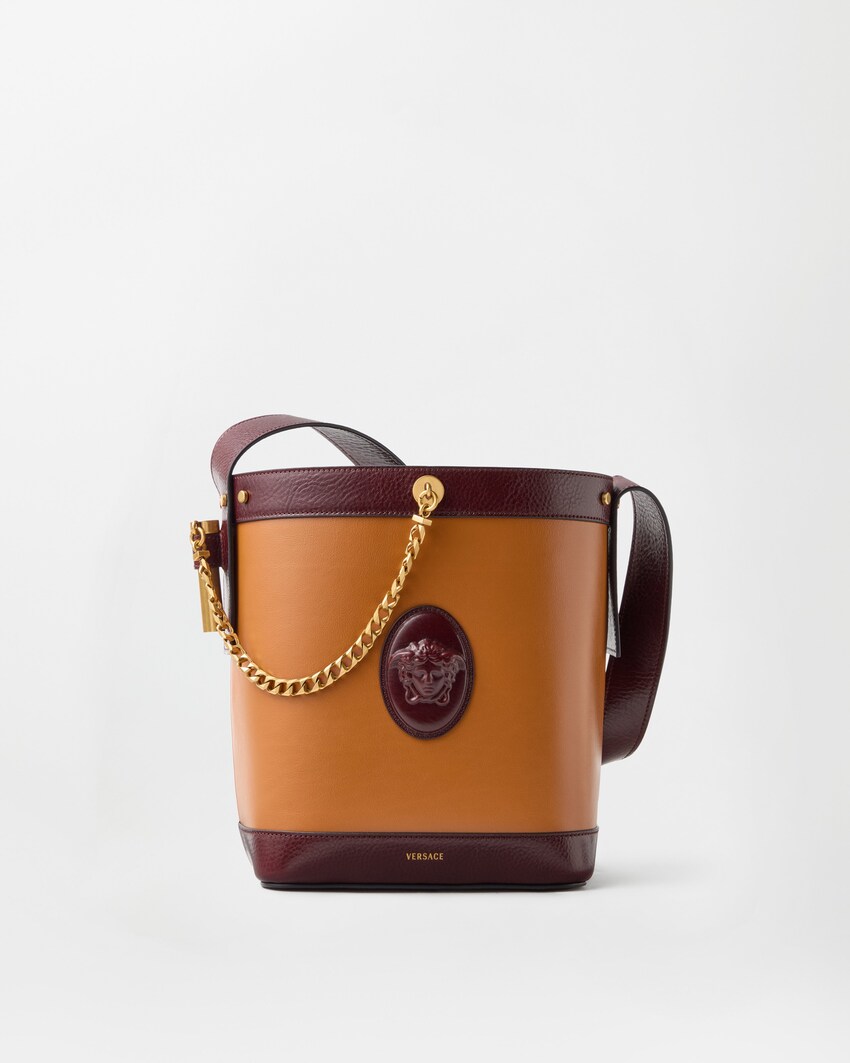
The Medusa head on a silk-screen frame does not apply itself
The Medusa head on a silk-screen frame does not apply itself. In the basement of Via Gesù 12, where Versace's Milan atelier occupies three floors of what was once a Napoleonic-era palazzo, a woman named Carla Brambilla has been positioning that gorgon for twenty-seven years. She works with a jig, a timer, and a steel rule. The ink is mixed two floors up. The silk arrives from Como. Brambilla's job is to ensure that the Medusa's left eye sits exactly 4.2 centimetres from the selvage, every time, on every scarf that will carry the mark.
This is not the story Versace tells about itself. The house prefers to speak of Donatella, of Gianni's ghost, of baroque maximalism and the super-top-model era. Fair enough. But if you want to understand how a Versace gown actually comes into being — how the pleated silk holds its shape through a six-hour gala, how the safety pins on that 2019 jungle-print revival dress stayed put under camera flash — you need to know about people like Brambilla, and the sixty-odd specialists who work in rooms the public never sees.
I visited Via Gesù on a Thursday in March. Donatella was in Los Angeles. The atelier was preparing for pre-fall. In the main workroom, a long table held bolts of duchess satin in a colour the sample tag called "tramonto" — sunset, essentially, though the Pantone reference was more prosaic. A cutter named Luca Meroni was working through the third iteration of a bias-cut column dress, adjusting the grain by a quarter-inch at the hip. He had been at Versace for sixteen years, previously at Genny. He did not look up when I entered.
"The bias doesn't forgive," he said, in Italian, when I asked what he was doing. "You miss by two millimetres and the whole thing twists on the body. Gianni knew this. Donatella knows this. The camera certainly knows this."
Meroni trained at the Istituto Marangoni in the 1990s, then spent five years at a bridal atelier in Monza before joining Versace in 2008. His job, as he describes it, is to translate the sketch into something that can be worn by an actual skeleton and musculature. "They give me a drawing," he said. "It's beautiful. It's also impossible. So I make it possible."
The structure beneath the surface
Versace is often discussed as though it materialises through sheer force of personality — Gianni's libidinal genius, Donatella's platinum-blonde intransigence. The reality is more mechanical. A signature Versace gown, the kind that appears on a red carpet and generates two hundred million impressions by morning, is the product of at least seven discrete stages: sketch, drape, first toile, fit, pattern correction, sample construction, and final finish. Each stage involves different hands.
The draping is handled by a team of three, all women, all trained in the classical Italian method: Antonella Riva, Giulia Moretti, and a younger draper named Stefania Conti, who joined in 2019 from Dolce & Gabbana. They work on dress forms that are cast from models Versace has used repeatedly — Amber Valletta's form from 1996 is still in rotation, as is Naomi Campbell's from 1991. The forms are adjusted for contemporary proportions, but the original casts remain.
"We don't drape on a generic form," Riva told me, while pinning a length of silk chiffon that would eventually become part of a handkerchief-hem cocktail dress. "We drape on her body, even if she's not here. You learn the way the fabric moves on a real woman, not an ideal."
Riva is sixty-two. She started at Versace in 1983, when the company was still operating out of a converted warehouse in Via della Spiga. She remembers Gianni walking the floor every morning, espresso in hand, adjusting a pin here, redrawing a seam there. "He was a tailor," she said. "People forget that. He could cut a pattern himself. He didn't need us, but he wanted us to be excellent anyway."
The hardware problem
One of the less discussed challenges in Versace's design vocabulary is the hardware. The safety pins, the Medusa buttons, the gold-tone chain mail that appeared in the spring 2024 collection — none of this is ornamental in the sense of being applied after the fact. It is structural. The pins hold the garment closed. The chain mail is the garment.
The metal components are produced by a supplier in Arezzo, a family-run operation called Fonterossa that has worked with Versace since 1989. The safety pins, specifically, are not standard dressmaker's pins. They are custom-cast in a brass alloy, then plated in either gold or palladium depending on the collection. Each pin is load-tested to ensure it can support the tension of the fabric without bending. A single gown might use forty pins. If one fails during a runway show, the whole piece fails.
"We test them to destruction," said Marco Fonterossa, the third-generation owner of the Arezzo workshop, when I reached him by phone. "We pull them until they break, then we back off twenty percent and that becomes the spec. Donatella doesn't want to hear that a pin opened on the red carpet. So we make sure it doesn't."
Fonterossa's team also produces the Medusa-head buttons, which are die-cast and hand-polished. The polishing alone takes eleven minutes per button. A blazer might carry eight buttons. Do the math.
The embroidery line
Versace's embroidery is outsourced, as it is at most Italian houses. The primary atelier is Tremolada, in Cantù, north of Como. Tremolada has been embroidering for Versace since 1993. They employ forty-seven people, most of whom work on Lunéville hooks, a nineteenth-century technique that allows for the application of beads, sequins, and thread in a single continuous motion.
A heavily embroidered Versace gown — the kind Donatella sends down the runway as the finale piece — can take three hundred hours of hand-work. The embroiderer works from a painted or printed template, applying each bead or sequin individually. There is no machine that can replicate the irregularity, the intentional imperfection, that makes hand embroidery read as luxurious rather than industrial.
"When you look closely," said Elena Tremolada, the atelier's director, "you see that the sequins are not perfectly aligned. That's the point. If they were perfect, you'd know it was done by machine. The imperfection is the signature."
Tremolada's atelier works for other houses as well — Dolce & Gabbana, Etro, a few smaller labels — but Versace accounts for roughly forty percent of their annual output. They keep three full-time staff dedicated exclusively to Versace projects, because the house's technical requirements are, in Tremolada's words, "particular."
"They want a specific tension on the thread," she said. "They want the sequins layered in a specific direction so they catch the light a certain way on the runway. It's not difficult, but it's specific. You learn the house's eye."
What comes next
Versace was acquired by Capri Holdings in 2018 for $2.12 billion. Since then, the atelier has remained in Milan, but the production structure has shifted. More of the ready-to-wear is now manufactured in external factories, in Italy and Portugal. The haute couture-adjacent pieces — the runway samples, the custom red-carpet commissions — are still made in-house, but the volume has decreased.
Several of the artisans I spoke with expressed quiet concern about what happens when they retire. Brambilla, the silk-screen specialist, is sixty-four. Riva, the head draper, is sixty-two. Meroni, the cutter, is fifty-one. There are younger people in the atelier, but not many, and the training pipeline is not what it was.
"When I started," Riva said, "there were five schools in Milan that taught draping at this level. Now there's maybe one, and the students want to be creative directors, not drapers. I don't blame them. But someone has to know how to do this work."
Donatella has spoken, in various interviews, about preserving the atelier's knowledge. In 2021, Versace launched an internal apprenticeship program, bringing in four new drapers and two cutters to train under the senior staff. It is a start, though whether it is enough remains to be seen.
For now, the work continues. Brambilla aligns her Medusas. Meroni adjusts his bias cuts. Riva pins her silk. The gowns appear on the runway, are photographed, are dissected on Instagram, and are eventually archived. The hands that made them are noted nowhere, except in the atelier's internal records and in the memories of the people who were there.
One suspects Gianni would have found that appropriate. He understood, better than most, that fashion is a collaborative art. The name on the label is the signature, but the work itself is choral. The Medusa may be the symbol, but Brambilla is the one who puts it in place.